Philippine Nobel winner Ressa calls Facebook ‘biased against facts’

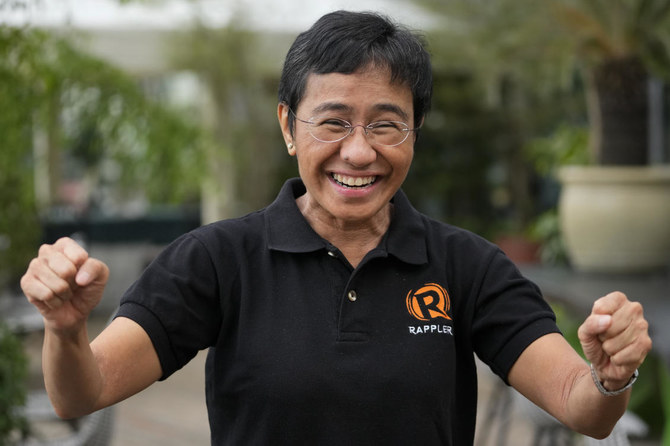
Rappler CEO and Executive Editor Maria Ressa reacts during an interview at a restaurant in Taguig city, Philippines on Saturday. (AP)
Short Url
Updated 09 October 2021
Follow

Philippine Nobel winner Ressa calls Facebook ‘biased against facts’

  • She said the social media giant fails to protect against the spread of hate and disinformation and is "biased against facts"
  • Facebook's algorithms "prioritise the spread of lies laced with anger and hate over facts"

MANILA: Nobel Peace Prize winner Maria Ressa used her new prominence to criticize Facebook as a threat to democracy. She said the social media giant fails to protect against the spread of hate and disinformation and is “biased against facts.”
The veteran journalist and head of Philippine news site Rappler told Reuters in an interview after winning the award that Facebook’s algorithms “prioritize the spread of lies laced with anger and hate over facts.”
Her comments add to the pile of recent pressure on Facebook, used by more than 3 billion people, which a former employee turned whistleblower accused of putting profit over the need to curb hate speech and misinformation. Facebook denies any wrongdoing.
Sought for comment on Ressa’s remarks, a Facebook spokesperson said the social media giant continues to invest heavily to remove and reduce the visibility of harmful content.
“We believe in press freedom and support news organizations and journalists around the world as they continue their important work,” the spokesperson added.
Ressa shared the Nobel with Russian journalist Dmitry Muratov on Friday, for what the committee called braving the wrath of the leaders of the Philippines and Russia to expose corruption and misrule, in an endorsement of free speech under fire worldwide.
Facebook has become the world’s largest distributor of news and “yet it is biased against facts, it is biased against journalism,” Ressa said.
“If you have no facts, you can’t have truths, you can’t’ have trust. If you don’t have any of these, you don’t have a democracy,” she said. “Beyond that, if you don’t have facts, you don’t’ have a shared reality, so you can’t solve the existential problems of climate, coronavirus.”
Ressa has been the target of intense social-media hatred campaigns from President Rodrigo Duterte’s supporters, which she said were aimed at destroying her and Rappler’s credibility.
“These online attacks on social media have a purpose, they are targeted, they are used like a weapon,” said the former CNN journalist.
Rappler’s reporting has included close scrutiny of Duterte’s deadly war on drugs and a series of investigative reports into what it says is his government’s strategy to “weaponize” the Internet, using bloggers on its payroll to stir up anger among online supporters who threaten and discredit Duterte’s critics.
Duterte has not commented on Ressa’s award. The presidential palace, Duterte’s spokesperson, his chief legal counsel, and communications office did not respond to Reuters requests for comment.
Facebook in March 2019 removed an online network in the Philippines for “coordinated inauthentic behavior,” and linked it to a businessman who has previously said he helped manage the president’s social media election campaign in 2016.
Filipinos top the world in time spent on social media, according to 2021 studies by social media management firms.
Platforms like Facebook have become political battlegrounds and have helped strengthen Duterte’s support base, having been instrumental in his election victory in 2016 and a rout by his allies in mid-term polls last year.
The Philippines will hold an election in May to choose a successor to Duterte, who under the constitution is not allowed to seek another term.
That campaign “will be a battle for facts,” Ressa said. “We are going to keep making sure our public sees the facts, understands it. We are not going to be harassed or intimidated into silence.”


Iran to consider lifting Internet ban; state TV hacked

Updated 13 sec ago
Follow

Iran to consider lifting Internet ban; state TV hacked

  • Authorities shut communications while they used force to crush protests ​in the worst domestic unrest since the 1979 Islamic Revolution
  • State television appeared to be hacked late on Sunday, briefly showing speeches by US President Donald Trump and the exiled son of Iran’s last shah calling on the public to revolt
DUBAI: Iran may lift its Internet blackout in a few days, a senior parliament member said on Monday, after authorities shut communications while they used massive force to crush protests ​in the worst domestic unrest since the 1979 Islamic Revolution.
In the latest sign of weakness in the authorities’ control, state television appeared to be hacked late on Sunday, briefly showing speeches by US President Donald Trump and the exiled son of Iran’s last shah calling on the public to revolt.
Iran’s streets have largely been quiet for a week, authorities and social media posts indicated, since anti-government protests that began in late December were put down in three days of mass violence.
An Iranian official told Reuters on condition of anonymity that the confirmed death toll was more than 5,000, including 500 members ‌of the security ‌forces, with some of the worst unrest taking place in ethnic ‌Kurdish ⁠areas ​in the ‌northwest. Western-based Iranian rights groups also say thousands were killed.

ARRESTS REPORTED TO BE CONTINUING
US-based Iranian Kurdish rights group HRANA reported on Monday that a significant number of injuries to protesters came from pellet fire to the face and chest that led to blindings, internal bleeding and organ injuries.
State television reported arrests continuing across Iran on Sunday, including Tehran, Kerman in the south, and Semnan just east of the capital. It said those detained included agents of what it called Israeli terrorist groups.
Opponents accuse the authorities of opening fire on peaceful demonstrators ⁠to crush dissent. Iran’s clerical rulers say armed crowds encouraged by foreign enemies attacked hospitals and mosques.
The death tolls dwarf those of ‌previous bouts of anti-government unrest put down by the authorities in ‍2022 and 2009. The violence drew repeated threats ‍from Trump to intervene militarily, although he has backed off since the large-scale killing stopped.
Trump’s warnings raised ‍fears among Gulf Arab states of a wider escalation and they conducted intense diplomacy with Washington and Tehran. Iran’s ambassador to Saudi Arabia Alireza Enayati said on Monday that “igniting any conflict will have consequences for the entire region.”

INTERNET TO RETURN WHEN ‘CONDITIONS ARE APPROPRIATE’
Iranian communications including Internet and international phone lines were largely stopped in the days ​leading up to the worst unrest. The blackout has since partially eased, allowing accounts of widespread attacks on protesters to emerge.
The Internet monitoring group Netblocks said on Monday ⁠that metrics showed national connectivity remained minimal, but that a “filternet” with managed restrictions was allowing some messages through, suggesting authorities were testing a more heavily filtered Internet.
Ebrahim Azizi, the head of parliament’s National Security and Foreign Policy Committee, said top security bodies would decide on restoring Internet in the coming days, with service resuming “as soon as security conditions are appropriate.”
Another parliament member, hard-liner Hamid Rasaei, said authorities should have listened to earlier complaints by Supreme Leader Ali Khamenei about “lax cyberspace.”
During Sunday’s apparent hack into state television, screens broadcast a segment lasting several minutes with the on-screen headline “the real news of the Iranian national revolution.”
It included messages from Reza Pahlavi, the US-based son of Iran’s last shah, calling for a revolt to overthrow rule by the Shiite Muslim clerics who have run the country since the 1979 revolution that toppled his father.
Pahlavi has emerged as ‌a prominent opposition voice and has said he plans to return to Iran, although it is difficult to assess independently how strong support for him is inside Iran.