

In rare overlap, Chinese Muslims observe Ramadan with Lunar New Year

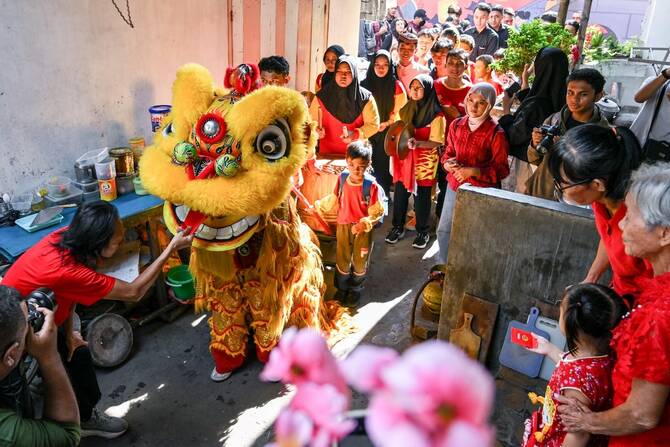
A man gives red envelopes containing money to a lion dancer during Lunar New Year celebrations in Surabaya on Jan. 29, 2025. (AFP)
Short Url
Updated 19 February 2026
Follow

In rare overlap, Chinese Muslims observe Ramadan with Lunar New Year

  • Lunar New Year started on Feb. 17 and is celebrated for another two weeks
  • Chinese Indonesians make up about 3 percent of the Indonesian population

JAKARTA: Every year, on the first day of Lunar New Year, Febriani visits relatives and gathers for a feast with her Chinese Muslim family, part of a long-standing tradition honoring their ethnic heritage.

But this year, as Thursday marks the beginning of Ramadan, she is celebrating two important occasions within the same week, in a rare overlap that last took place in 1995.

“I’m very happy and grateful that Lunar New Year and Ramadan are celebrated so closely. I observe both every year, so it’s truly special,” she told Arab News.

Widely observed across Asia, the Lunar New Year or Chinese New Year festival is believed to date back to the 14th century B.C., to the times of the Shang Dynasty, China’s earliest ruling dynasty, when people celebrated good harvests.

In 2026, it started on Feb. 17 and is celebrated for another two weeks. For many, celebrations typically involve elaborate feasts, giving children pocket money in red envelopes, and watching dragon dance parades.

In Indonesia, Chinese-descent citizens make up an estimated 3 percent of the country’s Muslim-majority population of more than 280 million. While most are either Buddhists or Christians, a small minority professes Islam.

For 25-year-old Febriani, both Lunar New Year and Ramadan are equally meaningful.

“The two celebrations teach us to strengthen bonds, to share with one another, and to become closer to family,” she said.

“They are both important to me because they happen only once every year and they’re always an occasion to gather with the extended family. It is also a chance to self-reflect and strengthen relationships with your loved ones.”

For Naga Kunadi, whose family lives in Central Java’s Cepu district, Chinese New Year is all about embracing his ethnic identity.

Earlier in the week, his family was busy preparing for the new year’s feast, which was a fusion of Chinese and Indonesian dishes, such as claypot tofu, meatball soup and shumai, or steamed dumplings.

“To celebrate Chinese New Year, we prepared halal Chinese food at home. It’s also a way to introduce to my children the traditions from our Chinese side, but there’s a bit of a fusion because my wife is Javanese,” Kunadi told Arab News.

Kunadi, an Islamic teacher at the Lautze Mosque in Jakarta, sees both Chinese New Year and Ramadan as opportunities to teach important life values for his two children. 

Upholding Chinese New Year traditions with his family is for him a way of preserving his ethnic heritage.

“We want to preserve cultural values as long as it does not clash with our religion,” he said.

“If we leave our culture behind, we might lose our identity, so this is something I want to teach my children.”

The fasting month of Ramadan, on the other hand, gives him a chance to teach and practice honesty.

“I want to focus on the religious and moral aspects during the holy month of Ramadan, when we practice honesty on a personal level,” Kunadi said.

“There’s always an opportunity to eat or snack in secret without anybody knowing, but we train ourselves not to do that. For me, Ramadan is a time for everyone to put honesty into practice, including myself and my children.”


Saudi ambassador becomes first foreign envoy to meet Bangladesh’s new PM

Updated 4 sec ago
Follow

Saudi ambassador becomes first foreign envoy to meet Bangladesh’s new PM

  • Tarique Rahman took oath as PM last week after landslide election win
  • Ambassador Abdullah bin Abiyah also meets Bangladesh’s new FM

Dhaka: Saudi Arabia’s ambassador to Dhaka became on Sunday the first foreign envoy to meet Bangladesh’s new Prime Minister Tarique Rahman since he assumed the country’s top office.

Rahman’s Bangladesh Nationalist Party made a landslide win in the Feb. 12 election, securing an absolute majority with 209 seats in the 300-seat parliament.

The son of former Prime Minister Khaleda Zia and former President and BNP founder Ziaur Rahman, he was sworn in as the prime minister last week.

The Saudi government congratulated Rahman on the day he took the oath of office, and the Kingdom’s Ambassador Abdullah bin Abiyah was received by the premier in the Bangladesh Secretariat, where he also met Bangladesh’s new foreign minister.

“Among the ambassadors stationed in Dhaka, this is the first ambassadorial visit with Prime Minister Tarique Rahman since he assumed office,” Saleh Shibli, the prime minister’s press secretary, told Arab News.

“The ambassador conveyed greetings and best wishes to Bangladesh’s prime minister from the king and crown prince of Saudi Arabia … They discussed bilateral matters and ways to strengthen the ties among Muslim countries.”

Rahman’s administration succeeded an interim government that oversaw preparations for the next election following the 2024 student-led uprising, which toppled former leader Sheikh Hasina and ended her Awami League party’s 15-year rule.

New Cabinet members were sworn in during the same ceremony as the prime minister last week.

Foreign Minister Khalilur Rahman is a former UN official who served as Bangladesh’s national security adviser during the interim government’s term.

He received Saudi Arabia’s ambassador after the envoy’s meeting with the prime minister.

“The foreign minister expressed appreciation for the Saudi leadership’s role in promoting peace and stability in the Middle East and across the Muslim Ummah. He also conveyed gratitude for hosting a large number of Bangladeshi workers in the Kingdom and underscored the significant potential for expanding cooperation across trade, investment, energy, and other priority sectors, leveraging the geostrategic positions of both countries,” the ministry said in a statement.

“The Saudi ambassador expressed his support to the present government and his intention to work with the government to enhance the current bilateral relationship to a comprehensive relationship.”

Around 3.5 million Bangladeshis live and work in Saudi Arabia. They have been joining the Saudi labor market since 1976, when work migration to the Kingdom was established during the rule of the new prime minister’s father.

Bangladeshis are the largest expat group in the Kingdom and the largest Bangladeshi community outside Bangladesh and send home more than $5 billion in remittances every year.