

Israel arrests relatives of escaped Palestinian prisoners

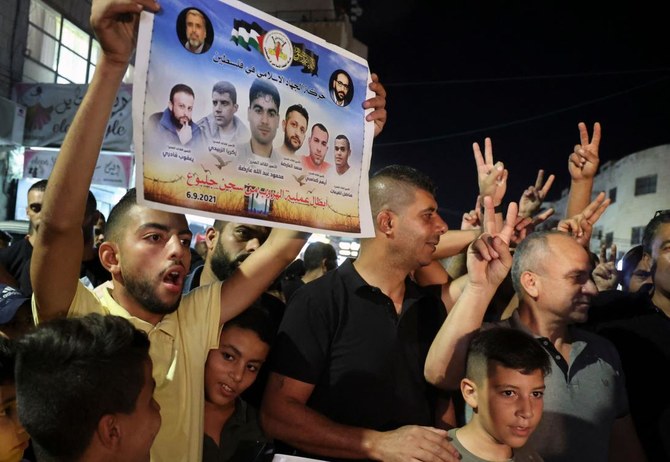
A Palestinian man flashes a poster by the militant group Islamic Jihad of 6 Palestinians who escaped from an Israeli prison, as people celebrate in the Jenin camp in the northern Israeli-occupied West Bank, on Monday. (AFP)
Short Url
Updated 08 September 2021
Follow

Israel arrests relatives of escaped Palestinian prisoners

  • ‘Hysterical’ security forces accused of collective punishment and ‘mafia-style tactics’ as manhunt fails
  • Six Palestinians fled Monday through a hole dug under a sink in a Gilboa prison cell in northern Israel

AMMAN: Israeli security forces unable to find six escaped Palestinian prisoners have arrested six of their relatives instead.

The prisoners tunnelled their way out of the high-security Gilboa jail in northern Israel on Monday, having dug a hole in the floor of their cell with a spoon.

Israel has deployed drones, road checkpoints and an army mission to Jenin, the home town in the occupied West Bank of many of the escaped prisoners, but has failed to track them down.
Instead, on Wednesday security forces arrested two brothers of Mahmoud Ardah, who masterminded the escape, Dr Nidal Ardah, another relative, two brothers of escaped prisoner Mohammad Ardah, and prisoner Munadel Infeiat’s father.

The arrests provoked anger in the West Bank. “Holding someone in order to coerce a relative to do something is a mafia-style tactic,” said Omar Shakir, Israel and Palestine director for Human Rights Watch.
Sami Shehadeh, a member of the Knesset from the Joint Arab List, told Arab News the reaction from the Israeli security forces was hysterical. “They are carrying out brutal acts of revenge against prisoners and their families. This is collective punishment, which we denounce, and we call for the immediate cessation of these acts against our people.”

Orthodox Bishop Atallah Hanna said arresting relatives of the escaped prisoners was barbaric. “This is an act of collective punishment and an inhuman act,” he said.

Opinion

This section contains relevant reference points, placed in (Opinion field)

Mohammed Rajoub, a broadcaster at Ajyal Radio in Ramallah, said the Israelis had initially delayed arresting relatives in the hope that they could trace calls with the escaped prisoners. “Now that they have failed to capture the prisoners they want to use their families as bargaining chips,” he said.

Palestinian Prime Minister Mohammad Shtayyeh said every Palestinian prisoner had the right to be free, and called on Israel to release them all.

Wadie Abu Nassar, director of the International Center for Consultations in Haifa, said the arrests were predictable. “Israeli security wants to recapture those escaped prisoners as soon as possible and they feel that the pressure on relatives will help them get valuable information about their possible whereabouts,” he said.

Amjad Shihab, a lecturer at Al Quds University, said the escape was a shock to the Israeli security apparatus.“Therefore politicians ordered oppressive measures against all prisoners, and the families of the escaped prisoners, with hopes that all this will lead to some information to help them out of the political scandal that they find themselves in.”


Turkish and Greek leaders set for talks on migration, maritime borders

Updated 4 sec ago
Follow

Turkish and Greek leaders set for talks on migration, maritime borders

  • Fifteen migrants died in a shipwreck off the Greek island of Chios last week after their boat collided with a Greek coast guard vessel and sank in the Aegean Sea off the Turkish coast
ANKARA: Turkish President Tayyip Erdogan ‌will host Greek Prime Minister Kyriakos Mitsotakis on Wednesday for talks likely to focus on migration and longstanding maritime disputes, as the ​NATO allies and historic rivals try to build on warming ties.
Fifteen migrants died in a shipwreck off the Greek island of Chios last week after their boat collided with a Greek coast guard vessel and sank in the Aegean Sea off the Turkish coast.
Mitsotakis will be accompanied by ministers responsible for foreign affairs, finance, ‌development and migration, ‌Greek officials said.
Developments in the Middle ​East, ‌Iran ⁠and ​Ukraine, migration, trade ⁠and organized crime are also likely to be on the agenda.
Greek Foreign Ministry spokeswoman Lana Zochiou said on Tuesday the aim was “to assess the progress of bilateral cooperation” and “to keep communication channels open to defuse any potential crises.”
Turkiye is a transit country for migrants seeking to ⁠reach the European Union via Greece. Ankara ‌says the EU has not ‌fully delivered on commitments under a ​2016 migration deal and ‌Athens wants Turkiye to do more to curb irregular ‌crossings.
Despite a thaw in rhetoric since a 2023 declaration on friendly relations, the neighbors are at odds over maritime boundaries in the Aegean, an area widely believed to hold energy resources ‌and with implications for airspace and military activity.
Ankara said last month it had issued ⁠a maritime ⁠notice urging Greece to coordinate research activities in areas of the Aegean that Turkiye considers part of its continental shelf.
Greece’s foreign minister had said Athens planned to extend its territorial waters further, including potentially in the Aegean.
In 1995, Turkiye’s parliament declared a casus belli — a cause for war — should Greece unilaterally extend its territorial waters beyond six nautical miles in the Aegean, a stance Athens says violates international maritime law. Greece says it wants ​only to discuss ​demarcation of maritime zones.