Yemen’s Houthis say they targeted American and Israeli ships

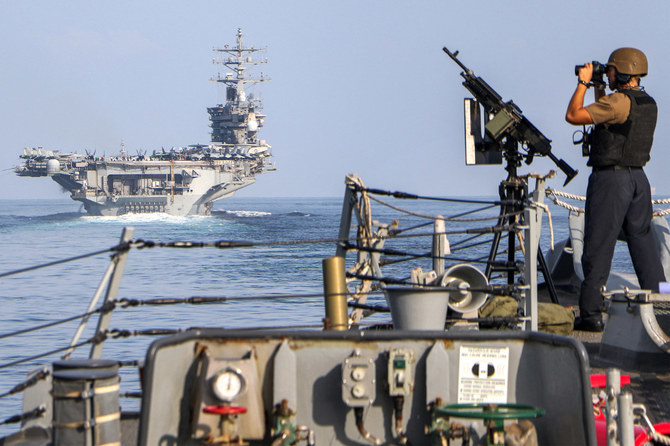
Yemen's Houthis said they targeted the Maersk Yorktown ship and an American warship destroyer in the Gulf of Aden as well as targeting the Israeli ship MSC Veracruz in the Indian Ocean. (AFP/File)
Short Url
Updated 25 April 2024
Follow

Yemen’s Houthis say they targeted American and Israeli ships

  • The Iran-aligned group said it targeted the US ship Maersk Yorktown, an American destroyer in the Gulf of Aden and Israeli ship MSC Veracruz in the Indian Ocean
  • US military confirms attack and said it downed one anti-ship missile and four drones on Wednesday

CAIRO/DUBAI: Houthi militants in Yemen have attacked what they said were two American ships and an Israeli vessel, the group’s military spokesman said on Wednesday, the first such attack in more than two weeks.
The Iran-aligned group said it targeted the US ship Maersk Yorktown, an American destroyer in the Gulf of Aden and Israeli ship MSC Veracruz in the Indian Ocean, the spokesman, Yahya Sarea, said in a televised speech.

American authorities confirmed the attack and said US-led coalition forces off the coast of Yemen shot down four drones and an anti-ship missile launched by the Houthis.

In a statement on X, formerly Twitter, the US Central Command (CENTCOM) said that just before noon Sanaa time (0900 GMT) a coalition vessel "successfully engaged one anti-ship ballistic missile (ASBM)" launched from Houthi controlled areas of Yemen.

It was determined that the ASBM and UAVs (drones) presented an imminent threat to US, coalition, and merchant vessels in the region," CENTCOM said.

Yemen’s Houthis have been attacking ships in the Red Sea region since November in what they say is a campaign of solidarity with Palestinians fighting Israel in Gaza.

“The Yemeni armed forces confirm they will continue to prevent Israeli navigation or any navigation heading to the ports of occupied Palestine in the Red and Arabian Seas, as well as in the Indian Ocean,” Sarea said on Wednesday.

Separately, British maritime security firm Ambrey said earlier on Wednesday that it was aware of an incident southwest of the port city of Aden, an area where the Houthis often target ships they say are linked to Israel or the United States.

The vessel reported an “explosion in the water” approximately 72 nautical miles east-southeast of Djibouti, an updated advisory from Ambrey said.

Houthi attacks have disrupted global shipping through the Suez Canal, forcing firms to re-route to longer and more expensive journeys around southern Africa. The United States and Britain have launched strikes on Houthi targets in Yemen.


Controversial Israeli minister enters area around Al-Aqsa Mosque on first Friday of Ramadan

Updated 11 sec ago
Follow

Controversial Israeli minister enters area around Al-Aqsa Mosque on first Friday of Ramadan

  • Far-right National Security Minister Itamar Ben-Gvir is seen making provocative remarks directed at Palestinians in presence of Israeli police
  • It comes amid heightened Israeli security and restrictions on Palestinians entering the mosque, despite which an estimated 80,000 people attend first Friday prayers of the holy month

JERUSALEM: Israel’s far-right national security minister, Itamar Ben-Gvir, entered the area around Al-Aqsa Mosque on Friday, coinciding with the first Friday prayers of Ramadan.

Footage shared on social media showed him arriving through the Moroccan Gate, accompanied by the Israeli police commissioner, Daniel Levy, and the Jerusalem District police commander, Avshalom Peled.

Ben-Gvir was seen making provocative remarks directed at Palestinians in the presence of Israeli police officers, the Palestinian Wafa news agency reported.

The Moroccan Gate, located near Al-Buraq Wall, is one of the main entrances to Al-Aqsa and has been under Israeli control since 1967. It is regularly used by Israeli forces and settlers to access the mosque compound.

Jerusalem Governorate said the minister’s actions came amid heightened Israeli security measures and tighter restrictions on Palestinian in occupied Jerusalem during Ramadan.

Despite this, an estimated 80,000 worshippers attended the first Friday prayers of Ramadan at Al-Aqsa Mosque, according to figures provided by the Islamic Waqf Department in Jerusalem.

From early in the morning, Israeli forces imposed strict controls on Palestinians traveling from the West Bank to Jerusalem. Dozens of elderly worshippers were reportedly turned back at the Qalandia and Bethlehem checkpoints after being told they lacked the necessary permits.

Security forces also briefly detained four paramedics and disrupted the work of journalists and medical teams at Qalandia, witnesses said.

Additional security measures were also enforced at entrances to Jerusalem’s Old City and the gates of Al-Aqsa, with young men subjected to identity checks and a number of worshippers denied access.