

British Royal Navy shoots down missile for first time since Gulf War in 1991 amid Houthi attacks on shipping

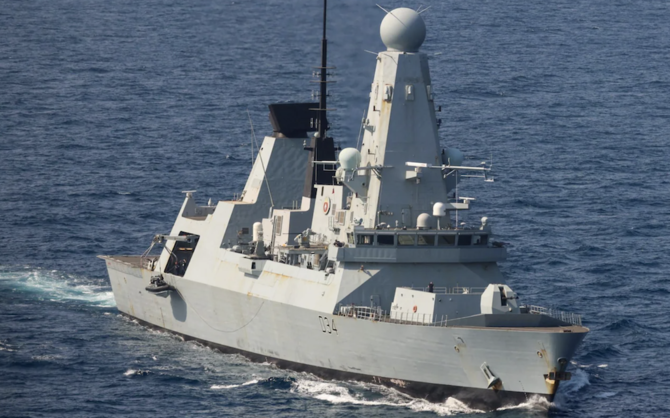
HMS Diamond patrolling the Red Sea. Grant Schapps confirmed it shot down a ballistic missile on Wednesday, the first since the first Gulf War in 1991. (Reuters/File Photo)
Short Url
Updated 25 April 2024
Follow

British Royal Navy shoots down missile for first time since Gulf War in 1991 amid Houthi attacks on shipping

  • Iran-backed group said its missiles targeted US ship Maersk Yorktown, an American destroyer in the Gulf of Aden and Israeli ship MSC Veracruz

LONDON: A British Royal Navy destroyer shot down a ballistic missile on Wednesday for the first time since the first Gulf War in 1991, the UK’s defense secretary told The Times newspaper.

In a report published Thursday, Grant Shapps told the newspaper that HMS Diamond used its “Sea Viper” missile system to target the weapon, which Yemen’s Houthi militia said they used to target two American ships in the Gulf of Aden and an Israeli vessel in the Indian Ocean.

The Iran-backed group said its missiles targeted US ship Maersk Yorktown, an American destroyer in the Gulf of Aden and Israeli ship MSC Veracruz in the Indian Ocean, its military spokesman Yahya Sarea confirmed.

It is the first such attack from the Yemeni militia in two weeks in the region, where Royal Navy Type 45 destroyers have been deployed to protect commercial ships since the Houthis initiated strikes on global shipping in November last year in solidarity with Palestinians in Gaza.

“The Yemeni armed forces confirm they will continue to prevent Israeli navigation or any navigation heading to the ports of occupied Palestine in the Red and Arabian Seas, as well as in the Indian Ocean,” Sarea said on Wednesday.

Shapps said the latest Houthi attack was an example of how dangerous the world was becoming and how “non-state actors were now being supplied with very sophisticated weapons” from states such as Iran.

His comments came after UK Prime Minister Rishi Sunak this week pledged to increase spending on British defense to 2.5 percent of national income, something Shapps said was “so vital” given continued tensions in the Middle East.


US, Qatar, Egypt, Turkiye urge restraint in Gaza after Miami talks

Updated 5 sec ago
Follow

US, Qatar, Egypt, Turkiye urge restraint in Gaza after Miami talks

  • Top officials from each nation met with Steve Witkoff, President Donald Trump’s special envoy, to review the first stage of the ceasefire

MIAMI: The US was joined Saturday by Qatar, Egypt and Turkiye in urging parties in the Gaza ceasefire to uphold their obligations and exercise restraint, the chief US envoy said after talks in Miami.

Top officials from each nation met with Steve Witkoff, President Donald Trump’s special envoy, to review the first stage of the ceasefire that came into effect on October 10.

“We reaffirm our full commitment to the entirety of the President’s 20-point peace plan and call on all parties to uphold their obligations, exercise restraint, and cooperate with monitoring arrangements,” said a statement posted by Witkoff on X.

Their meeting came amid continuing strains on the agreement.

Gaza’s civil defense said six people were killed Friday in Israeli shelling of a shelter. That brought to 400 the number of Palestinians killed by Israeli fire since the deal took effect.

Israel has also repeatedly accused Hamas of violating the truce, with the military reporting of its three soldiers killed in the territory since October.

Saturday’s statement cited progress yielded in the first stage of the peace agreement, including expanded humanitarian assistance, return of hostage bodies, partial force withdrawals and a reduction in hostilities.

It called for “the near-term establishment and operationalization” of a transitional administration which is due to happen in the second phase of the agreement, and said consultations would continue in the coming weeks over its implementation.

Under the deal’s terms, Israel is supposed to withdraw from its positions in Gaza, an interim authority is to govern the Palestinian territory instead of Hamas, and an international stabilization force is to be deployed.

On Friday, US Secretary of State Marco Rubio expressed hope that countries would contribute troops for the stabilization force, but also urged the disarmament of Hamas, warning the process would unravel unless that happened.