JERUSALEM: Israeli authorities remained short on answers Tuesday over how six Palestinian prisoners’ escape from a high-security jail went unnoticed and where they could have gone, with a vast manhunt still underway.
The group’s early-morning flight, through a hole made below a sink in a Gilboa prison cell to a tiny tunnel exit discovered by guards and police early Monday morning, sounds almost like a plotline from Israeli-Palestinian conflict drama “Fauda.”
In fact, it has made the escapees “heroes” to many Palestinians, with celebrations in the Jenin area of the occupied West Bank.
But the full weight of Israel’s security arsenal has been deployed to catch them, including aerial drones, checkpoints on roads and an army mission to Jenin, where many of the men locked up for their roles in attacks on the Jewish state grew up.
The search continued as the country was celebrating Rosh Hashana (the Jewish new year) on Tuesday, more than 24 hours after the “Great Escape” hailed by some Palestinian newspapers.
“We have made no progress at present,” said a spokesman for police in northern Israel, where the Gilboa prison has stood since its construction during the Second Intifada or uprising against Israel.
“But all branches of the security forces have been mobilized to find the prisoners, whether it’s the army, the Shin Bet (internal security service), the police, border guards, and their special units,” the spokesman added.
An Israeli injunction is in effect against publishing details of the investigation, even as local media report on the scramble to recover from the embarrassing slip-up and prevent any possible attack by the fugitives.
There are many possible destinations for the band, from their nearby West Bank home to the shelter of the Gaza Strip, ruled by Islamist group Hamas and a refuge for the Islamic Jihad group to which five of the six belong.
They could even have tried to cross the border to another country altogether.
It was “very probable” that the men crossed into Jordan, whose frontier lies only around 20 kilometers (12 miles) from the prison, a police source told Israeli daily Haaretz Tuesday.
The paper also reported that a car may have picked up some or all of the escapees three kilometers from the prison on Monday.
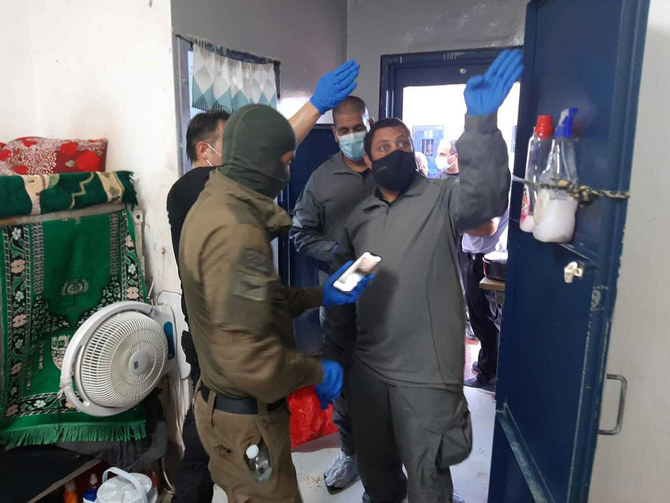
Another branch of the probe is focusing on how the escape succeeded without the prison guards noticing a thing.
Public broadcaster Kan reported that the men were visible on surveillance cameras as they wriggled out of the tunnel exit — but no-one was monitoring the screens at the time.
One guard in charge of that sector of the prison may even have been asleep on duty, Kan added.
Meanwhile a journalist for the Maariv newspaper said that constructing the tunnel could have taken the inmates as long as five months, according to elements from the investigation.


![]()

Questions plague Israeli security forces after jailbreak
Short Url
https://arab.news/9zdfb
Questions plague Israeli security forces after jailbreak
- It has made the escapees "heroes" to many Palestinians, with celebrations in the Jenin area of the occupied West Bank
- The full weight of Israel's security arsenal has been deployed to catch them


Latest updates


© 2026 SAUDI RESEARCH & PUBLISHING COMPANY, All Rights Reserved And subject to Terms of Use Agreement.