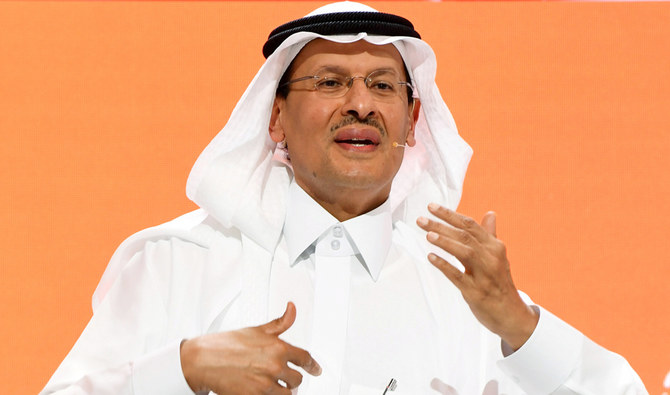
RIYADH: Saudi Energy Minister Prince Abdul Aziz bin Salman recently held a meeting with COP26 President-designate Alok Sharma and discussed ways to enhance cooperation in confronting global climate change.
The Saudi minister highlighted the Kingdom’s qualitative initiatives to help reduce emissions and preserve the environment, foremost of which are the Saudi Green and Middle East Green initiatives.
Saudi Crown Prince Mohammed bin Salman launched these initiatives on March 27. These initiatives are aimed at reducing carbon emissions in the region by 60 percent through the use of clean hydrocarbon technologies and the planting of 50 billion trees, including 10 billion in Saudi Arabia.
The “green” initiatives, which are part of the Vision 2030 strategy, will place Saudi Arabia at the center of regional efforts to meet international targets on climate change mitigation, as well as help it achieve its own goals.
Prince Abdul Aziz and Sharma also discussed the framework of the circular carbon economy adopted by G20 leaders during Saudi Arabia’s presidency in 2020.
While the Gulf Cooperation Council (GCC) region has long been a leading global supplier of fossil fuels, renewables are complementing its own energy mix, offering eco-friendly alternatives such as clean hydrogen fuel to decarbonize and reduce gas emissions.
With around 70 to 90 percent of the Arabian Peninsula facing the threat of desertification, owing to past and ongoing human activities, massive afforestation, and land restoration initiatives hold hope for millions of hectares of degraded land.
Unfortunately, in a G20 meeting held in Italian city, Naples on July 22-23, energy and environment ministers failed to agree on the wording of key climate change commitments in their final communique after China and India refused to give way on two key points.
One of these was phasing out coal power, which most countries wanted to achieve by 2025 but some said would be impossible for them.
The other concerned the wording surrounding a 1.5-2 degree Celsius limit on global temperature increases that was set by the 2015 Paris Agreement.
Average global temperatures have already risen by more than 1 degree compared to the pre-industrial baseline used by scientists and are on track to exceed the 1.5-2 degree ceiling.
“Some countries wanted to go faster than what was agreed in Paris and to aim to cap temperatures at 1.5 degrees within a decade, but others, with more carbon-based economies, said let’s just stick to what was agreed in Paris,” said Italy’s Ecological Transition Minister Roberto Cingolani.
The G20 meeting was seen as a decisive step ahead of United Nations climate talks, known as COP26, which take place in 100 days’ time in Glasgow in November.


![]()

Saudi Arabia reiterates its commitment to fight climate change
Short Url
https://arab.news/z2zjc
Saudi Arabia reiterates its commitment to fight climate change
- Prince Abdul Aziz and Sharma discussed the framework of the circular carbon economy adopted by G20 leaders during Saudi Arabia’s presidency in 2020


Latest updates


© 2026 SAUDI RESEARCH & PUBLISHING COMPANY, All Rights Reserved And subject to Terms of Use Agreement.