

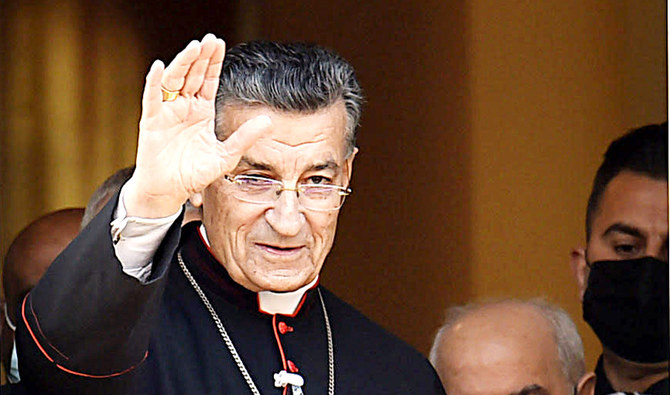

BEIRUT: Lebanon’s Maronite Patriarch Mar Bechara Boutros Al-Rahi on Sunday accused the state of colluding against its people and said the political elite was unable to form a government even “to secure medicine, a loaf of bread, electricity and fuel.”
Al-Rahi, whose mediation efforts to unlock the impasse between President Michel Aoun and Prime Minister-designate Saad Hariri are faltering, also said the country lacked “courageous people” who had the will to build a homeland for the Lebanese and who were characterized by a “pure patriotic thought liberated from loyalty to the foreign powers.”
On Oct. 22 last year, Hariri was instructed to form a new government following the resignation of then-Prime Minister Hassan Diab in the aftermath of the Aug. 4 explosion at Beirut Port.
But Hariri and Aoun have been unable to agree on who should be in the new government and which portfolios should be allocated to whom. Each man has blamed the other for the lack of progress, even as the country battles with financial collapse and the COVID-19 pandemic.
The cleric said part of the crisis being experienced by the Lebanese was caused by “greed and monopoly” and that he would adhere to the neutrality of Lebanon, so that it would not be a “platform for war, conflict and weapons.”
He called on security and judicial agencies “to raid the warehouses in which medicines are stored to gain after the removal of subsidies, and to stop the monopoly and close the smuggling routes.”
Earlier, activists from the Free Patriotic Movement (FPM) circulated rumors on social networking sites about Hariri’s absence from Lebanon. The whispering campaign came after two proposed government lineups, sent by the president to Al-Rahi, were leaked.
FASTFACT
The cleric is mediating to unlock political impasse between President Michel Aoun and Prime Minister-designate Saad Hariri.
Hariri’s team viewed the two draft formations as “interfering with the powers of the prime minister-designate and an attempt to restrict his authority.”
MP Mohammed Al-Hajjar, from the Future Parliamentary Bloc, said while Hariri had no objection to the adoption of new initiatives to form a government, Aoun’s “imposition of a new, unconstitutional method for naming ministers was unacceptable.”
“There is an internal and international agreement on forming a government of specialists, not partisans, but Hezbollah does not want a government,” Al-Hajjar added. “Had it (Hezbollah) wanted, a government would have been formed from the beginning, and it is using its ally to implement its agenda.”
MP Nazih Najm, from the Future bloc, warned that without a government, there were no solutions for electricity, flour, diesel or medicine. He described the current propositions for solutions as “morphine injections.”
“The country, without an executive authority, is going to ruin,’ he said. “The president and the leader of the FPM, MP Gebran Bassil, need to realize that it is not possible to form a government that has more than one head because it will not work or produce. If the intention is to form a government similar to the current caretaker government, then things should remain as they are today.”
The country is experiencing shortages of basic items. Medicines are missing from pharmacies and fuel is rarely found at petrol stations.
Figures issued by the Banque du Liban showed that, during 2020, the bank sold foreign currencies for the import of medicines, medical supplies and raw materials for the pharmaceutical industry at a value of $1.17 million. From the start of 2021 until May 20, the bank sold these at a value of $1.43 million. Excess quantities of medicine were either lost to smuggling outside Lebanon or hidden pending the removal of subsidies.
The bank recorded a 30 percent increase in the amount of money in hard currencies to import fuel during the current year compared to the whole of 2020, meaning that fuel was either smuggled to Syria or stored, which is less likely.


