

British Airways owner IAG expects travel recovery from July

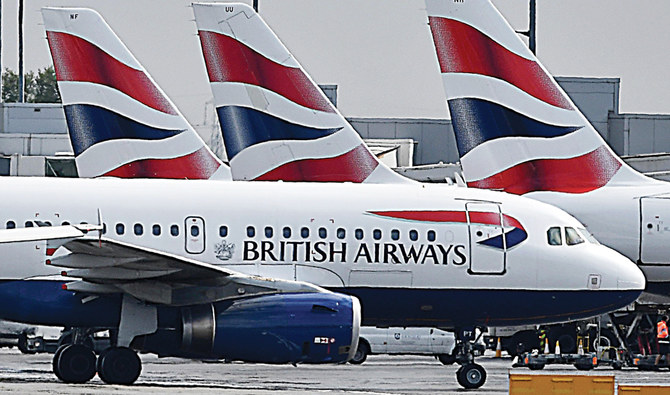
IAG’s first quarter operating loss before exceptional items of €1.14 billion was slightly better than the €1.17 billion loss forecast by analysts. (AFP/File)
Short Url
Updated 08 May 2021
Follow

British Airways owner IAG expects travel recovery from July

  • IAG’s first quarter operating loss before exceptional items of €1.14 billion was slightly better than the €1.17 billion loss forecast by analysts

LONDON: British Airways owner IAG is confident travel will recover from July onwards after forecasting only a minimal increase in its capacity to 25 percent for the April to June quarter.
IAG, which also owns Iberia and Vueling in Spain and Aer Lingus in Ireland, declined to forecast how much it would fly from July but said the recovery would be properly underway by then after more than a year of pandemic restrictions.
“We consider in the second half that we are going to be flying and we are prepared for that,” IAG Chief Executive Luis Gallego told reporters on Friday after the company posted a loss of €1.14 billion ($1.4 billion) in the first quarter.
Before July, however, Gallego said government action was needed on some issues, such as opening travel corridors between countries with high vaccination rates, including the United Kingdom and the US.
The rise to 25 percent of pre-pandemic capacity puts IAG’s plans behind those of rival airlines, and is only a marginal increase from the 19.6 percent it flew in the first three months of 2021.
Britain, which along with Spain is one of IAG’s main markets, is set to publish later on Friday its “green list” of low risk places where people can travel without needing to quarantine on their return.
Gallego said IAG was expecting only a small list of countries initially with more being added from June onwards.

FASTFACTS

● IAG, British Airways’ owner declined to forecast how much it would fly from July but said the recovery would be properly underway by then after more than a year of pandemic restrictions.

● The rise to 25 percent of pre-pandemic capacity puts IAG’s plans behind those of rival airlines, and is only a marginal increase from the 19.6 percent it flew in the first three months of 2021.

“Part of the reason we’re not giving guidance (for third quarter capacity) is simply because we don’t know what’s on the green list yet,” Chief Financial Officer Steve Gunning said.
Air France-KLM expects to operate 50 percent of its pre-pandemic flight capacity in the second quarter, picking up to 55 percent to 65 percent in July-September. Lufthansa expects to fly at about 40 percent of its pre-pandemic capacity for 2021 as a whole.
IAG’s first quarter operating loss before exceptional items of €1.14 billion was slightly better than the €1.17 billion loss forecast by analysts.
Shares in the company, which have risen 30 percent since the beginning of the year, traded up 0.7 percent.
“The company delivered a solid set of results and is pointing to the start of the recovery into the summer,” Goodbody analyst Mark Simpson said.
Given the ongoing uncertainty over COVID-19, IAG said it could not provide a profit outlook for 2021.


Education spending surges 251% as students return from autumn break: SAMA

Updated 12 December 2025
Follow

Education spending surges 251% as students return from autumn break: SAMA

RIYADH: Education spending in Saudi Arabia surged 251.3 percent in the week ending Dec. 6, reflecting the sharp uptick in purchases as students returned from the autumn break.

According to the latest data from the Saudi Central Bank, expenditure in the sector reached SR218.73 million ($58.2 million), with the number of transactions increasing by 61 percent to 233,000.

Despite this surge, overall point-of-sale spending fell 4.3 percent to SR14.45 billion, while the number of transactions dipped 1.7 percent to 236.18 million week on week.

The week saw mixed changes between the sectors. Spending on freight transport, postal and courier services saw the second-biggest uptick at 33.3 percent to SR60.93 million, followed by medical services, which saw an 8.1 percent increase to SR505.35 million.

Expenditure on apparel and clothing saw a decrease of 16.3 percent, followed by a 2 percent reduction in spending on telecommunication.

Jewelry outlays witnessed an 8.1 percent decline to reach SR325.90 million. Data revealed decreases across many other sectors, led by hotels, which saw the largest dip at 24.5 percent to reach SR335.98 million. 

Spending on car rentals in the Kingdom fell by 12.6 percent, while airlines saw a 3.7 percent increase to SR46.28 million.

Expenditure on food and beverages saw a 1.7 percent increase to SR2.35 billion, claiming the largest share of the POS. Restaurants and cafes retained the second position despite a 12.6 percent dip to SR1.66 billion.

Saudi Arabia’s key urban centers mirrored the national decline. Riyadh, which accounted for the largest share of total POS spending, saw a 3.9 percent dip to SR4.89 billion, down from SR5.08 billion the previous week.

The number of transactions in the capital settled at 74.16 million, down 1.4 percent week on week.

In Jeddah, transaction values decreased by 5.9 percent to SR1.91 billion, while Dammam reported a 0.8 percent surge to SR713.71 million.

POS data, tracked weekly by SAMA, provides an indicator of consumer spending trends and the ongoing growth of digital payments in Saudi Arabia. 

The data also highlights the expanding reach of POS infrastructure, extending beyond major retail hubs to smaller cities and service sectors, supporting broader digital inclusion initiatives. 

The growth of digital payment technologies aligns with the Kingdom’s Vision 2030 objectives, promoting electronic transactions and contributing to the nation’s broader digital economy.