

Iraq’s prime minister performs Umrah during Saudi visit

1 / 4
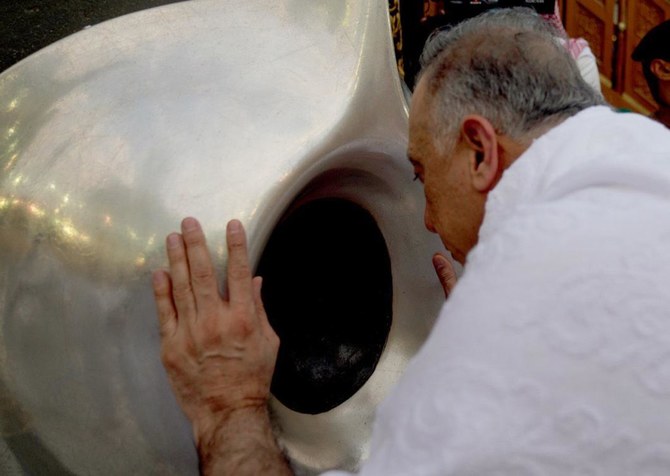
Iraq’s Prime Minister Mustafa Al-Kadhimi performs Umrah. (@IraqiPMO)
2 / 4
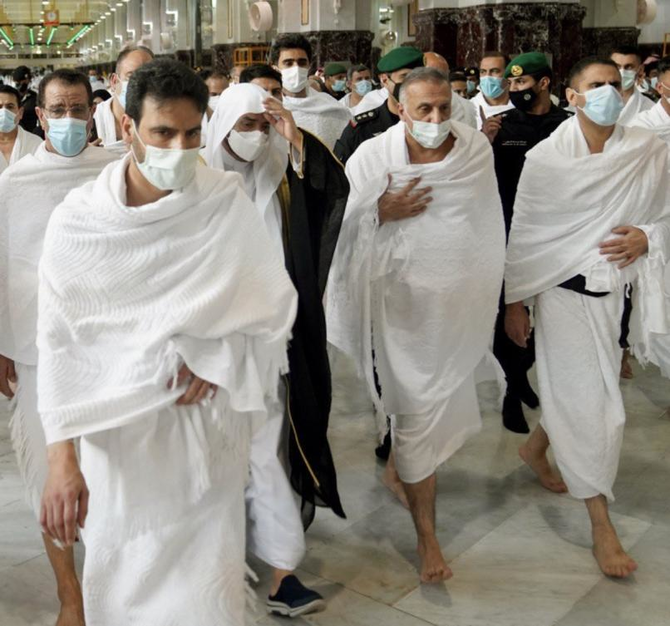
Iraq’s Prime Minister Mustafa Al-Kadhimi performs Umrah. (@IraqiPMO)
3 / 4
Iraq’s Prime Minister Mustafa Al-Kadhimi performs Umrah. (@IraqiPMO)
4 / 4
Iraq’s Prime Minister Mustafa Al-Kadhimi performs Umrah. (@IraqiPMO)
Short Url
Updated 01 April 2021
Follow

Iraq’s prime minister performs Umrah during Saudi visit

  • Al-Kadhimi was pictured entering the Kaaba on the second day of his Saudi visit and looking at the Black Stone
  • The prime minister arrived in Riyadh on Wednesday and held meetings with Crown Prince Mohammed bin Salman

RIYADH: Iraq’s Prime Minister Mustafa Al-Kadhimi performed Umrah on Thursday.

On his arrival at the Grand Mosque in Makkah, he was received by a number of officials from the General Presidency for the Affairs of the Two Holy Mosques.

Al-Kadhimi was pictured entering the Kaaba on the second day of his visit to Saudi Arabia and looking at the Black Stone.

On his arrival at the Grand Mosque in Makkah, he was received by a number of officials from the General Presidency for the Affairs of the Two Holy Mosques.

After performing Umrah, the Iraqi prime minister left Jeddah. At King Abdul Aziz International Airport, he was seen off by Makkah Gov. Prince Khalid Al-Faisal, and a number of officials.

Al-Kadhimi arrived in Riyadh on Wednesday for a visit on the invitation of King Salman. His official delegation included Foreign Minister Fuad Hussein as well as the ministers of finance, interior, oil, agriculture and housing.

He met with Crown Prince Mohammed bin Salman and they agreed on the need for their countries to continue coordinating in confronting extremism and terrorism. The two leaders also agreed to boost economic cooperation, starting with the creation of a joint Saudi-Iraqi fund worth $3 billion. 


Syrian leader to meet Putin, Russia seeks deal on military bases

Updated 28 January 2026
Follow

Syrian leader to meet Putin, Russia seeks deal on military bases

  • Russia’s continued sheltering of Assad and his wife since their ouster remains a thorny issue

MOSCOW: Syrian President Ahmed Al-Sharaa will meet Russian counterpart Vladimir Putin in Moscow on Wednesday, as the Kremlin seeks to secure the future of its military bases in the country.
Putin and Sharaa struck a conciliatory tone at their previous meeting in October, their first since Sharaa’s rebel forces toppled Moscow-ally Bashar Assad in 2024.
But Russia’s continued sheltering of Assad and his wife since their ouster remains a thorny issue. Sharaa has repeatedly pushed Russia for their extradition.
Sharaa, meanwhile, has embraced US President Donald Trump, who on Tuesday praised the Syrian leader as “highly respected” and said things were “working out very well.”
Putin, whose influence in the Middle East has waned since Assad’s ouster, is seeking to maintain Russia’s military footprint in the region.
Russia withdrew its forces from the Qamishli airport in Kurdish-held northeast Syria earlier this week, leaving it with only the Hmeimim air base and Tartus naval base on Syria’s Mediterranean coast — its only military outposts outside the former Soviet Union.
“A discussion is planned on the status of bilateral relations and prospects for developing them in various fields, as well as the current situation in the Middle East,” the Kremlin said of the upcoming meeting in a statement on Tuesday.
Russia was a key ally of Assad during the bloody 14-year Syrian civil war, launching air strikes on rebel-held areas of Syria controlled by Sharaa’s Islamist forces.
The toppling of Assad dealt a major blow to Russia’s influence in the region and laid bare the limits of Moscow’s military reach amid the Ukraine war.
The United States, which cheered Assad’s demise, has fostered ever-warmer ties with Sharaa — even as Damascus launched a recent offensive against Kurdish forces long backed by the West.
Despite Trump’s public praise, both the United States and Europe have expressed concern that the offensive in Syria’s northeast could precipitate the return of Islamic State forces held in Kurdish-held jails.