LONDON: Roche’s arthritis drug tocilizumab cuts the risk of death among patients hospitalized with severe COVID-19, also shortening the time to recovery and reducing the need for mechanical ventilation, results of a large trial showed on Thursday.
The findings — from the RECOVERY trial, which has been testing a range of potential treatments for COVID-19 since March 2020 — should help clear up confusion about whether tocilizumab has any benefit for COVID-19 patients after a slew of recent mixed trial results.
“We now know that the benefits of tocilizumab extend to all COVID patients with low oxygen levels and significant inflammation,” said Peter Horby, a professor of emerging infectious diseases at Oxford University and the joint lead investigator on the RECOVERY trial.
In June last year, the RECOVERY trial found that the cheap and widely available steroid dexamethasone reduced death rates by around a third among the most severely ill COVID-19 patients. That drug has since rapidly became part of standard-of-care recommended for severe patients.
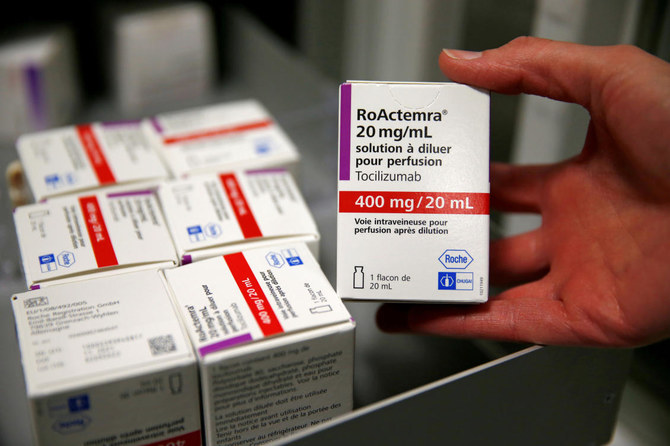
Tocilizumab, sold under the brand name Actemra, is an intravenous anti-inflammatory monoclonal antibody drug used to treat rheumatoid arthritis. It was added to the trial in April 2020 for patients with COVID-19 who required oxygen and had evidence of inflammation.
The study data were from 2,022 COVID-19 patients who were randomly allocated to receive tocilizumab by intravenous infusion and who were compared with 2,094 patients randomly allocated to usual care alone. Researchers said 82% of all patients were taking a systemic steroid such as dexamethasone.
Results showed that treatment with tocilizumab significantly reduced deaths — with 596 (29%) of the patients in the tocilizumab group dying within 28 days, compared with 694 (33%) patients in the usual care group.
This translates to an absolute difference of 4% and means that for every 25 patients treated with tocilizumab, one additional life would be saved, Horby and his co-lead investigator Martin Landray said.
They added that benefits of tocilizumab were clearly seen to be in addition to those of steroids.
“Used in combination, the impact is substantial,” said Landray, who is also an Oxford professor of medicine and epidemiology.
He added that results “clearly show the benefits of tocilizumab and dexamethasone in tackling the worst consequences of COVID-19 – improving survival, shortening hospital stay, and reducing the need for mechanical ventilators.”
Roche’s drug division chief Bill Anderson said last week that previous mixed results were likely due to differences in the type of patients studied, when they were treated, and the endpoint — the juncture at which success or failure is measured.
“We think we’re sort of zooming in on both the most relevant endpoints and relevant patient population,” Anderson said. “It seems like the ideal candidates are patients who are really in that acute phase of inflammatory attack.”
Actemra, along with Sanofi’s similar drug Kevzara, was authorized by Britain’s NHS in early January for COVID-19 patients in intensive care units after preliminary data from a smaller study called REMAP-CAP indicated it could reduce hospital stays by about 10 days.
During 2020, Actemra rose to become Roche’s fifth-best-selling drug, at more than $3 billion, with nearly $600 million from COVID-19 treatment.


![]()

Roche’s tocilizumab cuts deaths in hospitalized COVID-19 patients — study
Short Url
https://arab.news/2z2zu
Roche’s tocilizumab cuts deaths in hospitalized COVID-19 patients — study
- For every 25 patients treated with tocilizumab, one additional life is saved
- The UK's RECOVERY trials have unearthed a number of cost-effective treatments to tackle Covid-19's symptoms


Latest updates


© 2026 SAUDI RESEARCH & PUBLISHING COMPANY, All Rights Reserved And subject to Terms of Use Agreement.