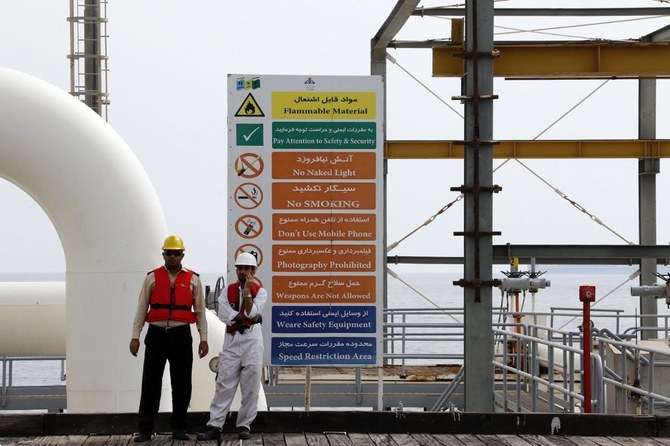
DUBAI: Iran has achieved record high exports of petroleum products despite US sanctions, Oil Minister Bijan Zanganeh said in televised remarks on Friday.
Zanganeh said former US President Donald Trump and his secretary of state, Mike Pompeo, had “joined the dustbin of history, but we are alive and working with more hope to build the country.”
“The enemy and Trump wanted us to perish and die, our exports to reach zero,” he said.
“We set the highest record of exports in the history of the oil industry during the embargo period.”
Trump abandoned the Iran nuclear deal in 2018 and imposed sanctions on the Iranian energy and banking sector.
It is estimated that Iran exports less than 300,000 barrels of oil per day (bpd), compared with a peak of 2.8 million bpd in 2018.
US President Joe Biden has said that if Iran resumed strict compliance with the nuclear agreement — under which it restrained its nuclear program in return for relief from economic sanctions — the United States would too.
However, two of Biden’s top national security nominees said on Tuesday that the United States was a long way from making a decision to rejoin the deal.
Iran has significantly increased exports of petroleum products in recent years although oil products, like crude, fall under US sanctions.
Unlike crude oil, where the ultimate buyer is a refinery, other products can find their way to potentially thousands of small-scale industrial or residential buyers, making them difficult to trace.


Iran: Oil product exports hit record high despite US sanctions
https://arab.news/vmurc
Iran: Oil product exports hit record high despite US sanctions

- ‘The enemy and Trump wanted us to perish and die, our exports to reach zero’
- ‘We set the highest record of exports in the history of the oil industry during the embargo period’


Saudi POS spending jumps 28% in final week of Jan: SAMA
RIYADH: Saudi Arabia’s point-of-sale spending climbed sharply in the final week of January, rising nearly 28 percent from the previous week as consumer outlays increased across almost all sectors.
POS transactions reached SR16 billion ($4.27 billion) in the week ending Jan. 31, up 27.8 percent week on week, according to the Saudi Central Bank. Transaction volumes rose 16.5 percent to 248.8 million, reflecting stronger retail and service activity.
Spending on jewelry saw the biggest uptick at 55.5 percent to SR613.69 million, followed by laundry services which saw a 44.4 percent increase to SR62.83 million.
Expenditure on personal care rose 29.1 percent, while outlays on books and stationery increased 5.1 percent. Hotel spending climbed 7.4 percent to SR377.1 million.
Further gains were recorded across other categories. Spending in pharmacies and medical supplies rose 33.4 percent to SR259.19 million, while medical services increased 13.7 percent to SR515.44 million.

Food and beverage spending surged 38.6 percent to SR2.6 billion, accounting for the largest share of total POS value. Restaurants and cafes followed with a 20.4 percent increase to SR1.81 billion. Apparel and clothing spending rose 35.4 percent to SR1.33 billion, representing the third-largest share during the week.
The Kingdom’s key urban centers mirrored the national surge. Riyadh, which accounted for the largest share of total POS spending, saw a 22 percent rise to SR5.44 billion from SR4.46 billion the previous week. The number of transactions in the capital reached 78.6 million, up 13.8 percent week on week.
In Jeddah, transaction values increased 23.7 percent to SR2.16 billion, while Dammam reported a 22.2 percent rise to SR783.06 million.

POS data, tracked weekly by SAMA, provides an indicator of consumer spending trends and the ongoing growth of digital payments in Saudi Arabia.
The data also highlights the expanding reach of POS infrastructure, extending beyond major retail hubs to smaller cities and service sectors, supporting broader digital inclusion initiatives.
The growth of digital payment technologies aligns with Saudi Arabia’s Vision 2030 objectives, promoting electronic transactions and contributing to the Kingdom’s broader digital economy.


