

European powers blast Iran over new work on nuclear bomb fuel

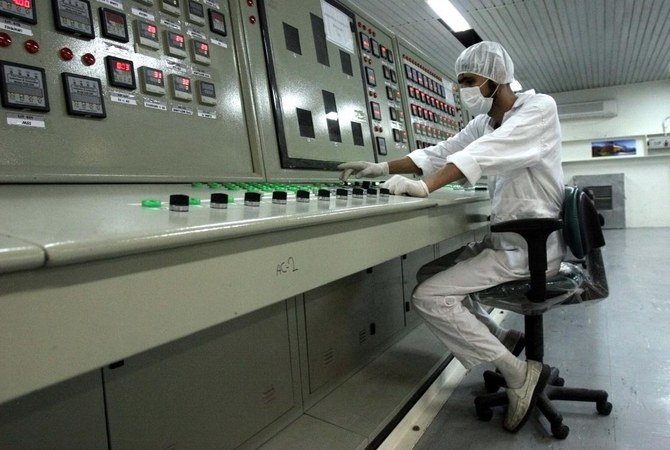
A technician works at the Uranium Conversion Facility just outside the city of Isfahan, Iran, 255 miles (410 kilometers) south of the capital Tehran. (File/AP)
Short Url
Updated 17 January 2021
Follow

European powers blast Iran over new work on nuclear bomb fuel

  • The production of uranium metal has potentially grave military implications: Britain, France and Germany
  • Iran had signed up to a 15-year ban on "producing or acquiring plutonium or uranium metals or their alloys" under the JCPOA

JEDDAH/BERLIN: France, Britain and Germany warned Iran on Saturday against starting controversial work on uranium metal-based fuel for a nuclear reactor, which they said had no civilian purpose.

The three countries, signatories to the Joint Comprehensive Plan of Action, the 2015 deal to curb Iran’s nuclear program, said the work was a clear breach of that agreement.

The nuclear deal bans Iran for 15 years from producing or acquiring uranium metal, a material that can be used in the core of a nuclear bomb.

“We strongly encourage Iran to end this activity, and return to full compliance with its commitments under the Joint Comprehensive Plan of Action without delay, if it is serious about preserving this agreement,” they said.

The three European powers, who remain in the JCPOA with China and Russia, said they were “deeply concerned,” and that Iran’s production of uranium metal had no civilian credibility but potentially serious military implications.

Iran has been accelerating its breaches of the JCPOA in the past two months. Some of those steps were triggered by a law passed in response to the killing of its top nuclear scientist in November, widely attributed to Israel.

They are also part of a process of retaliation that Tehran started in 2019 in response to US President Donald Trump’s withdrawal from the deal and reimposition of sanctions that the United States had scrapped in exchange for restrictions on Iran’s nuclear activities.

The Iranian breaches raise pressure on Joe Biden ahead of his inauguration as US president on Wednesday. Biden has pledged to return the US to the deal if Iran first resumes full compliance. Iran wants Washington to lift sanctions first.

Tehran sent another message on Saturday to Biden and America’s allies in the Gulf when the Islamic Revolutionary Guard Corps test-fired long-range ballistic missiles from central Iran toward targets in the Indian Ocean at the end of a two-day military exercise.

The missiles of “various classes” targeted “the enemy’s battleships and destroyed them from 1,800 km away,” the IRGC claimed.

Iran’s armed forces chief of staff Major General Mohammad Bagheri watched the display of firepower, alongside IRGC chief Maj. Gen. Hossein Salami and aerospace commander Brigadier General Amirali Hajizadeh.

Soleimani’s shadow
Qassem Soleimani left a trail of death and destruction in his wake as head of Iran’s Quds Force … until his assassination on Jan. 3, 2020. Yet still, his legacy of murderous interference continues to haunt the region

Enter


keywords

“One of our major goals in defence policies and strategies is to be able to target enemy ships, including aircraft carriers and battleships, using long-range ballistic missiles,” Salami said.

Bagheri said the launch showed Iran was ready to respond to any “ill will” by its enemies, and warned that “they will be targeted and destroyed by our missiles.”

The exercises also featured a drone attack on a missile defense system and a barrage of “new generation”surface-to-surface ballistic missiles. They followed a naval exercise in the Gulf of Oman last week, and an army drone drill on Jan. 5-6.

(With Agencies)


Hundreds flee to government-held areas in north Syria ahead of possible offensive

Updated 16 January 2026
Follow

Hundreds flee to government-held areas in north Syria ahead of possible offensive

  • Many of the civilians who fled used side roads to reach government-held areas
  • Men, women and children arrived in cars and pickup trucks that were packed with bags of clothes

DEIR HAFER, Syria: Scores of people carrying their belongings arrived in government-held areas in northern Syria on Friday ahead a possible attack by Syrian troops on territory held by Kurdish-led fighters east of the city of Aleppo.
Many of the civilians who fled used side roads to reach government-held areas because the main highway was blocked with barriers at a checkpoint that previously was controlled by the Kurdish-led and US-backed Syrian Democratic Forces, Associated Press journalists observed.
The Syrian army said late Wednesday that civilians would be able to evacuate through the “humanitarian corridor” from 9 a.m. to 5 p.m. Thursday. The announcement appeared to signal plans for an offensive against the SDF in the area east of Aleppo.
There were limited exchanges of fire between the two sides.
Men, women and children arrived in cars and pickup trucks that were packed with bags of clothes, mattresses and other belongings. They were met by local officials who directed them to shelters.
In other areas, people crossed canals on small boats and crossed a heavily damaged pedestrian bridge to reach the side held by government forces.
The SDF closed the main highway but about 4,000 people were still able to reach government-held areas on other roads, Syrian state TV reported.
A US military convoy arrived in Deir Hafer in the early afternoon but it was not immediately clear whether those personnel will remain. The US has good relations with both sides and has urged calm.
Inside Deir Hafer, many shops were closed and people stayed home.
“When I saw people leaving I came here,” said Umm Talal, who arrived in the government-held area with her husband and children. She added that the road appeared safe and her husband plans to return to their home.
Abu Mohammed said he came from the town of Maskana after hearing the government had opened a safe corridor, “only to be surprised when we arrived at Deir Hafer and found it closed.”
SDF fighters were preventing people from crossing through Syria’s main east-west highway and forcing them to take a side road, he said.
The tensions in the Deir Hafer area come after several days of intense clashes last week in Aleppo, previously Syria’s largest city and commercial center, that ended with the evacuation of Kurdish fighters from three neighborhoods north of the city that were then taken over by government forces.
The fighting broke out as negotiations stalled between Damascus and the SDF over an agreement reached in March to integrate their forces and for the central government to take control of institutions including border crossings and oil fields in the northeast.
The US special envoy to Syria, Tom Barrack, posted on X Friday that Washington remains in close contact with all parties in Syria, “working around the clock to lower the temperature, prevent escalation, and return to integration talks between the Syrian government and the SDF.”
The SDF for years has been the main US partner in Syria in fighting against the Daesh group, but Turkiye considers the SDF a terrorist organization because of its association with Kurdish separatist insurgents in Turkiye.