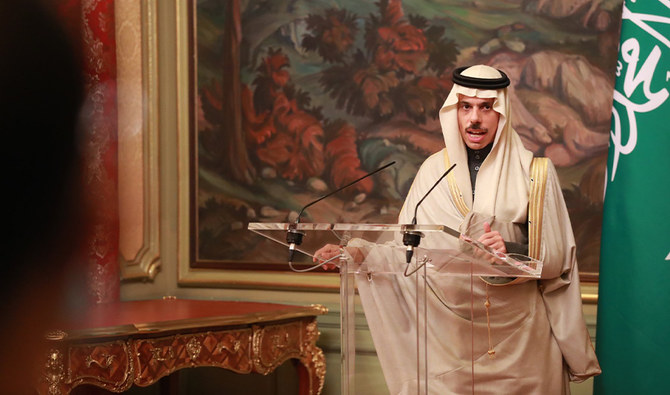

JEDDAH: During a visit to Moscow on Thursday, Saudi Foreign Minister Prince Faisal bin Farhan accused Iran of spreading “havoc and destruction” in the Middle East.
Speaking during a joint press conference with his Russian counterpart, Sergei Lavrov, he denounced regional “interventions” by the Iranian regime and said it must be confronted to protect and benefit the people who live there.
He added that Tehran’s proxy militias are obstructing efforts to end the war in Syria, and the Iran-backed Houthi group in Yemen is obstructing peace efforts there.
“The Kingdom has an ambitious vision: it seeks not only the development and stability of Saudi Arabia, but of the entire region and its peoples, and this requires concerted efforts to stop activities that undermine security and stability,” said Prince Faisal.
Lavrov said Russia understands Saudi concerns about Iran, and wants stability in the Gulf. He added that Moscow wants dialogue between Iran and Gulf states, along with confidence-building measures.
FM Prince @FaisalbinFarhan: This year marks the 95th year since Russia's recognition of the Kingdom of Saudi Arabia, and we look forward to making use of this relationship to serve the common interests of the two countries pic.twitter.com/GwIJBcuYuL
— Foreign Ministry (@KSAmofaEN) January 14, 2021
Iran conducted a two-day naval drill in the Gulf of Oman on Wednesday and Thursday, as the country’s navy inaugurated its largest military vessel. According to state media, cruise missiles were fired by land units and ships.
Hamdan Al-Shehri, a Saudi political analyst and international-relations expert, said the military activity aims to attract the attention of the international community. The regime is mindful of the change of administration in Washington next week and wants to encourage a focus on a renewed deal on its nuclear program, similar to the one brokered by the Obama administration in 2015. Tehran wants this to help reintegrate with the world as a normal state, he added.
“However, the global community and the next US administration will be forced to deal with Iran cautiously, if not firmly, because Iran has already benefited from the previous opportunities,” he said.
Israeli concerns about Iran might cause the Biden administration to pay greater attention to Tehran’s activity in the region.
#Moscow | FM Prince @FaisalBinFarhan held a formal discussion with FM of the Russian Federation #SergeyLavrov, during which they discussed bilateral relations and joint coordination on a number of issues of common concern pic.twitter.com/k62XIGueCT
— Foreign Ministry (@KSAmofaEN) January 14, 2021
“The new administration won’t be like the Trump administration (which withdrew from the nuclear deal and reimposed tough sanctions on Tehran),” said Al-Shehri. “However, it will not be like the Obama administration either.”
There are many obstacles to the Iranian attempts to re-engage with the world, he added, including the US designation of the Houthis in Yemen as a terrorist organization and accusations about Iran’s relationship with Al-Qaeda.
“These factors will make it difficult for the US administration to deal with Iran as a normal country,” said Al-Shehri.
He also noted that the US realizes the importance of preserving its strategic ties with Saudi Arabia and other traditional allies in the region in the face of expanding Chinese and Russian influences.

keywords