

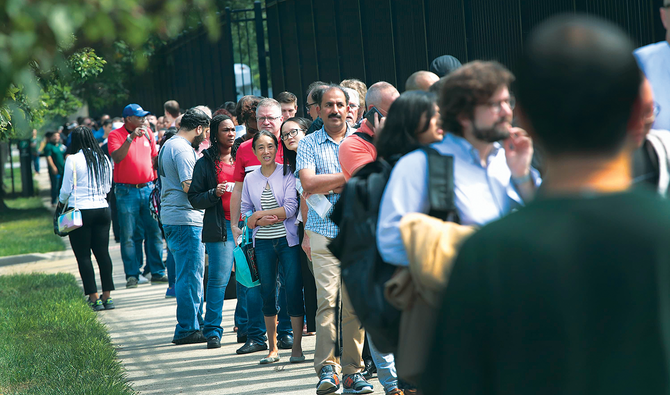
Millions of Americans lose jobless benefits as Trump refuses to sign aid bill

Many economists agree the bill’s aid is too low but say the immediate support is still welcome and necessary. (AFP)
Short Url
Updated 26 December 2020
Follow

Millions of Americans lose jobless benefits as Trump refuses to sign aid bill

  • Without Trump’s signature, about 14 million people could lose those extra benefits, according to Labor Department data

WASHINGTON: Millions of Americans saw their jobless benefits expire on Saturday after US President Donald Trump refused to sign into law a $2.3 trillion pandemic aid and spending package, protesting that it did not do enough to help everyday people.

Trump stunned Republicans and Democrats alike when he said this week he was unhappy with the massive bill, which provides $892 billion in badly needed coronavirus relief, including extending special unemployment benefits expiring on Dec. 26, and $1.4 trillion for normal government spending. Without Trump’s signature, about 14 million people could lose those extra benefits, according to Labor Department data. A partial government shutdown will begin on Tuesday unless Congress can agree to a stopgap government funding bill before then. After months of wrangling, Republicans and Democrats agreed to the package last weekend, with the support of the White House.

Trump, who hands over power to Democratic President-elect Joe Biden on Jan. 20, did not object to terms of the deal before Congress voted it through on Monday night.

But since then he has complained that the bill gives too much money to special interests, cultural projects and foreign aid, while its one-time $600 stimulus checks to millions of struggling Americans were too small. He has demanded that be raised to $2,000.

“Why would politicians not want to give people $2,000, rather than only $600? Give our people the money!” the president tweeted on Christmas Day, much of which he spent golfing at his Mar-a-Lago resort in Palm Beach, Florida.

Many economists agree the bill’s aid is too low but say the immediate support is still welcome and necessary.

A source familiar with the situation said Trump’s objection to the bill caught many White House officials by surprise. While the outgoing president’s strategy for the bill remains unclear, he has
not vetoed it and could still sign it in coming days.

On Saturday, he was scheduled to remain at Mar-a-Lago, where the bill has been sent and awaits his decision. Biden, whose Nov. 3 electoral victory Trump refuses to acknowledge, is spending the holiday in his home state of Delaware and had no public events scheduled for Saturday.


Saudi investment pipeline active as reforms advance, says Pakistan minister

Updated 08 February 2026
Follow

Saudi investment pipeline active as reforms advance, says Pakistan minister

ALULA: Pakistan’s Finance Minister Mohammed Aurangzeb described Saudi Arabia as a “longstanding partner” and emphasized the importance of sustainable, mutually beneficial cooperation, particularly in key economic sectors.

Speaking to Arab News on the sidelines of the AlUla Conference for Emerging Market Economies, Aurangzeb said the relationship between Pakistan and Saudi Arabia remains resilient despite global geopolitical tensions.

“The Kingdom has been a longstanding partner of Pakistan for the longest time, and we are very grateful for how we have been supported through thick and thin, through rough patches and, even now that we have achieved macroeconomic stability, I think we are now well positioned for growth.”

Aurangzeb said the partnership has facilitated investment across several sectors, including minerals and mining, information technology, agriculture, and tourism. He cited an active pipeline of Saudi investments, including Wafi’s entry into Pakistan’s downstream oil and gas sector.

“The Kingdom has been very public about their appetite for the country, and the sectors are minerals and mining, IT, agriculture, tourism; and there are already investments which have come in. For example, Wafi came in (in terms of downstream oil and gas stations). There’s a very active pipeline.”

He said private sector activity is driving growth in these areas, while government-to-government cooperation is focused mainly on infrastructure development.

Acknowledging longstanding investor concerns related to bureaucracy and delays, Aurangzeb said Pakistan has made progress over the past two years through structural reforms and fiscal discipline, alongside efforts to improve the business environment.

“The last two years we have worked very hard in terms of structural reforms, in terms of what I call getting the basic hygiene right, in terms of the fiscal situation, the current economic situation (…) in terms of all those areas of getting the basic hygiene in a good place.”

Aurangzeb highlighted mining and refining as key areas of engagement, including discussions around the Reko Diq project, while stressing that talks with Saudi investors extend beyond individual ventures.

“From my perspective, it’s not just about one mine, the discussions will continue with the Saudi investors on a number of these areas.”

He also pointed to growing cooperation in the IT sector, particularly in artificial intelligence, noting that several Pakistani tech firms are already in discussions with Saudi counterparts or have established offices in the Kingdom.

Referring to recent talks with Saudi Minister of Economy and Planning Faisal Alibrahim, Aurangzeb said Pakistan’s large freelance workforce presents opportunities for deeper collaboration, provided skills development keeps pace with demand.

“I was just with (Saudi) minister of economy and planning, and he was specifically referring to the Pakistani tech talent, and he is absolutely right. We have the third-largest freelancer population in the world, and what we need to do is to ensure that we upscale, rescale, upgrade them.”

Aurangzeb also cited opportunities to benefit from Saudi Arabia’s experience in the energy sector and noted continued cooperation in defense production.

Looking ahead, he said Pakistan aims to recalibrate its relationship with Saudi Arabia toward trade and investment rather than reliance on aid.

“Our prime minister has been very clear that we want to move this entire discussion as we go forward from aid and support to trade and investment.”