

Lebanese judge charges caretaker PM Diab, ex-ministers over Beirut port blast

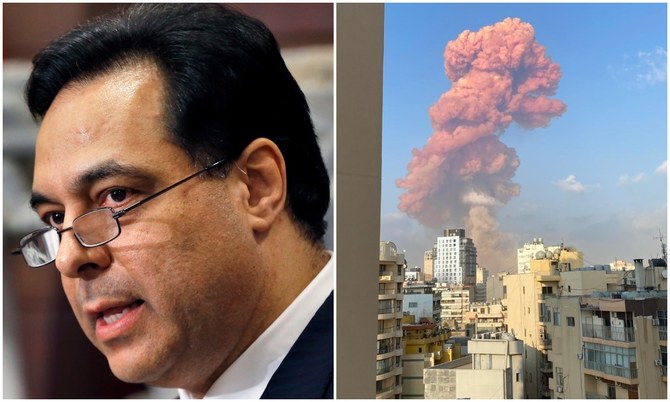
The Lebanese prosecutor probing this summer's port explosion in Beirut filed charges against Diab, and three former ministers, Lebanon's official news agency said. All four were charged with negligence leading to deaths over the Aug. 4 explosion at Beirut port, which killed more than 200 people and injured thousands. (AP/AFP/File Photos)
Short Url
Updated 10 December 2020
Follow

Lebanese judge charges caretaker PM Diab, ex-ministers over Beirut port blast

  • Others include former finance minister Ali Hassan Khalil, as well as former public works ministers Ghazi Zeaiter and Youssef Finianos

BEIRUT: Lebanon’s caretaker Prime Minister Hassan Diab and three former ministers have been charged with negligence over the Beirut port explosion that killed more than 200 people and devastated vast areas of the Lebanese capital.

Investigating judge Fadi Sawan called Diab in for questioning “as a defendant” next week along with former finance minister Ali Hassan Khalil, and former public works ministers Ghazi Zeaiter and Youssef Finianos.

Officials have said that a cargo of ammonium nitrate, a highly explosive chemical, was stored unsafely for years at Beirut’s port.

The investiagting judge set aside three days from next Monday to interrogate the defendants.


All four were charged with carelessness and negligence leading to death over the Aug. 4 explosion at the port.

Sawan will question the caretaker prime minister at the government headquarters, while the three former ministers will be interrogated at his office at the Palais de Justice in Beirut.

Responding to the judicial announcement, Diab said that his conscience is clear, and he is confident that his handling of the case has been both responsible and transparent.

Diab, who resigned in the wake of the August blast after taking office in early 2020, said that he “will not allow the prime minister’s position to be targeted by any party.”

------

READ MORE: People disabled by Beirut explosion stage protest

How the port explosion rubbed raw Beirut’s psychological scars

In blast-hit Beirut, ‘invisible’ elderly women face destitution

------

A judicial source told Arab News that the charge against Diab and the ministers is based on signed correspondence and letters confirming their knowledge of the risk posed by substances stored at the port.

“The number of cases filed by those affected (by the port blast) has reached 1,000. These include families of the victims and those whose homes, shops, and cars have been damaged,” the source said.

The judge’s decision to prosecute the caretaker prime minister and three former ministers follows growing public dismay at the length of the investigation and the fact that no senior officials have been charged.

According to the Supreme Judicial Council, Sawan informed the parliament that “there are serious suspicions relating to some government officials,” and highlighted that “one of the heads of the security services” was among those interrogated.

The council said that two French judges investigating the deaths of French citizens in the port explosion believe the results of specialized tests taken at the blast site will not be available until February or March.

Family and friends of Land and Maritime Transport director-general Abdul Hafeez Al-Qaisi, who was arrested in connection with the explosion, staged a sit-in on Thursday outside the Palais de Justice in Beirut to demand his release.

Protesters said that Al-Qaisi “carried out his administrative duty to the fullest within the limits of his legal powers and the regulations in force, and repeatedly warned in official correspondence that this substance was dangerous.”


First responders enter devastated Aleppo neighborhood after days of deadly fighting

Updated 12 January 2026
Follow

First responders enter devastated Aleppo neighborhood after days of deadly fighting

  • The US-backed SDF, which have played a key role in combating the Daesh group in large swaths of eastern Syria, are the largest force yet to be absorbed into Syria’s national army

ALEPPO, Syria: First responders on Sunday entered a contested neighborhood in Syria’ s northern city of Aleppo after days of deadly clashes between government forces and Kurdish-led forces. Syrian state media said the military was deployed in large numbers.
The clashes broke out Tuesday in the predominantly Kurdish neighborhoods of Sheikh Maqsoud, Achrafieh and Bani Zaid after the government and the Syrian Democratic Forces, the main Kurdish-led force in the country, failed to make progress on how to merge the SDF into the national army. Security forces captured Achrafieh and Bani Zaid.
The fighting between the two sides was the most intense since the fall of then-President Bashar Assad to insurgents in December 2024. At least 23 people were killed in five days of clashes and more than 140,000 were displaced amid shelling and drone strikes.
The US-backed SDF, which have played a key role in combating the Daesh group in large swaths of eastern Syria, are the largest force yet to be absorbed into Syria’s national army. Some of the factions that make up the army, however, were previously Turkish-backed insurgent groups that have a long history of clashing with Kurdish forces.
The Kurdish fighters have now evacuated from the Sheikh Maqsoud neighborhood to northeastern Syria, which is under the control of the SDF. However, they said in a statement they will continue to fight now that the wounded and civilians have been evacuated, in what they called a “partial ceasefire.”
The neighborhood appeared calm Sunday. The United Nations said it was trying to dispatch more convoys to the neighborhoods with food, fuel, blankets and other urgent supplies.
Government security forces brought journalists to tour the devastated area, showing them the damaged Khalid Al-Fajer Hospital and a military position belonging to the SDF’s security forces that government forces had targeted.
The SDF statement accused the government of targeting the hospital “dozens of times” before patients were evacuated. Damascus accused the Kurdish-led group of using the hospital and other civilian facilities as military positions.
On one street, Syrian Red Crescent first responders spoke to a resident surrounded by charred cars and badly damaged residential buildings.
Some residents told The Associated Press that SDF forces did not allow their cars through checkpoints to leave.
“We lived a night of horror. I still cannot believe that I am right here standing on my own two feet,” said Ahmad Shaikho. “So far the situation has been calm. There hasn’t been any gunfire.”
Syrian Civil Defense first responders have been disarming improvised mines that they say were left by the Kurdish forces as booby traps.
Residents who fled are not being allowed back into the neighborhood until all the mines are cleared. Some were reminded of the displacement during Syria’s long civil war.
“I want to go back to my home, I beg you,” said Hoda Alnasiri.