

The methodology behind a new Arab News/YouGov pan-Arab survey

The survey was conducted using YouGov’s online survey methodology. (AFP)
Short Url
Updated 26 October 2020
Follow

The methodology behind a new Arab News/YouGov pan-Arab survey

  • Poll aims to understand what people in the Arab world anticipate from the next US administration
  • People from 18 countries in North Africa, the Levant and GCC region took part in an online survey

RIYADH: Voters across the US will decide on Nov. 3 whether President Donald Trump will remain their leader for another four years. The White House occupant is challenged by Joe Biden, who served two terms as Barack Obama’s vice-president and has been a prominent Democrat politician since the 1970s.
As part of its continued partnership with Arab News to reveal the public’s views on current events, YouGov conducted an opinion poll in late September 2020 to gauge how Arabs across the Middle East view the 2020 US election, the candidates and their policies.
The main aim of the Arab News/YouGov pan-Arab survey is to understand what the region anticipates from a future US presidential administration.
The survey was conducted using YouGov’s online survey methodology. The respondents were picked from among YouGov’s global panel of over 8 million individuals across the world who agreed to take part in the online surveys.
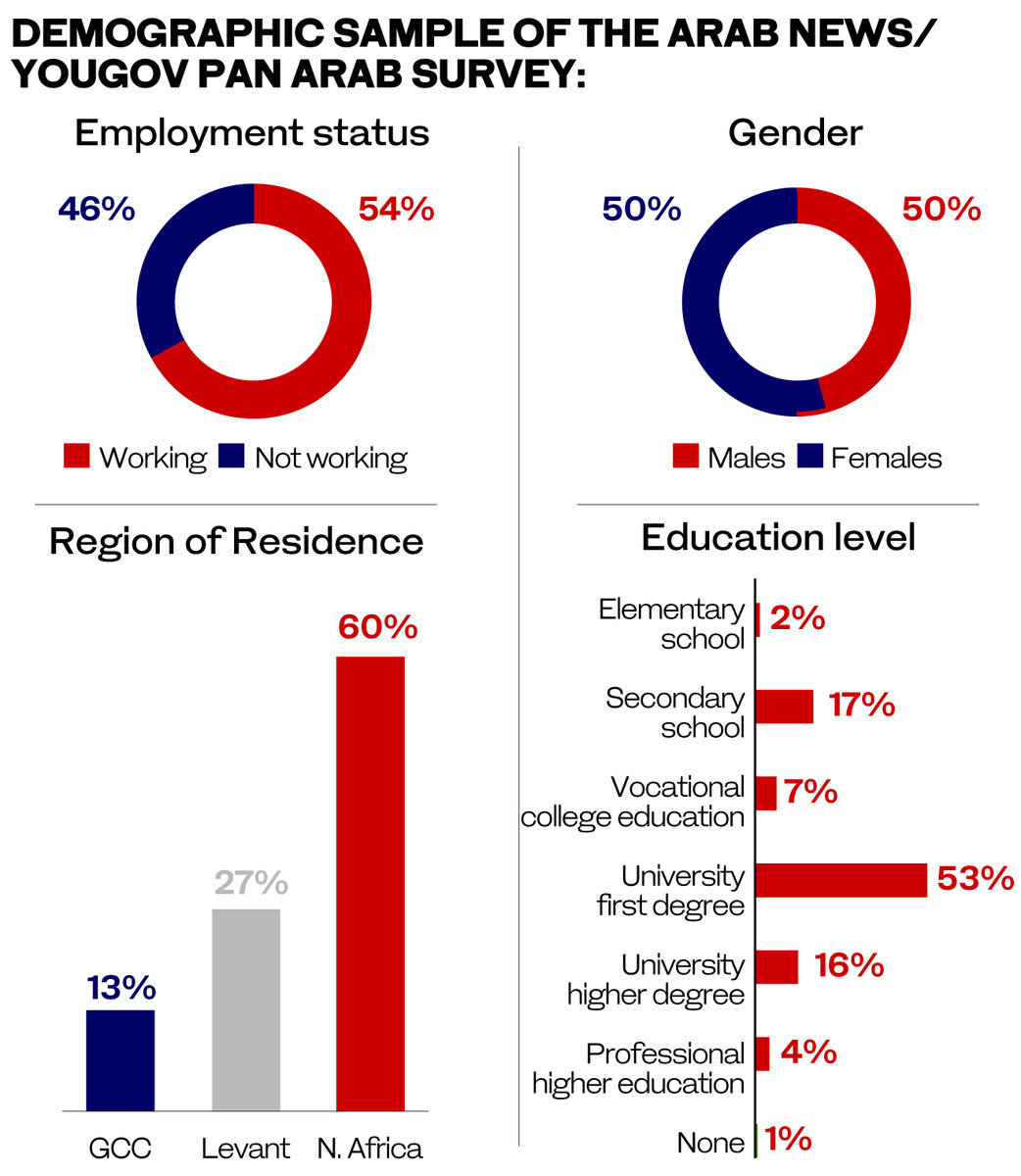
An email was sent to panelists selected at random from the panel, inviting them to take part in the survey and providing a link to questions. All figures, unless otherwise stated, are based on the responses to the Arab News/YouGov pan-Arab survey.
The total sample size was 3,097 Arabic speakers, aged 18 years or above, residing across 18 Arab-speaking countries in North Africa, the Levant and the Gulf. Fieldwork was undertaken between Sept. 21 and Sept. 27
this year. The overall margin of error is ±1.761 percent. The sample was weighted as per the population distribution of all the countries covered. Weights were also added in line with regional distribution of age groups, and for equal representation of men and women.
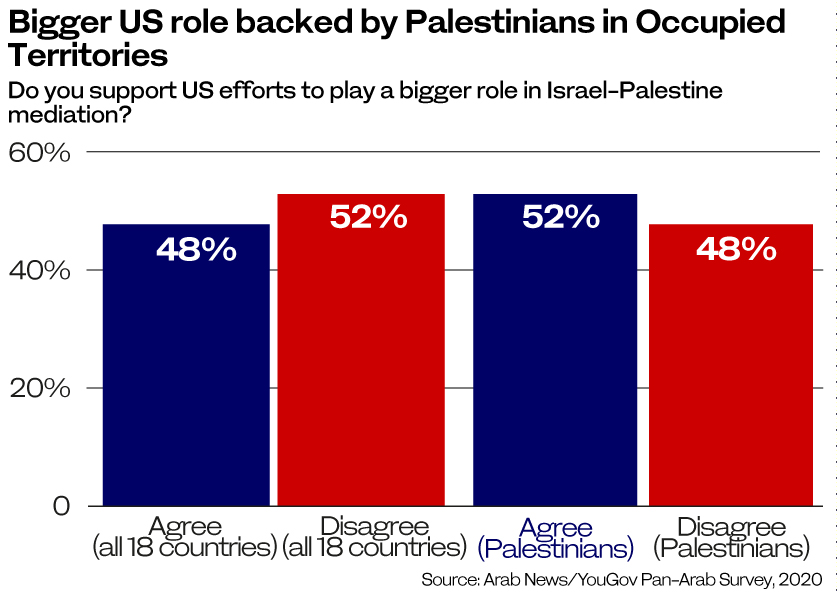
A staggering majority were not familiar with how the US president was elected: 82 percent agreed that the candidate with the most votes across the board will win the presidential elections, omitting the Electoral College which is the ultimate decider of the presidential vote.
The survey results have been rebased, in line with accepted industry standards, to remove “Don’t Know” or “Can’t Say” answers to compare only relevant answers.
A majority of the respondents (76 percent) said they believe in the significance of the next US president and his impact on the Arab world in 2021. Regardless of who will fill the post on Inauguration Day, residents of the Arab region believe in the importance and impact the US president will have in 2021.
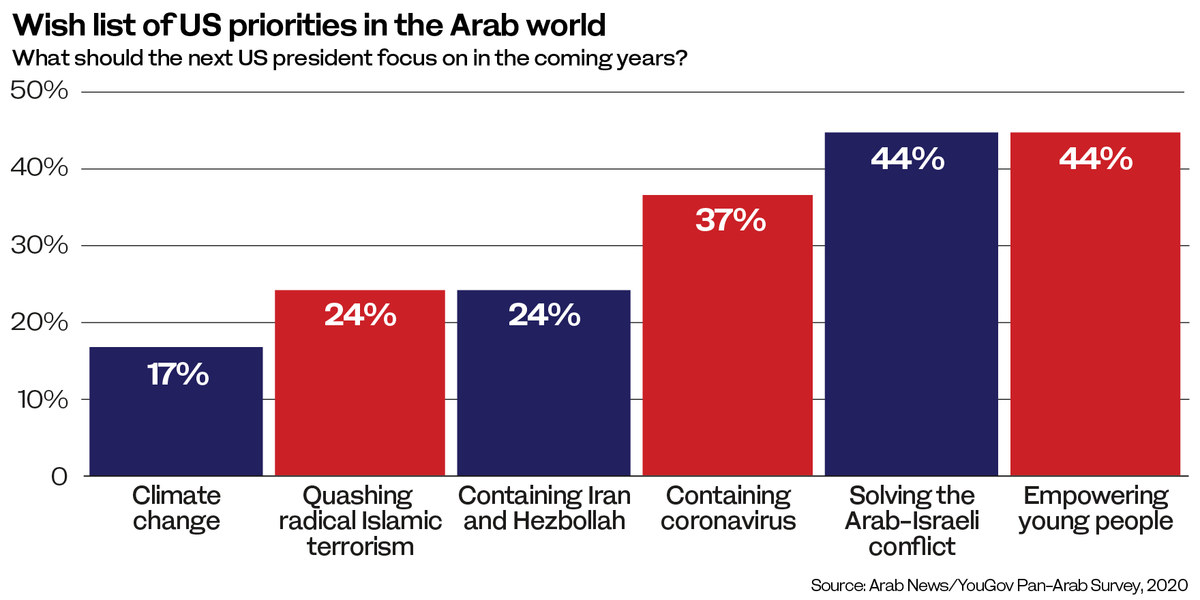
When asked which candidate would be better for the Arab world, most respondents (49 percent) said neither candidate would be, but Biden (40 percent) was still considered a better option than Trump (12 percent).
Analysts say this in part reflects the emotional nature with which Arabs are seeing the candidates and their potential administrations despite the facts on the ground. For, although Biden is not as well known as Trump, he is perceived more favorably perhaps because he is Trump’s opponent.


Israel blocks a Canadian delegation from visiting the occupied West Bank

Updated 5 sec ago
Follow

Israel blocks a Canadian delegation from visiting the occupied West Bank

  • The Israeli statement said The Canadian-Muslim Vote receives the vast majority of its funding from Islamic Relief Canada, a subsidiary of Islamic Relief Worldwide that is listed as a terror entity by Israel

OTTAWA, Ontario: Israel on Tuesday blocked a private Canadian delegation that included six members of Parliament from entering the occupied West Bank.
The Israeli Embassy in Canada said the group was denied entry because of its links to Islamic Relief Worldwide, a nongovernmental organization that Israel lists as a terror group.
Canadian Foreign Minister Anita Anand said in a post on social media that Canada has expressed its “objections regarding the mistreatment of these Canadians.”
Ontario Member of Parliament Iqra Khalid, from Prime Minister Mark Carney’s Liberal party, said she was part of the delegation and was shoved several times by Israeli border officials.
She said she was pushed after trying to check on a member of the roughly 30-person delegation who was pulled aside for additional questioning after the group had been at the Allenby border crossing between Jordan and the Israeli-occupied West Bank.
Khalid said the border officials were able to see she was a lawmaker as they had taken her special passport, which looks different from a standard Canadian document.
The Israeli Embassy statement said Israel “will not allow the entry of organizations and individuals who are associated with designated terror entities.”
The delegation, sponsored by the group The Canadian-Muslim Vote, had planned to meet with displaced Palestinians in the West Bank, where the Israeli government recently approved the construction of 764 new homes in Jewish settlements.
The Israeli statement said The Canadian-Muslim Vote receives the vast majority of its funding from Islamic Relief Canada, a subsidiary of Islamic Relief Worldwide that is listed as a terror entity by Israel.
In Ottawa, the National Council of Canadian Muslims said the Israeli government’s refusal to allow Canadian parliamentarians into the country raises serious concerns about transparency and accountability.
British Columbia New Democrat Member of Parliament Jenny Kwan said the entire delegation had electronic travel authorizations to enter the West Bank but they were revoked “on the day of our arrival.”
In September, Canada joined several other countries in recognizing a Palestinian state, a significant shift in its policy and a move that came despite opposition from the United States. At the time, Canada said it hopes the recognition paves the way for peace based on two states living side by side.