Poll: Arabs support Trump on Iran, but not on Jerusalem embassy move

The survey showed opinion in the Arab world overall is divided on the regional impact of the killing of Iranian military commander Qassem Soleimani. AFP WASHINGTON, DC - September 29: President Trump, en route to Cleveland for the first televised debate with opponent Joe Biden, gestures to reporters as he departs the White House, in Washington, DC on September 29. (Photo by Bill O’Leary/The Washington Post via Getty Images)
Short Url
Updated 30 December 2020
Follow

Poll: Arabs support Trump on Iran, but not on Jerusalem embassy move

  • Arab News/YouGov pan-Arab survey finds Trump much better known in the Arab region than rival Biden
  • Analysts say praises for Trump’s strong Iran stance drowned out by backlash against Jerusalem embassy move

BEIRUT: Regardless of the outcome of the Nov. 3 presidential election, US President Donald Trump does not have to worry about one thing: being accused of leaving the Middle East in a worse condition than he inherited it. Judging by the Arab News/YouGov pan-Arab survey’s findings, that dubious honor goes to his predecessor, Barak Obama, whose vice president Joe Biden is now Trump’s main challenger.
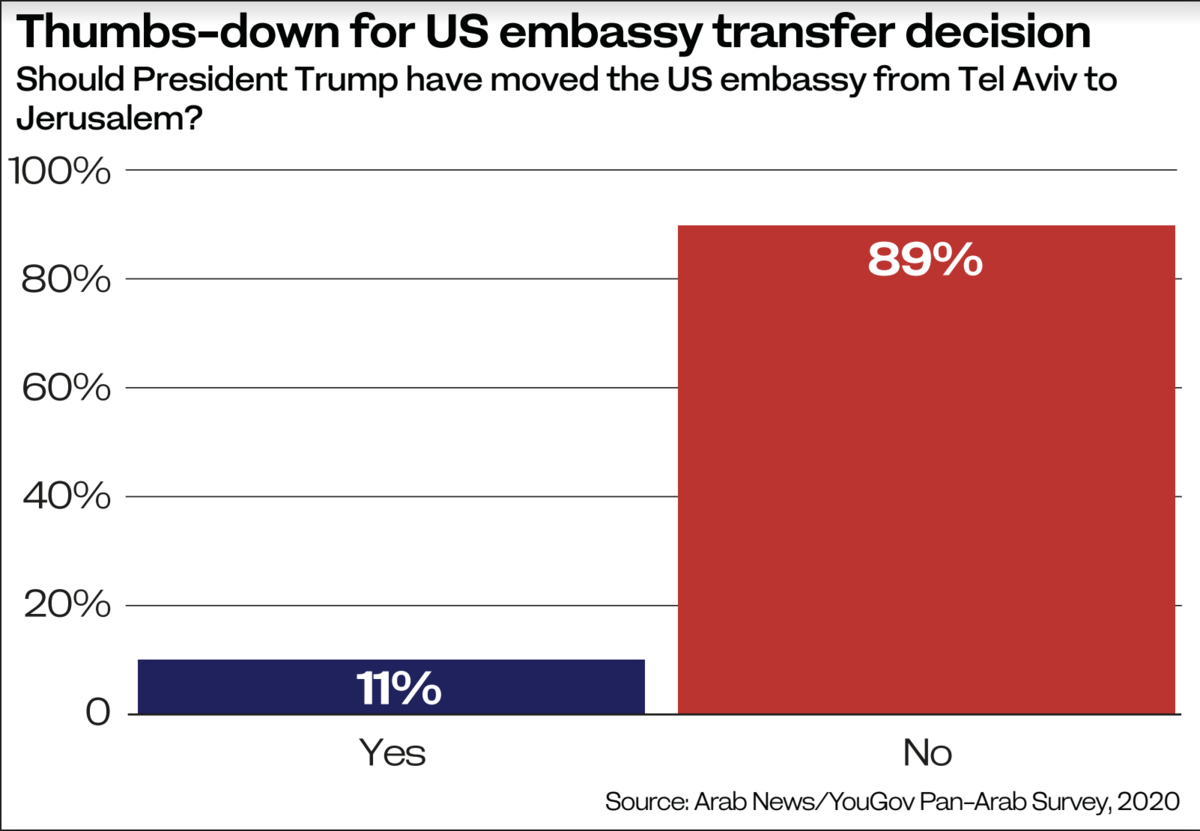
In a nutshell, the study shows that Arabs broadly support Trump’s iron-fist approach towards the Iranian regime, although they oppose his decision in 2018 to transfer the US embassy in Tel Aviv to Jerusalem. And even though he is seen as not better for the Arab region than his Democratic opponent, far more respondents were aware of him than Biden. Some of his policies were also viewed favorably in specific parts of the Arab world.

While gone are the days when a White House occupant could run for a second term on their foreign-policy achievements, there is no denying that the US remains a global power whose decisions affect the lives of people from Central America to the Middle East. As such, the importance of understanding what the Arab world is anticipating from a future US administration cannot be overstated.
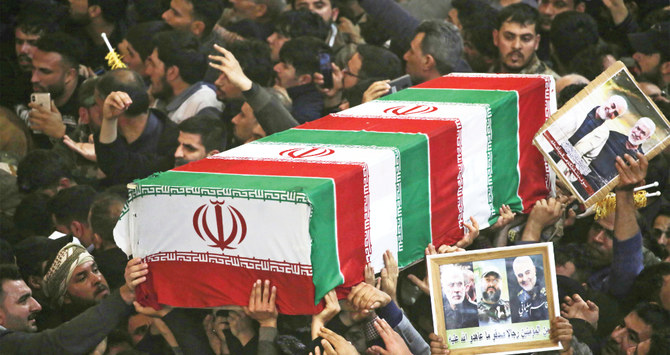
Covered extensively by the Arab news media, the first big news story of 2020 was the elimination of Iranian Major General Qassem Soleimani, head of the Islamic Revolutionary Guard Corps’ (IRGC) extraterritorial Quds Force. Soleimani was on his way to meet the Iraqi prime minister when he was killed in a US drone strike near Baghdad airport on Jan. 3.
According to the survey, opinion in the Arab world overall is divided on the regional impact of the killing.
Respondents in Yemen were very supportive of the action, with 71 percent approving it as a positive move, as were many residents of Saudi Arabia (68 percent) and Iraqi (57 percent). In contrast, some 59 percent of respondents in Lebanon and 62 percent in Qatar said it was a negative move for the region.

“The poll accurately assesses the interests of Arab states,” said Dr. John Hulsman, president and managing partner of John C. Hulsman Enterprises, a prominent global political risk consultancy.
“For people who knew Soleimani in Iraq, he was part of the problem … as a satrap (viceroy) of Iran. They are delighted in Iraq now they have a vaguely reformist prime minister who is vaguely tolerated by Iran and the US. And that couldn’t have happened with Soleimani there.”

On the other hand, Hulsman said, “If you live somewhere where there is an American base in the region (such as Qatar), then Soleimani’s killing might mean that you are next, because no one thinks the Iranians are going to forget that Soleimani died.”

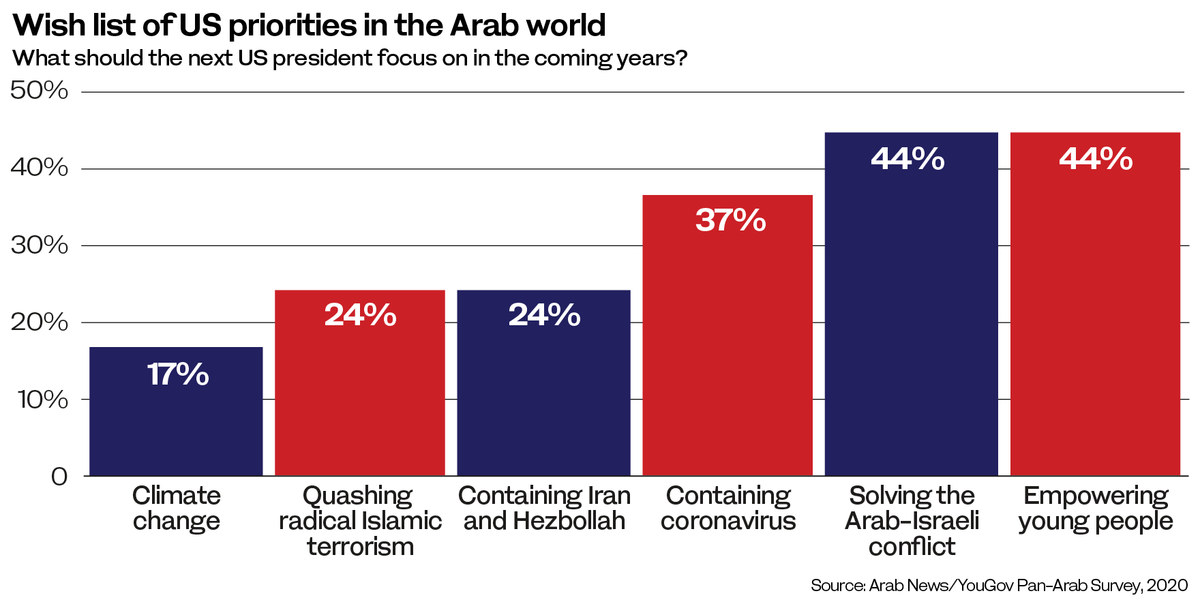
Under the circumstances, why did 40 percent of the Arab News/YouGov survey’s respondents say Biden would be better for the Middle East, as opposed to the 12 percent who said the same thing about Trump?
For one thing, analysts point out, an even larger number, 49 percent, felt neither candidate would be better for the region.
For another thing, they note that just a little more than half of the respondents (53 percent) said they were aware of Biden compared to a massive 90 percent who were aware of Trump. Besides, they say, the points scored by Trump by taking a hard line on the Iranian problem are outweighed by the consequences of the Jerusalem embassy transfer decision, which was opposed by 89 percent of the respondents.


READ: The methodology behind the Arab News/YouGov Pan-Arab Survey


According to David Romano, Thomas G. Strong professor of Middle East Politics at Missouri State University, Iran remains the key issue in understanding the Arab world’s bad aftertaste from the Obama administration. “When it comes to the Arab states, Biden is a lot like Obama,” he told Arab News. “They are not sure if he’s the kind of president who will throw them under the bus like many feel Obama did to (former Egyptian President) Hosni Mubarak.”
Trump, by comparison, might represent stability for the Middle East. “Trump has come through on his word. He sent more troops to Saudi Arabia and he’s been harder on Iran,” Romano said.

Presumably, by the same token, about one fifth of GCC residents believe Trump’s withdrawal from the Obama-era Joint Comprehensive Plan of Action (JCPOA), better known as the Iran nuclear deal, has boosted safety in the region (led particularly by 49 percent of Saudi nationals).

Furthermore, residents of countries intimately tied without a choice to Iran said they want a combative stance from the next US president, including toughened sanctions and a war posture. These included: Iraq (53 percent), Yemen (54 percent) and Saudi Arabia (49 percent).
“The Trump team came in and decided that Obama’s efforts, particularly with the JCPOA, were a disaster because it bankrolled a whole list of people who want America out of the region and who don’t want stability in the region. They want to dominate the region,” Hulsman said.
The fear among many is that Biden may abandon Trump’s “maximum pressure” campaign on Iran. “From the point of view of the Middle East, this is one of those moments that looks like whiplash. If you are living in the region, this is zig-zag diplomacy,” Hulsman said.
It is not just analysts who are deeply skeptical about Biden’s stance on Iran, fearing a return to the perceived weak-kneed and irresolute approach of Obama.
Agop K, a Lebanese-Armenian-American attorney who lives in Beirut but practices law in the US, said “we need an iron fist here in the Middle East, unfortunately. And Trump represents that.”
Speaking to Arab News, he said: “As long as the pressure is on Iran and Iran is being sanctioned and cut off from financing, this is what might help us down the line in Lebanon. If I wanted to vote for Trump, this is one of the biggest reasons I would do so.”

Twitter: @rebeccaaproctor


As tensions flare on Israel-Lebanon border, war-torn communities struggle to rebuild

Updated 09 December 2025
Follow

As tensions flare on Israel-Lebanon border, war-torn communities struggle to rebuild

  • The Lebanon strikes have killed at least 127 civilians, including children, since the ceasefire took hold, according to a November UN report
  • The Israeli strikes into southern Lebanon continue, with several a week

METULA, Israel: Ilan Rosenfeld walks through the burnt-out shell of his former business, stepping over crackling pieces of clay plates that used to line his cafe and past metal scraps of Hezbollah rockets littering the rubble.
It’s all that’s left for him in this small, war-ravaged town — the northernmost in Israel, surrounded on three sides by Lebanon.
“Everything I had, everything I saved, everything I built – it’s all burned,” he said as he scanned the damage of the business he’d run for 40 years in Metula, which has long been at the crosshairs of flare-ups along the volatile border. “Every day I wake up, and all I have left are tears.”
Rosenfeld was among tens of thousands of people forced from their homes when war broke out between Israel and the militant group Hezbollah in October 2023, following Hamas’ attack in southern Israel.
One year into a shaky ceasefire on this heavily fortified border, Israel’s government says most of those displaced have returned to their homes in the north, where they struggle to pick up the pieces of their lives. Others are reluctant to come back, as Israel has stepped up attacks in Lebanon. Communities like Metula that were in the center of the conflict remain little more than ghost towns, most still half empty, with many people skeptical of their government’s promise to keep them safe.
The Israeli strikes into southern Lebanon continue, with several a week. Hezbollah has refused to completely disarm until Israel fully withdraws.
“The security situation is starting to deteriorate again,” Rosenfeld said, looking at the bomb shelters on a list recently distributed by the local government. “And where am I in all this? I can barely survive the day-to-day.”
In some towns on the Israel-Lebanon border, the return has been a trickle
Metula residents were among the 64,000 forced to evacuate and relocate to hotels and temporary homes farther south when Hezbollah began firing rockets over the border into Israel in fall 2023. Months of fighting escalated into a full-fledged war. In September 2024, Israel killed 12 and wounded over 3,000 in a coordinated pager attack and killed Hezbollah’s leader in a strike. A month later, the ceasefire deal was reached.
Today, residents have trickled back to the sprawling apple orchards and mountains as Israel’s government encourages them to go home. Officials say about 55,000 people have returned.
In Metula, just over half of the 1,700 residents are back. Yet the streets remain largely empty.
Many hoped to rebuild their lives, but they returned to find 60 percent of the town’s homes damaged from rocket fire, according to the local government. Others were infested and destroyed by rats. The economy — largely based on tourism and agriculture — has been devastated.
With many people, especially young families, reluctant to return, some business owners have turned to workers from Thailand to fill labor shortages.
“Most of the people who worked with us before the war didn’t come back,” said Jacob Katz, who runs a produce business. “We’ve lost a lot … and we can’t read the future.”
Rosenfeld’s modest cafe and farm were perched on a hill overlooking the border fence. Tourists would come to eat, camp in buses converted to rooms and enjoy the view. But now, the towns on the Lebanese side of the border have been reduced to rubble by Israel’s attacks.
Without a home, Rosenfeld sleeps in a small shelter next to the scraps that remain of his business. He has little more than a tent, a refrigerator and a few chairs. Just a stone’s throw away sit a military watch tower and two armored vehicles.
Israel’s government says it has invested hundreds of millions of dollars in border recovery efforts, that it plans to invest more in economic revival, and that residents can apply for support funds.
But Rosenfeld said that despite his requests for government assistance, he hasn’t received any aid.
He’s among residents and business leaders who say they feel forgotten. Most say they need more resources to rebuild.
“The Israeli government needs to do much more for us,” Metula deputy mayor Avi Nadiv said. “The residents who live on Israel’s northern border, we are Israel’s human shield.”
A spokesman for Zeev Elkin, a Cabinet minister overseeing reconstruction in the north, said the local government has not used funds allocated to reconstruction “due to narrow political and oppositional considerations.”
Hezbollah-Israel tensions are flaring
As Hezbollah refuses to disarm, Israel has accused Lebanon’s government of not doing enough to neutralize the militant group. The Lebanese army says it has boosted its presence over the border area to strengthen the ceasefire.
Israel continues to bombard what it says are Hezbollah sites. Much of southern Lebanon has been left in ruins.
The strikes are among a number of offensives Israel has launched – including those in Gaza, the West Bank and Syria – in what it calls an effort to crack down on militant groups.
The Lebanon strikes have killed at least 127 civilians, including children, since the ceasefire took hold, according to a November UN report. UN special rapporteur Morris Tidball-Binz said the strikes amount to “war crimes.” Israel has maintained that it has the right to continue strikes to protect itself from Hezbollah rearming and accuses the group of using civilians as human shields.
Last week, Israel struck the southern suburbs of the Lebanese capital of Beirut, killing Hezbollah’s top military commander. The group, still weakened by last year’s fighting, has not responded.
‘The army cannot protect me’
In Metula, signs of the tensions are everywhere. The local government’s list of public shelters reads: “Metula is prepared for an emergency.”
Explosions and gunfire periodically echo from military drills while farmer Levav Weinberg plays with his 10-, 8- and 6-year-old children. Weinberg, a military reservist, said his kids are too scared to ride their bikes on the street.
Weinberg, 44, and his family returned in July, skeptical of the government’s promise that everything was returning to normal but eager to keep their business alive.
Metula’s government continues to encourage people to come back, telling residents the region is safe and the economy will bounce back.
“Today we feel the winds of, let’s call it, the winds of war – but it doesn’t deter us,” Nadiv said. “Coming back to Metula – there’s nothing to be afraid of. ... The army is here. The houses are fortified. Metula is prepared for anything.”
Weinberg isn’t so sure. In recent weeks, he and his wife have considered leaving once again.
“The army cannot protect me and my family,” Weinberg said. “You sacrifice your family to live in Metula these days. It’s not a perfect life, it’s not that easy, and at some point your kids pay the price.”