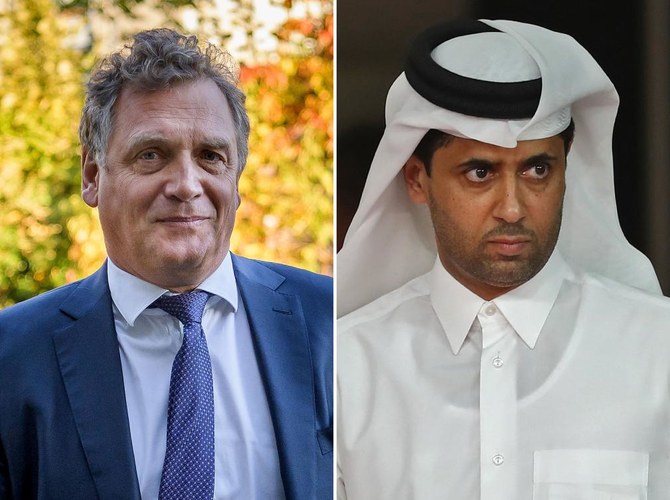
LAUSANNE, France: FIFA’s disgraced former secretary general Jerome Valcke and Paris Saint-Germain chief Nasser Al-Khelaifi go on trial in Switzerland on Monday in the latest chapter of football’s seemingly endless corruption saga.
The two men have been indicted for alleged corruption in the attribution of football broadcasting rights — Al-Khelaifi is also the boss of beIN Media.
The hearing, which has already been delayed because of the coronavirus, is scheduled to last until September 25 at the Federal Criminal Court of Bellinzona. But it will open under another cloud as suspicions of collusion between the Swiss prosecution and FIFA have undermined its credibility.
Center stage is Valcke, former right-hand man of ousted FIFA president Sepp Blatter, who appears in two separate cases of television rights corruption — he faces up to five years in prison if found guilty.
The 59-year-old Frenchman stands accused of wanting to transfer the Middle East and North Africa rights for screening the 2026 and 2030 World Cups to the Qatari giant beIN Media, in exchange for “unwarranted benefits” from Al-Khelaifi.
According to the prosecution, the case relates to a meeting on October 24, 2013 at the French headquarters of beIN, when Al-Khelaifi allegedly promised to buy a villa in Sardinia for five million euros, granting its exclusive use to Valcke.
Al-Khelaifi, who has denied the charges, was then to hand the property over to the Frenchman two years later under certain conditions.
In return, the prosecution claims, Valcke committed to “do what was in his power” to ensure beIN would become the regional broadcaster for the two World Cups, something which happened on April 29, 2014, in an agreement that FIFA has never since contested.
Legally, however, it is no longer a question of “private corruption.” The prosecution had to drop that qualification because of an “amicable agreement” reached at the end of January between FIFA and Al-Khelaifi, the contents of which have not been made public.
So Valcke must now justify having “kept for himself” advantages “which should have gone to FIFA.”
An employee at the time, the obligation to return money received in the course of his duties “also applies to bribes,” according to a decision in March.
Al-Khelaifi, one of the most influential men in world football, faces the charge of “inciting Valcke to commit aggravated criminal mismanagement,” for which he could also face five years in prison.
“The major part of this file does not concern our client,” his lawyers told AFP while dismissing the charges against him as “clearly artificial.”
Al-Khelaifi denies buying the property in question or promising it to Valcke.
Valcke, who will be at the hearing, also stands accused of exploiting his position at FIFA between 2013 and 2015 to influence the awarding of media rights for Italy and Greece for various World Cup and other tournaments scheduled between 2018 and 2030 “in order to favor media partners that he preferred” in exchange for payments from Greek businessman Dinos Deris, who has also been charged.
Valcke, who allegedly stood to receive 1.25 million euros in exchange, “disputes the charges,” according to his lawyer Patrick Hunziker.
The case has been weakened by accusations of collusion born of three secret meetings in 2016 and 2017 between the current president of FIFA, Gianni Infantino, and Switzerland’s former Attorney General Michael Lauber.
Both are under investigation for “obstructing criminal proceedings” — Lauber resigned from his post in July.
If the hearing runs its course, it will be the first judgment handed down in Switzerland, the seat of most international sports organizations, on the 20 or so proceedings opened in the last five years surrounding FIFA.

FIFA on trial as Valcke, Al-Khelaifi trial begins in Swiss court
https://arab.news/9a95v
FIFA on trial as Valcke, Al-Khelaifi trial begins in Swiss court
- Switzerland will judge Valcke, Al-Khelaifi in a case of TV rights on Monday
- The case is major step in the cascade of investigations on world football
Anger and anguish spread across Cuba as it learns of Trump’s tariff threat on those who provide oil
- Cuba is hit every day with widespread outages blamed on fuel shortages
- Cuban President Miguel Díaz-Canel said Trump’s measure was “fascist, criminal and genocidal”
HAVANA: Massive power outages in Cuba meant that many people awoke Friday unaware that US President Donald Trump had threatened to impose tariffs on any country that sells or supplies oil to the Caribbean island.
As word spread in Havana and beyond, anger and anguish boiled over about the decision that will only make life harder for Cubans already struggling with an increase in US sanctions.
“This is a war,” said Lázaro Alfonso, an 89-year-old retired graphic designer.
He described Trump as the “sheriff of the world” and said he feels like he’s living in the Wild West, where anything goes.
After Trump made the announcement late Thursday, he described Cuba as a “failing nation” and said, “it looks like it’s something that’s just not going to be able to survive.”
Alfonso, who lived through the severe economic depression in the 1990s known as the ” Special Period ” following cuts in Soviet aid, said the current situation in Cuba is worse, given the severe blackouts, a lack of basic goods and a scarcity of fuel.
“The only thing that’s missing here in Cuba … is for bombs to start falling,” he said.
Cuba is hit every day with widespread outages blamed on fuel shortages and crumbling infrastructure that have deepened an economic crisis exacerbated by a fall in tourism, an increase in US sanctions and a failed internal financial reform to unify the currency. Now Cubans worry new restrictions on oil shipments will only make things worse.
On Friday, Cuban President Miguel Díaz-Canel said on X that Trump’s measure was “fascist, criminal and genocidal” and asserted that his administration “has hijacked the interests of the American people for purely personal gain.”
Meanwhile, Cuban Foreign Minister Bruno Rodríguez wrote on X that Trump’s measure “constitutes an unusual and extraordinary threat” and said he was declaring an international emergency.
Trump previously said he would halt oil shipments from Venezuela, Cuba’s biggest ally, after the US attacked the South American country and arrested its leader.
Meanwhile, there is speculation that Mexico would slash its shipments to Cuba.
Mexican President Claudia Sheinbaum said Friday that she would seek alternatives to continue helping Cuba and prevent a humanitarian crisis after Trump’s announcement.
Sheinbaum said one option could be for the United States itself to manage the shipment of Mexican oil to the island, although it was necessary to first understand the details of Trump’s order.
Mexico became a key supplier of fuel to Cuba, along with Russia, after the US sanctions on Venezuela paralyzed the delivery of crude oil to the island.
“It’s impossible to live like this,” said Yanius Cabrera Macías, 47, a Cuban street vendor who sells bread and sweet snacks.
He said he doesn’t believe Cuba is a threat to the United States.
“Cuba is a threat to Cubans, not to the United States. For us Cubans here, it is the government that is a threat to us,” he said, adding that Trump’s latest measure would hit hard. “In the end, it’s the people who suffer … not the governments.”
Jorge Piñon, an expert at the University of Texas Energy Institute who tracks shipments using satellite technology, said there is no answer to a key question: how many days’ worth of fuel does Cuba have?
If no tanker looms in the horizon within the next four to eight weeks, Piñón warned Cuba’s future would be grim.
“This is now a critical situation because the only country we had doubts about was Mexico,” he said, noting that diesel is “the backbone of the Cuban economy.”
Piñón noted that the Chinese don’t have oil, and that all they could do is give Cuba credit to buy oil from a third party. Meanwhile, he called Russia a “wild card: It has so many sanctions that one more doesn’t bother (Vladimir) Putin,” adding that because of those sanctions, a lot of Russian oil is looking for a destination.
Meanwhile, many Cubans continue to live largely in darkness.
Luis Alberto Mesa Acosta, a 56-year-old welder, said he is often unable to work because of the ongoing outages, which remind him of the “Special Period” that he endured.
“I don’t see the end of the tunnel anywhere,” he said, adding that Cubans need to come together and help each other.
Daily demand for power in Cuba averages some 3,000 megawatts, roughly half what is available during peak hours.
Dayanira Herrera, mother of a five-year-old boy, said she struggles to care for him because of the outages, noting they spend evenings on their stoop.
She couldn’t believe it when she heard on Wednesday morning what Trump had announced.
“The end of the world,” she said of the impact it would have on Cuba.


