HAVANA: Massive power outages in Cuba meant that many people awoke Friday unaware that US President Donald Trump had threatened to impose tariffs on any country that sells or supplies oil to the Caribbean island.
As word spread in Havana and beyond, anger and anguish boiled over about the decision that will only make life harder for Cubans already struggling with an increase in US sanctions.
“This is a war,” said Lázaro Alfonso, an 89-year-old retired graphic designer.
He described Trump as the “sheriff of the world” and said he feels like he’s living in the Wild West, where anything goes.
After Trump made the announcement late Thursday, he described Cuba as a “failing nation” and said, “it looks like it’s something that’s just not going to be able to survive.”
Alfonso, who lived through the severe economic depression in the 1990s known as the ” Special Period ” following cuts in Soviet aid, said the current situation in Cuba is worse, given the severe blackouts, a lack of basic goods and a scarcity of fuel.
“The only thing that’s missing here in Cuba … is for bombs to start falling,” he said.
Cuba is hit every day with widespread outages blamed on fuel shortages and crumbling infrastructure that have deepened an economic crisis exacerbated by a fall in tourism, an increase in US sanctions and a failed internal financial reform to unify the currency. Now Cubans worry new restrictions on oil shipments will only make things worse.
On Friday, Cuban President Miguel Díaz-Canel said on X that Trump’s measure was “fascist, criminal and genocidal” and asserted that his administration “has hijacked the interests of the American people for purely personal gain.”
Meanwhile, Cuban Foreign Minister Bruno Rodríguez wrote on X that Trump’s measure “constitutes an unusual and extraordinary threat” and said he was declaring an international emergency.
Trump previously said he would halt oil shipments from Venezuela, Cuba’s biggest ally, after the US attacked the South American country and arrested its leader.
Meanwhile, there is speculation that Mexico would slash its shipments to Cuba.
Mexican President Claudia Sheinbaum said Friday that she would seek alternatives to continue helping Cuba and prevent a humanitarian crisis after Trump’s announcement.
Sheinbaum said one option could be for the United States itself to manage the shipment of Mexican oil to the island, although it was necessary to first understand the details of Trump’s order.
Mexico became a key supplier of fuel to Cuba, along with Russia, after the US sanctions on Venezuela paralyzed the delivery of crude oil to the island.
“It’s impossible to live like this,” said Yanius Cabrera Macías, 47, a Cuban street vendor who sells bread and sweet snacks.
He said he doesn’t believe Cuba is a threat to the United States.
“Cuba is a threat to Cubans, not to the United States. For us Cubans here, it is the government that is a threat to us,” he said, adding that Trump’s latest measure would hit hard. “In the end, it’s the people who suffer … not the governments.”
Jorge Piñon, an expert at the University of Texas Energy Institute who tracks shipments using satellite technology, said there is no answer to a key question: how many days’ worth of fuel does Cuba have?
If no tanker looms in the horizon within the next four to eight weeks, Piñón warned Cuba’s future would be grim.
“This is now a critical situation because the only country we had doubts about was Mexico,” he said, noting that diesel is “the backbone of the Cuban economy.”
Piñón noted that the Chinese don’t have oil, and that all they could do is give Cuba credit to buy oil from a third party. Meanwhile, he called Russia a “wild card: It has so many sanctions that one more doesn’t bother (Vladimir) Putin,” adding that because of those sanctions, a lot of Russian oil is looking for a destination.
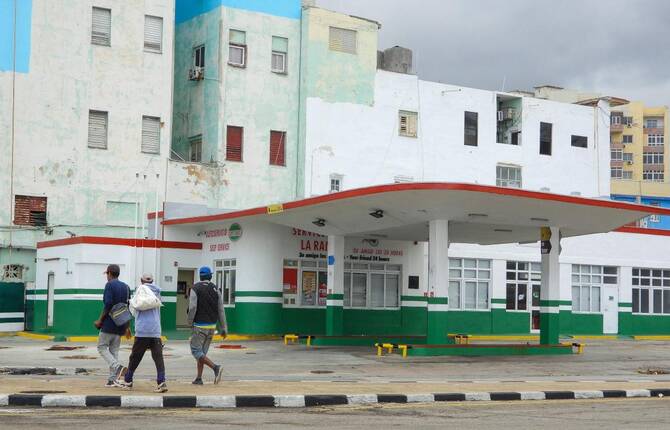
Meanwhile, many Cubans continue to live largely in darkness.
Luis Alberto Mesa Acosta, a 56-year-old welder, said he is often unable to work because of the ongoing outages, which remind him of the “Special Period” that he endured.
“I don’t see the end of the tunnel anywhere,” he said, adding that Cubans need to come together and help each other.
Daily demand for power in Cuba averages some 3,000 megawatts, roughly half what is available during peak hours.
Dayanira Herrera, mother of a five-year-old boy, said she struggles to care for him because of the outages, noting they spend evenings on their stoop.
She couldn’t believe it when she heard on Wednesday morning what Trump had announced.
“The end of the world,” she said of the impact it would have on Cuba.


![]()

Anger and anguish spread across Cuba as it learns of Trump’s tariff threat on those who provide oil
Short Url
https://arab.news/nckx7
Anger and anguish spread across Cuba as it learns of Trump’s tariff threat on those who provide oil
- Cuba is hit every day with widespread outages blamed on fuel shortages
- Cuban President Miguel Díaz-Canel said Trump’s measure was “fascist, criminal and genocidal”


Latest updates


© 2026 SAUDI RESEARCH & PUBLISHING COMPANY, All Rights Reserved And subject to Terms of Use Agreement.