Pakistan explores underground gas storage to manage supply swings, price shocks

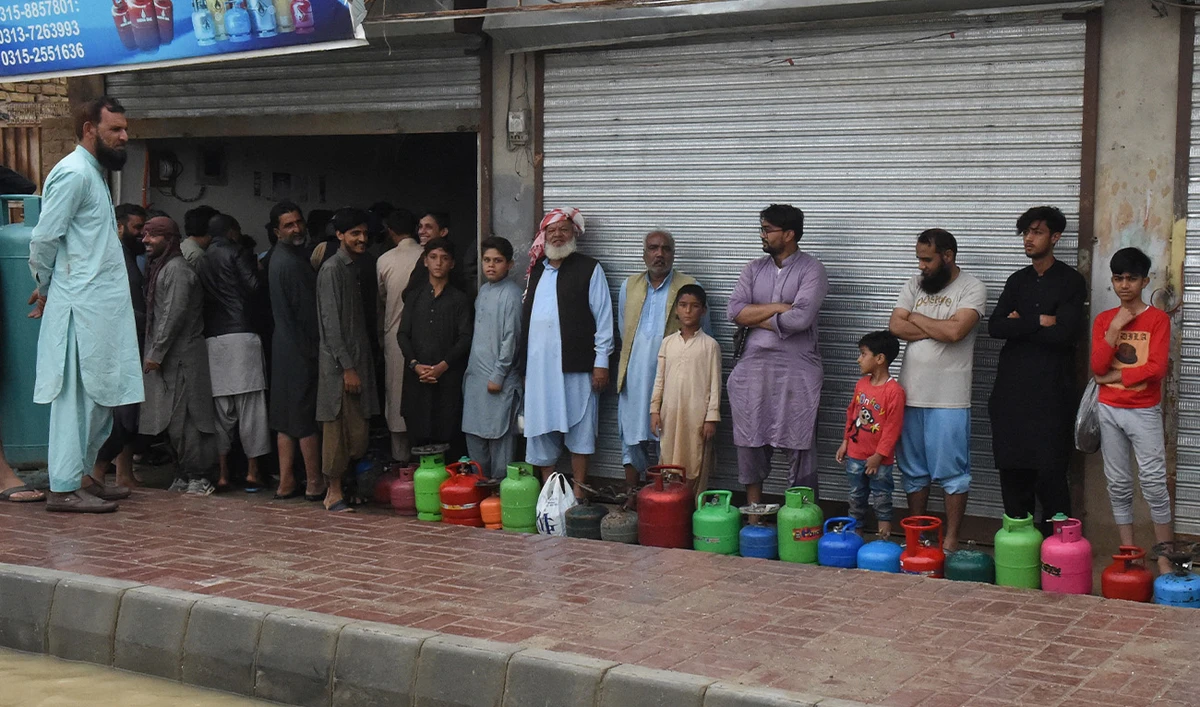
Residents stand in a queue to fill cooking gas cylinders alongside a flooded street after heavy monsoon rainfalls in Quetta on August 26, 2022. (AFP/File)
Short Url
Updated 30 January 2026
Follow

Pakistan explores underground gas storage to manage supply swings, price shocks

  • Pakistan seeks consultants to assess feasibility of underground gas storage
  • Industry officials say storage could ease shortages, cut cargo cancelations

KARACHI: Pakistan is exploring the construction of underground gas storage facilities, a long-discussed energy infrastructure project that officials and industry experts say could help manage supply shortages and cushion the country against global price volatility during periods of geopolitical disruption.

The initiative has resurfaced after a state-run gas infrastructure company this month issued a tender seeking consultants to assess the market need and technical feasibility of underground gas storage, potentially marking the first concrete step toward a project that could cost more than $1 billion.

Pakistan’s energy ministry, through Inter State Gas Systems (Private) Limited (ISGS), posted the tender on the Public Procurement Regulatory Authority (PPRA) portal, inviting local and international firms to conduct a pre-feasibility study for the project.

Asif Inam, chairman of Sui Southern Gas Company (SSGC), welcomed the move, confirming that the idea had been envisioned decades earlier but never implemented.

“If they make it, it will be very helpful because we are forced to close the field in summer and sell LNG cargoes on the spot,” Inam, whose state-owned utility is responsible for gas transmission in Sindh and Balochistan, told Arab News.

He said the ability to store up to one billion cubic feet of gas would ease operational pressures during periods of excess supply and reduce the need to offload imported cargoes.

According to official data, Pakistan imports about $5 billion worth of liquefied natural gas (LNG) and petroleum gas annually, accounting for roughly 30 percent of the country’s total energy imports.

The energy ministry’s spokesperson, Zafar Abbas, did not answer queries about why Pakistan wanted to carry out the project. However, building such storage facilities can help the country avoid costly cargo cancelations.

In November last year, the country scrapped 21 LNG shipments under a long-term contract with Italy’s Eni after excess imports flooded its gas network, while also negotiating the deferment or resale of cargoes with Qatar.

“These storages can also be helpful in war-like situations,” the SSGC official said. “At least we should have storage for a month.”

The tender issued this month by ISGS seeks consultants to assess market demand, identify potential underground storage sites and evaluate their technical and commercial viability.

Inam said if these facilities were built at Port Qasim, then the LNG could be stored right after its arrival.

Energy analyst Muhammad Saad Ali said Pakistan had previously missed opportunities to build strategic reserves during the COVID-19 pandemic when global prices were low due to the absence of storage infrastructure.

“At that time, we did not have storage facilities and lost that opportunity,” said Ali, head of research at Karachi-based Lucky Investments Ltd.

Asked about the expected project cost, he said it could go up to $1 billion.

Ali noted that Pakistan currently has surplus gas, though he said it was a wise move since such storage facilities would provide insurance against future shocks.

“Right now, we have a surplus, so we don’t really need it that much,” he said. “But obviously, in the future, if there is a geopolitical crisis, wars, there can be an energy price shock in all these things.”


Imran Khan’s party warns government against shifting him to hospital without informing family, physicians

Updated 5 sec ago
Follow

Imran Khan’s party warns government against shifting him to hospital without informing family, physicians

  • Pakistan’s government said on Saturday it would shift Khan to a hospital, form medical board for eye treatment amid outcry over health concerns
  • Commencing any medical examination or treatment of Khan in absence of family, physicians will be in violation of constitution, jail rules, says party

ISLAMABAD: Former prime minister Imran Khan’s Pakistan Tehreek-e-Insaf (PTI) party this week warned the government against shifting him to a hospital for treatment without informing his family and physicians, saying such a move would be in violation of the constitution and jail rules. 

The PTI’s response came after the government announced on Saturday that it has decided to transfer the jailed former prime minister from the Central Prison in Rawalpindi to a hospital and form a medical board for his eye treatment. 

The developments follow a report submitted to the Supreme Court by a lawyer appointed as a “friend of the court” who was asked to visit Khan at Rawalpindi’s Adiala jail earlier this month. The report said the 73-year-old had suffered severe vision loss in his right eye due to central retinal vein occlusion, leaving him with only 15 percent sight in the affected eye.

The report’s findings triggered a sit-in by an opposition alliance, including members of Khan’s PTI, outside Parliament House in Islamabad, who demanded his immediate transfer to Islamabad’s Al-Shifa Hospital. Khan was also allowed to speak to his sons for about 20 minutes, according to his family, despite the former premier’s limited interactions with his family and legal team in recent months due to restrictions that the PTI has challenged in court.

“The party’s stance in this regard is clear: transferring Imran Khan to any location without informing his family and physicians or commencing any medical examination or treatment in their absence, is a grave violation of the Constitution of Pakistan and jail rules,” the PTI said in a statement issued late Saturday.

“This will not be acceptable under any circumstances.”

The party said it rejects “any form of secrecy” around Khan’s health, adding that hiding facts about it would be tantamount to putting the former premier’s health at risk. 

The PTI said Khan’s medical examinations and treatments should be ensured immediately in the presence of his personal physicians and at least one member of his family.

“Furthermore, it is essential that this process be conducted independently under the supervision of reputable doctors and hospitals recommended by the party,” it said.

“The government will be held entirely responsible for the consequences of any secretive or unilateral action.”

GOVERNMENT’S RESPONSIBILITY’

Parliamentary Affairs Minister Tariq Fazal Chaudhry said on Saturday that the government gives priority to humanitarian considerations and legal requirements. 

“Providing facilities to every prisoner in accordance with the law is the government’s responsibility,” Chaudhry wrote on social media. 

Meanwhile, Khan’s lawyers on Saturday filed a petition in the Islamabad High Court seeking suspension of a Dec. 20, 2025 conviction in a graft case involving state gifts, arguing that continued incarceration during the pendency of the appeal would result in a grave miscarriage of justice.

The petition says the judgment is under substantive legal challenge and requests suspension of the sentence until the appeal is decided, a remedy available under Pakistani law when serious questions are raised about a conviction.

Khan, who was ousted from office via a parliamentary vote in April 2022, has been in jail since August 2023 after his conviction on a slew of charges he says are politically motivated.

The opposition alliance has vowed to continue its sit-in outside Parliament House until Khan is shifted to the hospital.