

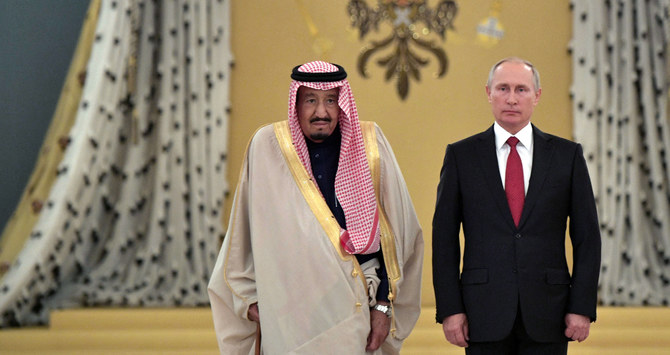
King Salman and Putin discuss oil partnership, vaccine production

Saudi Arabia’s King Salman held a phone call on Monday with Russian President Vladimir Putin. (AFP/File)
Short Url
Updated 08 September 2020
Follow

King Salman and Putin discuss oil partnership, vaccine production

  • The king said he was satisfied with the increase in trade exchange between both countries

DUBAI: Saudi King Salman told President Vladimir Putin of Russia of his keenness to strengthen bilateral ties between the two countries, with special emphasis on their partnership within the OPEC+ alliance of oil producing countries.
In a phone call between the new mega-development of NEOM and Moscow, the two leaders also discussed the work of the G20 under the Saudi presidency ahead of the summit in just over two months’ time and Russian advances toward developing a vaccine against the COVID-19 coronavirus.
According to a statement from the Saudi Press Agency, King Salman expressed “satisfaction over the increasing trade exchange between the two countries, stressing the constructive role of the Russian Federation in OPEC+ in achieving stability and balance in the oil market.”
President Putin highlighted the “fruitful cooperation with Saudi Arabia in the field of energy.”
The conversation comes as oil markets — buoyed for the past four months by the historic cuts deal led by the two biggest producers in OPEC+ — come under renewed pressure as doubts emerge about the strength of recovery in global energy demand.
Brent crude, the international benchmark, fell below $42 in market trading yesterday, off its recent best of more than $46.
The OPEC+ committee of ministers meets by virtual conference in 10 days’ time to assess the current status of the world’s oil markets, with both Saudi Arabia and Russia committed to seeing through the disciplined strategy of cuts, compliance and compensation that has brought them back from the carnage of April.
The two leaders also discussed the work of the G20 to “mitigate the effects of the COVID-19 pandemic and the return to normal life.”
Putin highlighted the continuing cooperation between the two countries in efforts to find a vaccine to the disease. Russia has developed the first vaccine — Sputnik V — to be registered with a national health administration, and is working in partnership with the Kingdom on the next crucial stage of widespread trials on humans in Russia and other countries.
The Russian vaccine was recently favorably judged in a peer-reviewed study in the prestigious British scientific journal The Lancet, which found it to be effective in developing antibodies with no serious side effects.
Saudi Arabia is one of five countries in which wider human trials will be held, the Russians have said, and scientists from the Kingdom have been in touch with Moscow’s Gamaleya Institute, where the vaccine was developed.
In Lebanon, the total number of COVID-19 patients has exceeded 20,000, with the country’s health minister on Monday describing the situation as “delicate and in need of full awareness by all citizens.”
About 12,753 COVID-19 patients were registered during August, while 3,118 cases were registered during the first week of September.

The UN said than 200 UN staff members have been infected by COVID-19 in Syria as the global body steps up its contingency plans to combat the fast spread of the pandemic in the country, medical workers and UN officials said.

“More than two hundred cases have been reported among UN staff members, some of whom have been hospitalized and three who were medically evacuated,” UN Resident Coordinator and Humanitarian Coordinator in Syria, Imran Riza, said in the letter, which was leaked to Reuters from an infected local staff member.


Jeddah students get closer look at electric motorsport

Updated 24 January 2026
Follow

Jeddah students get closer look at electric motorsport

  • A PIF-linked initiative highlights technical and engineering careers behind electric racing events

JEDDAH: Students from local and international schools in Jeddah were introduced to STEM-related career pathways in electric motorsport this week, as part of an education program linked to the UIM E1 World Championship held on the Red Sea.

The sessions formed part of Driving Force Presented by the Public Investment Fund, an initiative run by Formula E and its electric racing series partners, to familiarize students aged eight to 18 with science, technology, engineering and mathematics through electric racing and sustainability-focused industries.

The sessions for students formed part of Driving Force Presented by the Public Investment Fund, an initiative run by Formula E and its electric racing series partners. (Supplied)

The programme took place alongside the 2026 E1 Jeddah GP and included workshops, school visits and trackside access designed to show how engineering, data, broadcast technology and event operations function within professional motorsport.

According to organisers, the initiative reached more than 60,000 students globally in 2025, with further expansion planned this year. 

HIGHLIGHTS

• The program took place alongside the 2026 E1 Jeddah GP and included workshops, school visits and trackside access.

• Students learned about E1 races and their technical and environmental dimensions and discussed the engineering and marine aspects of electric boats.

• According to organisers, the initiative reached more than 60,000 students globally in 2025, with further expansion planned this year. 

John Williams, managing director at E1, told Arab News: “The PIF is absolutely vital to everything we do here at the E1. They were crucial initial investment partner since the start of the championship and they continue to support us in a number of ways and more specifically around the Driving Force program.”

The sessions for students formed part of Driving Force Presented by the Public Investment Fund, an initiative run by Formula E and its electric racing series partners. (Supplied)

Elaborating more on the program, he said: “What we are doing is presenting and showing these students the available careers of science, technology, engineering and mathematics, as well as careers in sports, not only pilots but also engineers and mechanics.”

Williams added that the main key to the program was bringing a new generation to the mechanism of sport.

“We are introducing to these exciting new technologies around the race but it could be our technology on the boat or our broadcast products, as well as how to manage the event its self. There are a range of opportunities to show it to the children in addition to enjoying the excitement of the race and meeting the pilots.”

The program’s Jeddah activities began at King Abdulaziz University’s faculty of maritime studies, where students took part in a hands-on workshop focused on STEM careers in the motorsport and sustainability areas conducted by technology experts and famous water pilots such as Dani Clos, Emma Kimilainen and Patricia Pita.

Students learned about E1 races and their technical and environmental dimensions and discussed the engineering and marine aspects of electric boats.

They also enjoyed exclusive behind-the-scenes access at the E1 Jeddah GP, pilot meet-and-greets, and front-row seats to watch the RaceBird boats in action.