ANKARA: The chief of NATO said Thursday that Greece and Turkey have agreed to start “technical talks” aimed at helping to reduce the risks of military incidents and accidents in the eastern Mediterranean, where the allies have been locked in a tense standoff over offshore energy rights.
NATO Secretary General Jens Stoltenberg announced the possible diplomatic opening in a statement on the military alliance’s website the same day that Turkey announced that Russia plans to conduct live-fire naval exercises this month in the eastern Mediterranean .
“Greece and Turkey are valued Allies, and NATO is an important platform for consultations on all issues that affect our shared security,” the statement read. “I remain in close touch with all concerned Allies to find a solution to the tensions in the spirit of NATO solidarity.”
There was no immediate confirmation from Ankara or Athens and it was not immediately clear when the talks would begin.
Turkey announced the Russian exercises in a navigational notice issued late Wednesday that said they would take place Sept. 8-22 and Sept. 17-25 in areas of the Mediterranean Sea where Turkish research vessels are doing seismic work for oil and gas exploration. Greece says the disputed area is over its continental shelf.
There was no immediate comment from Moscow on the exercises, which Turkey announced after the United States said it was partially lifting a 33-year-old arms embargo against ethnically divided Cyprus. Like Greece, Cyprus has been in a dispute with Turkey over drilling rights in the Mediterranean.
In Athens, Greek government spokesman Stelios Petsas said the planned Russian exercises were being “monitored by all the countries in the region, as well as our NATO allies and European Union partners.”
It’s unclear why NATO-member Turkey announced such drills on Russia’s behalf, but the two countries have in recent years significantly strengthened their military, political and economic ties. They are coordinating closely on their military presence in Syria, while Turkey has purchased Russia’s advanced S-400 missiles and has broken ground on a Russian-built nuclear power plant on its southern coast.
Cyprus government spokesman Kyriakos Koushos said that Russia notifies Cypriot authorities directly about issuing any navigation notice. He said Cyprus has no issue with Russia and that its only complaint concerns Turkey’s attempts to “take advantage” of the situation.
German Chancellor Angela Merkel and Turkish President Recep Tayyip Erdogan spoke by phone on Thursday. Germany currently holds the European Union’s rotating presidency and has been trying to informally mediate the dispute over eastern Mediterranean drilling.
A statement from Erdogan’s office said the Turkish leader wants an arrangement in which resources are shared “fairly” and complained that Greece, Greek Cypriots, and countries backing the two, were the ones escalating tensions.
The Turkish government has reacted angrily to the US move on the Cyprus arms embargo, saying it went against the “spirit of alliance” between Washington and Ankara. It also warned that it would harm efforts to reunify Cyprus, a Mediterranean island nation which is split between Turkish Cypriot and Greek Cypriot communities.
Turkish officials have also vowed to take steps to guarantee the security of the self-declared Turkish state in the island’s north.
The Russian exercises come at a time of increased friction between Turkey on the one side and Greece and Cyprus on the other over offshore energy exploration rights.
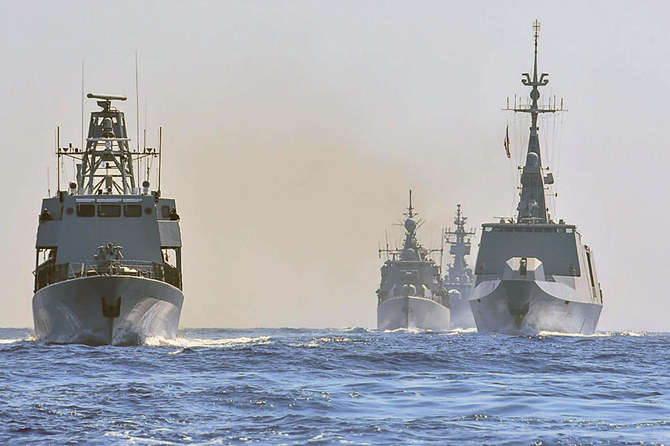
Warships from Greece and Turkey have shadowed each other in recent weeks as Turkish survey vessels and drill ships continue to prospect for hydrocarbons in waters where Greece and Cyprus claim exclusive economic rights. Greek and Turkish armed forces held their own exercises in the area last month.
The US embargo, imposed in 1987, was designed to prevent an arms race that would hinder UN-facilitated reunification efforts for Cyprus. It was directed against the southern, Greek Cypriot part of the island, where Cyprus’ internationally-recognized government is seated.
Washington said it was lifting the arms embargo against Cyprus for one year — with the option of renewal — to let it procure non-lethal equipment.
Turkish Defense Minister Hulusi Akar said Thursday that the lifting of the embargo would lead to a deadlock.
“If you lift the embargo on (Greek Cypriot-administered Cyprus) and try to disrupt the balance in this way, this will bring conflict, not peace. This will create a deadlock, not a solution,” he said.
Cyprus split in 1974 when Turkey invaded following a coup by supporters of union with Greece. Turkey is the only nation to recognize a Turkish Cypriot declaration of independence and it maintains more than 35,000 troops in northern Cyprus.
Akar also took aim at France, which joined Greece and Cyprus for military exercises in the region, accusing it of “bullying, making claims and playing the role of a guardian angel.”
US Ambassador to Cyprus Judith Garber said the embargo lifting had no connection to “valued partner and ally” Turkey, but aimed to strengthen regional security and to “counter malign actors in the region.”
Garber said Washington waived a requirement that Cyprus cease to offer refueling and other port services to Russian warships, but that it would continue to “encourage” Cypriot government authorities to deny those services.
“We believe that Russia is playing a very destabilizing role in the region, especially in Syria,” Garber said.
Russian Ambassador to Cyprus Stanislav Osadchiy on Thursday rejected Garber’s remarks. He said that Russia is in Syria legally at the behest of the country’s government, and he accused the US of sowing “blood, chaos, unrest and an unprecedented migration crisis” through its actions in Syria, Iraq, Egypt and Libya.
Osadchiy also accused Washington of pursuing a policy of “divide and rule” in the eastern Mediterranean by attempting to drive a wedge between Russia and Cyprus through its demand for the island nation to deny Russian warships access to its ports.
Russia maintains a sizable naval presence in the eastern Mediterranean and regularly conducts naval maneuvers there. The announcement of the latest live-fire drill could be a message from Moscow that it remains a major regional player whose influence won’t be diminished by Washington’s embargo move.


![]()

NATO: Turkey, Greece agree to talks about tensions at sea
Short Url
https://arab.news/pk3bq
NATO: Turkey, Greece agree to talks about tensions at sea
- “Greece and Turkey are valued Allies, and NATO is an important platform for consultations on all issues that affect our shared security,” a statement said
- There was no confirmation from Ankara or Athens and it was not immediately clear when the talks would begin


Latest updates


© 2026 SAUDI RESEARCH & PUBLISHING COMPANY, All Rights Reserved And subject to Terms of Use Agreement.