


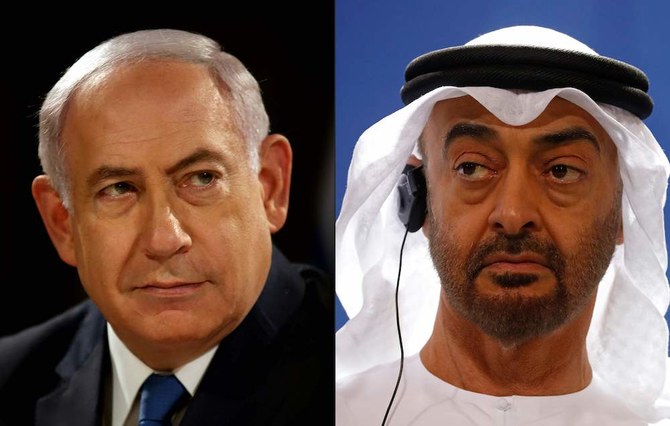

JERUSALEM: World leaders on Friday voiced hope that a historic deal between the UAE and Israel could kick-start moribund Middle East peace talks, even as the Palestinians and some of their allies denounced the move to normalize ties as a betrayal of their cause.
Announced by US President Donald Trump on Thursday, it is only the third such accord Israel has struck with an Arab country, and raised the prospect of similar deals with other states.
The deal sees Israel pledge to suspend its planned annexation of Palestinian lands, a concession welcomed by European and some pro-Western Arab governments as a boost for hopes of peace.
Bahrain and Oman welcomed the deal, and Egypt, which signed 1979 peace treaty with Israel, praised a deal that would scrap annexation.
Thanking them, Netanyahu said the “peace treaty” with the UAE was “expanding the circle of peace.”
Jordan, which borders the West Bank and Israel, said the outcome of the agreement would depend on Israel's actions, including its stance on a two-state solution with the Palestinians.
Opinion
This section contains relevant reference points, placed in (Opinion field)
Foreign Minister Ayman al-Safadi said: "The impact of the deal on peace efforts is linked to the actions Israel will take".
"I appreciate the efforts of the architects of this agreement for the prosperity and stability of our region," Egyptian President Abdel Fattah al-Sisi tweeted.
He added he hoped the deal to halt Israel's annexation of Palestinian land, would help bring "peace" to the Middle East.Omar Saif Ghobash, UAE assistant minister for culture and public diplomacy, said the deal was designed to “shake up” the Middle East impasse and serve his country’s interests.
“We didn’t consult with anybody, we didn’t inform anybody, and as a sovereign state we don’t feel that we have the obligation to do that,” Ghobash said.
“It’s to be expected that not everybody will ... applaud or comment,” he added.
The EU said normalization would benefit both Israel and the UAE, but foreign policy spokeswoman Nabila Massrali stressed the bloc’s commitment to a two-state solution.
“We are, of course, ready to work on the resumption of the negotiations between the Israelis and the Palestinians,” she said.France welcomed the deal, stressing the suspension of Israel's plans to annex swathes of the occupied West Bank.
"The decision... by the Israeli authorities to suspend the annexation of Palestinian territories is a positive step, which must become a definitive measure," French Foreign Minister Jean-Yves Le Drian said.
President Emmanuel Macron tweeted: "I hail the courageous decision by the United Arab Emirates and its desire to contribute the establishment of a just and lasting peace between the Israelis and Palestinians."
"China is happy to see measures that are helping to ease tensions between countries in the Middle East and promoting regional peace and stability," said foreign ministry spokesman Zhao Lijian.
"We hope relevant parties will take concrete actions to bring the Palestinian issue back to the track of dialogue and negotiation on an equal footing at an early date," Zhao said, reiterating Beijing's support for an independent Palestinian state.
Germany welcomed the "historic" deal, with Foreign Minister Heiko Maas saying normalization of ties between the two countries was "an important contribution to peace in the region."
UN chief Antonio Guterres said he hoped the deal would help realise a two-state solution.
"The secretary general (hopes) it will create an opportunity for Israeli and Palestinian leaders to re-engage in meaningful negotiations that will realize a two-state solution in line with relevant UN resolutions, international law and bilateral agreements," his spokesman said.


