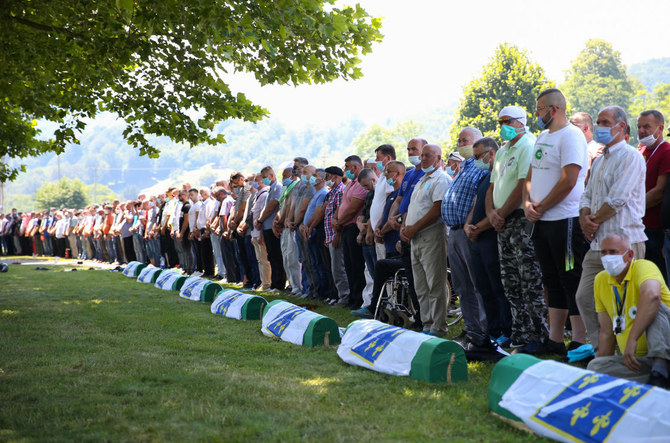
SREBRENICA: Bosnian Muslims began marking the 25th anniversary of the Srebrenica massacre on Saturday, the worst atrocity on European soil since World War II, with the memorial ceremony sharply reduced as a result of the coronavirus pandemic.
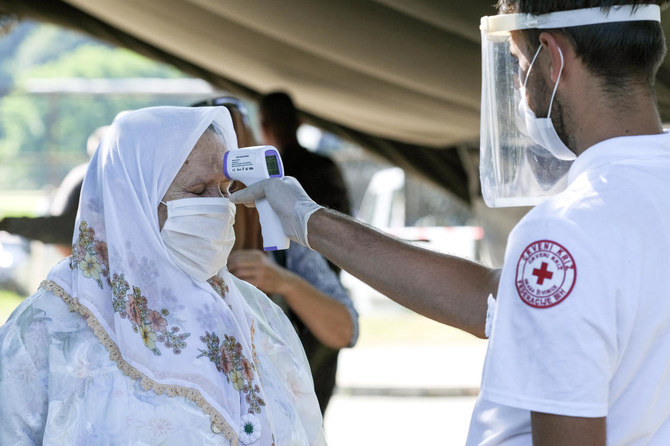
Proceedings got underway in the morning with many mourners braving the tighter restrictions put in place to stem the spread of COVID-19.
At 1100 GMT, a ceremony laying to rest the remains of nine victims identified over the past year began at the memorial cemetery in Potocari, a village just outside Srebrenica that served as the base for the UN protection force during the conflict.
On July 11, 1995, after capturing the ill-fated town, Serb forces killed more than 8,000 Muslim men and boys in Srebrenica in a few days.
Sehad Hasanovic, 27, has a two-year-old daughter — the same age he was when he lost his father in the violence.
“It’s difficult when you see someone calling their father and you don’t have one,” Hasanovic said in tears, not dissuaded from attending the commemorations in spite of the virus.
His father, Semso, “left to go into the forest and never returned. Only a few bones have been found,” said Hasanovic.
Like his brother Sefik and father Sevko, Semso was killed when Bosnian Serb troops led by Ratko Mladic entered the Srebrenica enclave before systematically massacring Bosnian men and adolescents.
“The husbands of my four sisters were killed,” said Ifeta Hasanovic, 48, whose husband Hasib was one of the nine victims whose remains have been identified since July 2019.
“My brother was killed, so was his son. My mother-in-law lost another son as well as her husband.”
The episode — labelled as genocide by two international courts — came at the end of a 1992-1995 war between Bosnia’s Croats, Muslims and Serbs that claimed some 100,000 lives.
So far, the remains of nearly 6,900 victims have been found and identified from more than 80 mass graves.
Bosnian Serb wartime military chief general Ratko Mladic, still revered as a hero by many Serbs, was sentenced to life in prison by a UN court in 2017 over war crimes including the Srebrenica genocide. He is awaiting the decision on his appeal.
Radovan Karadzic, a Bosnian Serb wartime political leader, was also sentenced to life in prison in The Hague.
The Srebrenica massacre is the only episode of the Bosnian conflict to be described as genocide by the international community.
And while for Bosnian Muslims recognizing the scale of the atrocity is a necessity for lasting peace, for most Serbs — leaders and laypeople in both Bosnia and Serbia — the use of the word genocide remains unacceptable.
In the run-up to the anniversary, Serbian President Aleksandar Vucic described Srebrenica as “something that we should not and cannot be proud of,” but he has never publicly uttered the word “genocide.”
Several thousand Serbs and Muslims live side by side in impoverished Srebrenica, a town in eastern Bosnia with just a few shops in its center.
On Friday, the town’s Serbian mayor Mladen Grujicic — who was elected in 2016 after a campaign based on genocide denial — said that “there is new evidence every day that denies the current presentation of everything that has happened.”
Bosnian Serb political leader Milorad Dodik has also described the massacre as a “myth.”
But on Friday, the Muslim member of Bosnia’s joint presidency, Sefik Dzaferovic, said: “We will tirelessly insist on the truth, on justice and on the need to try all those who have committed this crime.”
“We will fight against those who deny the genocide and glorify its perpetrators,” he said at the memorial center where he attended a collective prayer.
In order to avoid large crowds on Saturday, organizers have invited people to visit the memorial center over the whole month of July.
A number of different exhibitions are on display, including paintings by Bosnian artist Safet Zec.
Another installation, entitled “Why Aren’t You Here?” by US-Bosnian artist Aida Sehovic, comprises more than 8,000 cups of coffee spread out on the cemetery’s lawn.
“We still haven’t answered the question why they are no longer here,” she told AFP.
“How could this have happened in the heart of Europe, that people were killed in such a terrible way in a UN protected area? Not to mention the fact that the genocide is still being denied.”


![]()
![]()
![]()
![]()


Bosnia Muslims mourn their dead 25 years after Srebrenica massacre


Short Url
https://arab.news/mfzsm
Bosnia Muslims mourn their dead 25 years after Srebrenica massacre
- At 1100 GMT, a ceremony laying to rest the remains of nine victims identified over the past year began at the memorial cemetery in Potocari
- On July 11, 1995, after capturing the ill-fated town, Serb forces killed more than 8,000 Muslim men and boys in Srebrenica in a few days


Venezuelans wonder who’s in charge as Trump claims contact with Maduro’s deputy
CARACAS: Venezuelans on Saturday scrambled to understand who was in charge of their country after the US military captured President Nicolás Maduro, ousting the strongman who had outlasted a botched coup attempt, several army mutinies, mass protests and economic sanctions in the vast nation of 29 million.
“What will happen tomorrow?” asked Juan Pablo Petrone, a resident of Venezuela’s capital of Caracas. As fear gripped the city, streets quickly emptied save for long lines snaking from supermarkets and gas stations. “What will happen in the next hour?”
President Donald Trump offered a shocking answer: The United States would take control of Venezuela, perhaps in coordination with one of Maduro’s most trusted aides.
Delcy Rodríguez, who is next in the presidential line of succession, served as Maduro’s vice president since 2018, overseeing much of Venezuela’s oil-dependent economy as well as its feared intelligence service. On Saturday, Venezuela’s high court ordered her to assume the role of interim president.
“She’s essentially willing to do what we think is necessary to make Venezuela great again,” Trump told reporters of Rodríguez, who faced US sanctions during Trump’s first administration for her role in undermining Venezuelan democracy.
In a major snub, Trump said opposition leader Maria Corina Machado, who was awarded last year’s Nobel Peace Prize, didn’t have the support to run the country.
Trump said Rodríguez had a long conversation with US Secretary of State Marco Rubio in which Trump claimed she said, “‘We’ll do whatever you need.’”
“I think she was quite gracious,” Trump added. “We can’t take a chance that somebody else takes over Venezuela that doesn’t have the good of the Venezuelan people in mind.”
Senior officials remain in place
Key Venezuelan officials appeared to have survived the military operation and held onto their jobs, at least for now. There was no immediate sign that the US was running Venezuela.
Rodríguez tried to project strength and unity among the ruling party’s many factions, downplaying any hint of betrayal. In remarks on state television before the court decision, she demanded the immediate release of Maduro and his wife, Cilia Flores, and denounced the US operation as a flagrant violation of the United Nations charter.
“There is only one president in this country, and his name is Nicolás Maduro,” Rodríguez said, surrounded by top civilian officials and military commanders.
Seeking to assuage the jittery public, Venezuelan military officials struck a defiant tone in video messages, lashing out at Trump and vowing to stand up to US pressure.
“They have attacked us but will not break us,” said Defense Minister Gen. Vladimir Padrino López, dressed in fatigues.
Interior Minister Diosdado Cabello, among Maduro’s top enforcers, urged Venezuelans to “get out on the streets” to defend the country’s sovereignty.
“These rats attacked and they will regret what they did,” he said of the US
Some Venezuelans heeded his call, rallying in support of the government and burning American flags in scattered gatherings across Caracas on Saturday.
But most people stayed inside out of fear.
“What’s happening is unprecedented,” said Yanire Lucas, another Caracas resident, picking up pieces of glass from an explosion at a nearby military base that blew out the windows of her house.
“We’re still on edge, and now we’re unsure what to do.”
No sign of a political transition
Trump indicated that Rodríguez had been sworn in already as president of Venezuela, per the transfer of power outlined in the constitution.
But state TV did not broadcast any swearing-in ceremony.
During Rodríguez’s televised speech, a ticker at the bottom of the screen identified her as the vice president. She gave no sign that she would be cooperating with the US, and did not immediately respond to a request for comment.
“What is being done to Venezuela is an atrocity that violates international law,” she said in her address. “History and justice will make the extremists who promoted this armed aggression pay.”
The Venezuelan constitution also says a new election must be called within a month in the event of the president’s absence. But experts have been debating whether the succession scenario would apply here, given the government’s lack of popular legitimacy and the extraordinary US military intervention.
Strong ties with Wall Street
A lawyer educated in Britain and France, Rodríguez has a long history of representing the revolution started by the late Hugo Chávez on the world stage.
She and her brother, Jorge Rodríguez, head of the Maduro-controlled National Assembly, have sterling leftist credentials born from tragedy. Their father was a socialist leader who died in police custody in the 1970s, a crime that shook many activists of the era, including a young Maduro.
Unlike many in Maduro’s inner circle, the Rodríguez siblings have avoided criminal indictment in the US
Delcy Rodríguez developed strong ties with Republicans in the oil industry and on Wall Street who balked at the notion of US-led regime change.
Among her past interlocutors were Blackwater founder Erik Prince and, more recently, Richard Grenell, a Trump special envoy who tried to negotiate a deal with Maduro for greater US influence in Venezuela.
Internal tensions could erupt
Fluent in English, Rodríguez is sometimes portrayed as a well-educated, market-friendly moderate in contrast to the military hard-liners who took up arms with Chávez against Venezuela’s democratically elected president in the 1990s.
Many of them, especially Cabello, are wanted in the US on drug trafficking charges and stand accused of serious human rights abuses. But they continue to hold sway over the armed forces, the traditional arbiter of political disputes in Venezuela.
That presents major challenges to Rodríguez asserting authority. But some analysts said they expected Venezuela’s power brokers to close ranks, as they’ve done before.
“These leaders have all seen the value of staying united. Cabello has always taken a second seat or third seat, knowing that his fate is tied up with Maduro’s, and now he very well might do that again,” said David Smilde, a sociology professor at Tulane University who has studied Venezuela’s political dynamics over the past three decades.
Much depends on the state of Venezuela’s military after the US bombing raid, Smilde added. “If it doesn’t have much firepower anymore, they’re more vulnerable and diminished.”
An snub of the opposition
Shortly before Trump’s press conference, Machado, the opposition leader, called on her ally Edmundo González — a retired diplomat widely considered to have won the country’s disputed 2024 presidential election — to “immediately assume his constitutional mandate and be recognized as commander-in-chief.”
In a triumphant statement, Machado promised that her movement would “restore order, free political prisoners, build an exceptional country and bring our children back home.”
She added: “Today we are prepared to assert our mandate and take power.”
Trump seemed to throw cold water on those plans.
Asked about Machado, Trump was blunt: “I think it would be very tough for (Machado) to be the leader,” he said, shocking many Venezuelan viewers who expected Trump’s talk of liberation to mean a swift democratic transition.
“She doesn’t have the support or respect within the country.”
Machado has not responded to Trump’s remarks.
“What will happen tomorrow?” asked Juan Pablo Petrone, a resident of Venezuela’s capital of Caracas. As fear gripped the city, streets quickly emptied save for long lines snaking from supermarkets and gas stations. “What will happen in the next hour?”
President Donald Trump offered a shocking answer: The United States would take control of Venezuela, perhaps in coordination with one of Maduro’s most trusted aides.
Delcy Rodríguez, who is next in the presidential line of succession, served as Maduro’s vice president since 2018, overseeing much of Venezuela’s oil-dependent economy as well as its feared intelligence service. On Saturday, Venezuela’s high court ordered her to assume the role of interim president.
“She’s essentially willing to do what we think is necessary to make Venezuela great again,” Trump told reporters of Rodríguez, who faced US sanctions during Trump’s first administration for her role in undermining Venezuelan democracy.
In a major snub, Trump said opposition leader Maria Corina Machado, who was awarded last year’s Nobel Peace Prize, didn’t have the support to run the country.
Trump said Rodríguez had a long conversation with US Secretary of State Marco Rubio in which Trump claimed she said, “‘We’ll do whatever you need.’”
“I think she was quite gracious,” Trump added. “We can’t take a chance that somebody else takes over Venezuela that doesn’t have the good of the Venezuelan people in mind.”
Senior officials remain in place
Key Venezuelan officials appeared to have survived the military operation and held onto their jobs, at least for now. There was no immediate sign that the US was running Venezuela.
Rodríguez tried to project strength and unity among the ruling party’s many factions, downplaying any hint of betrayal. In remarks on state television before the court decision, she demanded the immediate release of Maduro and his wife, Cilia Flores, and denounced the US operation as a flagrant violation of the United Nations charter.
“There is only one president in this country, and his name is Nicolás Maduro,” Rodríguez said, surrounded by top civilian officials and military commanders.
Seeking to assuage the jittery public, Venezuelan military officials struck a defiant tone in video messages, lashing out at Trump and vowing to stand up to US pressure.
“They have attacked us but will not break us,” said Defense Minister Gen. Vladimir Padrino López, dressed in fatigues.
Interior Minister Diosdado Cabello, among Maduro’s top enforcers, urged Venezuelans to “get out on the streets” to defend the country’s sovereignty.
“These rats attacked and they will regret what they did,” he said of the US
Some Venezuelans heeded his call, rallying in support of the government and burning American flags in scattered gatherings across Caracas on Saturday.
But most people stayed inside out of fear.
“What’s happening is unprecedented,” said Yanire Lucas, another Caracas resident, picking up pieces of glass from an explosion at a nearby military base that blew out the windows of her house.
“We’re still on edge, and now we’re unsure what to do.”
No sign of a political transition
Trump indicated that Rodríguez had been sworn in already as president of Venezuela, per the transfer of power outlined in the constitution.
But state TV did not broadcast any swearing-in ceremony.
During Rodríguez’s televised speech, a ticker at the bottom of the screen identified her as the vice president. She gave no sign that she would be cooperating with the US, and did not immediately respond to a request for comment.
“What is being done to Venezuela is an atrocity that violates international law,” she said in her address. “History and justice will make the extremists who promoted this armed aggression pay.”
The Venezuelan constitution also says a new election must be called within a month in the event of the president’s absence. But experts have been debating whether the succession scenario would apply here, given the government’s lack of popular legitimacy and the extraordinary US military intervention.
Strong ties with Wall Street
A lawyer educated in Britain and France, Rodríguez has a long history of representing the revolution started by the late Hugo Chávez on the world stage.
She and her brother, Jorge Rodríguez, head of the Maduro-controlled National Assembly, have sterling leftist credentials born from tragedy. Their father was a socialist leader who died in police custody in the 1970s, a crime that shook many activists of the era, including a young Maduro.
Unlike many in Maduro’s inner circle, the Rodríguez siblings have avoided criminal indictment in the US
Delcy Rodríguez developed strong ties with Republicans in the oil industry and on Wall Street who balked at the notion of US-led regime change.
Among her past interlocutors were Blackwater founder Erik Prince and, more recently, Richard Grenell, a Trump special envoy who tried to negotiate a deal with Maduro for greater US influence in Venezuela.
Internal tensions could erupt
Fluent in English, Rodríguez is sometimes portrayed as a well-educated, market-friendly moderate in contrast to the military hard-liners who took up arms with Chávez against Venezuela’s democratically elected president in the 1990s.
Many of them, especially Cabello, are wanted in the US on drug trafficking charges and stand accused of serious human rights abuses. But they continue to hold sway over the armed forces, the traditional arbiter of political disputes in Venezuela.
That presents major challenges to Rodríguez asserting authority. But some analysts said they expected Venezuela’s power brokers to close ranks, as they’ve done before.
“These leaders have all seen the value of staying united. Cabello has always taken a second seat or third seat, knowing that his fate is tied up with Maduro’s, and now he very well might do that again,” said David Smilde, a sociology professor at Tulane University who has studied Venezuela’s political dynamics over the past three decades.
Much depends on the state of Venezuela’s military after the US bombing raid, Smilde added. “If it doesn’t have much firepower anymore, they’re more vulnerable and diminished.”
An snub of the opposition
Shortly before Trump’s press conference, Machado, the opposition leader, called on her ally Edmundo González — a retired diplomat widely considered to have won the country’s disputed 2024 presidential election — to “immediately assume his constitutional mandate and be recognized as commander-in-chief.”
In a triumphant statement, Machado promised that her movement would “restore order, free political prisoners, build an exceptional country and bring our children back home.”
She added: “Today we are prepared to assert our mandate and take power.”
Trump seemed to throw cold water on those plans.
Asked about Machado, Trump was blunt: “I think it would be very tough for (Machado) to be the leader,” he said, shocking many Venezuelan viewers who expected Trump’s talk of liberation to mean a swift democratic transition.
“She doesn’t have the support or respect within the country.”
Machado has not responded to Trump’s remarks.
Latest updates


© 2026 SAUDI RESEARCH & PUBLISHING COMPANY, All Rights Reserved And subject to Terms of Use Agreement.