China, Pakistan term bilateral partnership ‘vital for peace, stability’ in region 

1 / 2
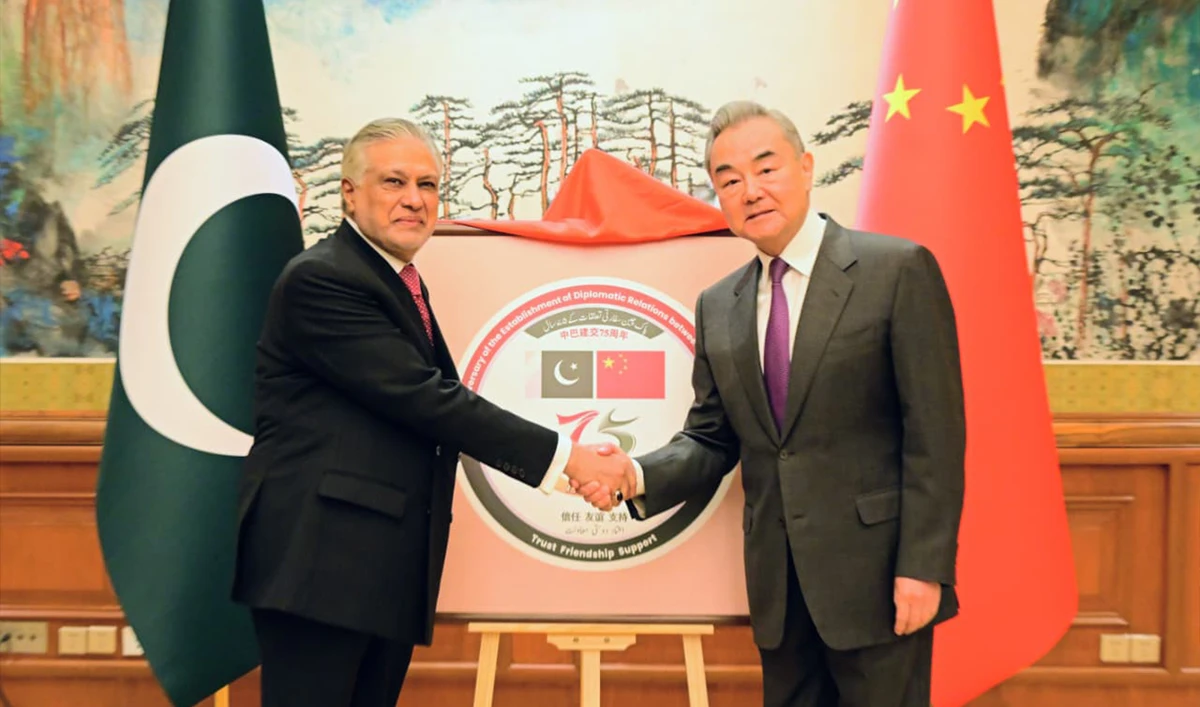
Pakistani Foreign Minister Ishaq Dar shakes hands with his Chinese counterpart Wang Yi upon jointly unveiling the logo for the 75th anniversary of Pakistan-China diplomatic relations, in Beijing on January 3, 2026. (@ForeignOfficePk/X)
2 / 2
Pakistan Deputy Prime Minister Ishaq Dar (left) meets China's Special Representative on Afghanistan Ambassador Yue Xiaoyong in Beijing on January 3, 2026. (@ForeignOfficePk/X)
Short Url
Updated 04 January 2026
Follow

China, Pakistan term bilateral partnership ‘vital for peace, stability’ in region 

  • While Beijing maintains close ties with Islamabad, it has a recurring border dispute with India, which US sees as a counterbalance to China
  • Pakistani, Chinese FMs review entire spectrum of bilateral ties, vow deeper trade and multilateral cooperation at Beijing strategic dialogue

ISLAMABAD: China and Pakistan on Sunday described their bilateral partnership as “vital for peace and stability” in the region as top officials from both sides reviewed the full spectrum of ties and pledged to deepen cooperation, amid evolving regional and global challenges.

The remarks came during the latest round of the Pakistan–China Foreign Ministers’ Strategic Dialogue in Beijing, co-chaired by Pakistani Foreign Minister Ishaq Dar and his Chinese counterpart Wang Yi, at which the two sides discussed political, economic and security cooperation, and reaffirmed mutual support on core interests.

While Beijing maintains close defense, diplomatic and economic ties with Islamabad, it has a recurring border dispute with New Delhi, which Washington and allies have long viewed as a counterbalance to China. A rising military superpower, China hasn’t fought a major war in over four decades but has raced under President Xi Jinping to modernize its armed forces, develop sophisticated weaponry and cutting-edge technologies, extending that modernization drive to Pakistan.

During the 7th round of Pakistan–China Foreign Ministers’ Strategic Dialogue in Beijing, the two sides reviewed the entire spectrum of Pakistan–China relations and discussed key issues at the regional and global levels. 

“Views were exchanged on CPEC [China-Pakistan Economic Corridor], trade, multilateral cooperation, and people-to-people exchanges,” the Pakistani foreign office said in a statement.

“Highlighting the salience of the All-Weather Strategic Cooperative Partnership, both leaders reaffirmed that the Pakistan–China friendship is vital for peace, stability, and prosperity in the region and for the two countries.”

The development comes months after Pakistan declared victory in a four-day military conflict with India, saying its air force used Chinese J-10C aircraft to shoot down six Indian fighter jets, including three French Rafales. Though Indian officials have acknowledged losses, they have not specified the number of jets downed by Pakistan in May.

Over the past five years, China has supplied 81 percent of Pakistan’s imported weapons, according to data from the Stockholm International Peace Research Institute (SIPRI). Those exports include advanced fighter jets, missiles, radars and air-defense systems. Some Pakistan-made weapons have also been co-developed with Chinese firms or built with Chinese technology and expertise.

Both foreign ministers agreed to enhance coordination at bilateral and multilateral fora as well as to befittingly celebrate the 75th anniversary of the establishment of Pakistan–China diplomatic relations.

China is Pakistan’s largest trading partner. According to China’s General Administration of Customs, its bilateral trade with Pakistan reached $23.06 billion in 2024, up by 11.1 percent on a year-on-year basis. Islamabad also views Beijing as a key investment partner which has funneled billions of dollars into the country under the CPEC energy and infrastructure project for over a decade.

The Foreign Ministers’ Strategic Dialogue is the highest consultative mechanism between Pakistan and China, providing a structured platform to review the entire spectrum of bilateral cooperation, as well as regional and international developments of mutual interest.

Earlier during his visit to Beijing, Dar met Liu Haixing, the Chinese Minister of the International Department of the Communist Party of China.

“The two sides expressed satisfaction with the steady and forward-looking trajectory of bilateral relations, while reviewing party-to-party exchanges, regional developments, and progress on various projects under CPEC,” the foreign office said in a statement.

The Pakistani deputy premier also met China’s Executive Vice Premier Ding Xuexiang, according to the statement. The Chinese official appreciated Pakistan’s consistent support to Beijing on issues of core interest.
Four militants, three paramilitary personnel killed in Pakistan's restive northwest

Updated 9 sec ago
Follow

Four militants, three paramilitary personnel killed in Pakistan's restive northwest

  • The troops were killed when militants targeted an ambulance transporting them after a quadcopter attack on a paramilitary camp in Karak
  • Pakistan is witnessing a surge in militancy in its western regions, which last week prompted Islamabad to conduct airstrikes in Afghanistan

ISLAMABAD: Four militants and three paramilitary personnel were killed in separate incidents in Pakistan's northwestern Khyber Pakhtunkhwa (KP) province, authorities said on Monday, amid a surge in militancy in the region bordering Afghanistan.

Security forces conducted an intelligence-based operation in KP's Dera Ismail Khan district on reports about militant presence, according to the Inter-Services Public Relations (ISPR), the military's media wing.

An intense exchange of fire followed between the two sides and four Pakistani Taliban militants were killed during the operation.

“Weapons and ammunition were also recovered from Indian sponsored killed Khwarij (Pakistani Taliban militants), who remained actively involved in numerous terrorist activities in the area,” the ISPR said.

“Sanitization operation is being conducted to eliminate any other Indian-sponsored kharji found in the area.”

New Delhi did not immediately respond to the Pakistani military's statement.

In the second incident, militants gunned down three personnel of the Federal Constabulary (FC) paramilitary force after a quadcopter attack on an FC camp in KP's Karak district, a police official said on Monday.

The explosive-laden quadcopter struck the FC camp in the Bahadur Khel area early Monday morning and injured seven FC troops, according to Karak police spokesperson Shaukat Khan.

Three FC personnel were killed when militants attacked a Rescue 1122 ambulance which was transporting the injured troops to a hospital following the attack.

“With this incident, the total number of FC personnel martyred has risen to three, while five others, including a member of the rescue team, were injured,” Khan told Arab News.

“A search operation is currently underway to trace those responsible.”

No group immediately claimed responsibility for the attack, but Pakistani officials have said in the past that armed groups, particularly the Pakistani Taliban, have been increasingly using commercial drones modified to drop explosives, alongside other weapons they say were acquired after the US military withdrawal from neighboring Afghanistan.

Pakistan is witnessing a surge in militancy in its northwestern KP and southwestern Balochistan provinces that border Afghanistan. Islamabad accuses Afghanistan of allowing the use of its soil and India of backing militant groups for cross-border attacks against Pakistan. Kabul and New Delhi deny this.

On Sunday, Pakistani security forces killed five militants, including a suicide bomber, during an intelligence-based operation in the country’s southwestern Balochistan province, the military’s media wing said. The operation took place in Balochistan’s Pishin district after security forces received reports about the presence of Pakistani Taliban militants.

The Pakistani Taliban, or the Tehreek-e-Taliban Pakistan (TTP), have carried out some of the deadliest attacks against civilians and law enforcement agencies in Pakistan since 2007 in their bid to impose their own brand of Islamic law in the country.

Pakistan also carried out intelligence-based strikes on alleged militant camps and hideouts in Afghanistan’s Nangarhar, Paktika and Khost provinces on Saturday, a security official said. The official said more than 80 militants were killed in the attacks, a claim denied by the Afghan Taliban who said Islamabad killed and wounded dozens of civilians in the strikes.

The strikes have increased tensions between the neighbors, with Afghanistan warning it will retaliate at a “suitable time.”