

Muslim World League Secretary-General Al-Issa calls for lessons of Srebrenica to be learnt

1 / 3
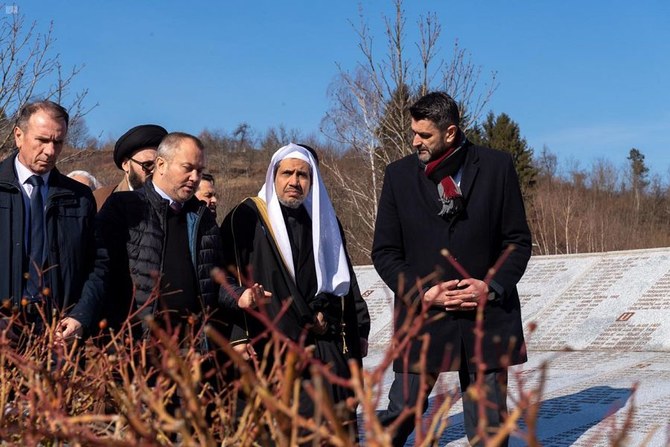
Dr. Mohammed bin Abdul Karim Al-Issa led a delegation of Muslim scholars and other religious leaders to the town of Srebrenica. (SPA)
2 / 3
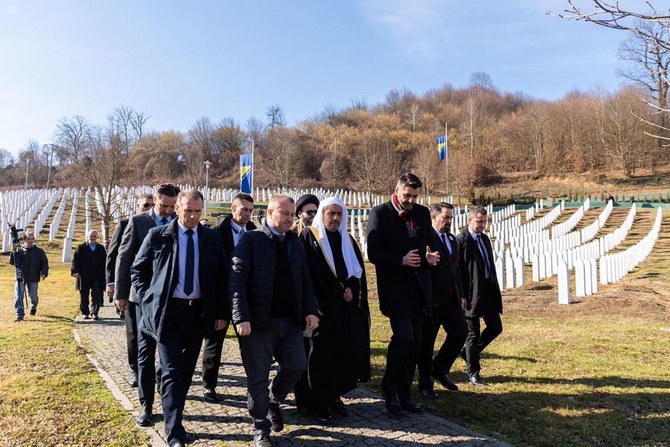
Dr. Mohammed bin Abdul Karim Al-Issa led a delegation of Muslim scholars and other religious leaders to the town of Srebrenica. (SPA)
3 / 3
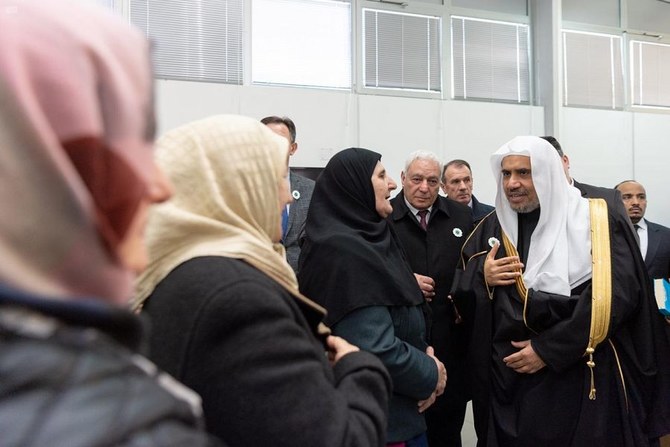
Dr. Mohammed bin Abdul Karim Al-Issa led a delegation of Muslim scholars and other religious leaders to the town of Srebrenica. (SPA)
Short Url
Updated 10 February 2020
Follow

Muslim World League Secretary-General Al-Issa calls for lessons of Srebrenica to be learnt

  • Dr. Mohammed bin Abdul Karim Al-Issa: The Srebrenica Museum should be a center radiating peace, where one can learn from the past
  • The Srebrenica massacre, carried out by Serbian forces, claimed the lives of 8,372 men and boys in July 1995

SREBRENICA: Dr. Mohammed bin Abdul Karim Al-Issa, secretary-general of the Muslim World League (MWL) and president of the Association of Muslim Scholars, led a delegation of Muslim scholars and other religious leaders to the town of Srebrenica, the site of a massacre in Bosnia and Herzegovina, where Muslims were subjected to a genocide in the 1990s.

Al-Issa stressed that all members of the delegation condemned the dreadful crimes that took place in the town. 

“The Srebrenica Museum should be a center radiating peace, where one can learn from the past. The women who lost their husbands and children in that massacre told me that they’ve known great sorrow, but they do not bear hatred,” he said.

“We are certain that this duty of solidarity, which gathered leading Muslim scholars, thinkers and academics with many other religious leaders to visit the massacre sites in Bosnia, Herzegovina and Poland, reflects a form of brotherhood and a just attitude towards these horrific crimes,” he added.

The Srebrenica massacre claimed the lives of 8,372 men and boys in July 1995. It was carried out by Serbian forces, and the wider conflict led to the displacement of thousands of Muslims from the region. Historians consider the massacre among the most horrific war crimes on the European continent since the Second World War.



Children’s Theater Festival opens in Qassim region

Updated 27 January 2026
Follow

Children’s Theater Festival opens in Qassim region

  • To develop future ‘cultural architects,’ says CEO Khaled Al-Baz
  • ‘Nurture creativity, aesthetic awareness and sense of belonging’

BURAIDAH: The Qassim Children’s Theater Festival opened on Tuesday bringing together professionals from across Saudi Arabia and the Gulf.

The event is being held under the patronage of Prince Dr. Faisal bin Mishaal bin Saud bin Abdulaziz, governor of Qassim, at the Science Center in Unaizah governorate.

It has been Organized by the Theater and Performing Arts Association and executed by the Unaizah Theater Association, the Saudi Press Agency reported.

Running until Jan. 31, it features shows, panel discussions, as well as training workshops to develop children’s theater and strengthen professional skills in the field.

Khaled Al-Baz, CEO of the Theater and Performing Arts Association, told the SPA the festival forms part of a broader strategy to position children’s theater as a distinct cultural sector.

“Children today constitute genuine audiences — tomorrow’s cultural architects,” Al-Baz said.

Ahmed Al-Humaimidi, president of the Unaizah Theater Association, said it was an investment in young people, noting that it extends beyond performances to include cultural and educational programming.

He said the initiative aims to nurture creativity, aesthetic awareness and a sense of belonging, while also identifying emerging talent and encouraging knowledge exchange among theater practitioners.

“Our association recognizes children’s theater as foundational to cultivating aware, creative character,” he said.

The festival serves as both an artistic showcase and a platform for professional dialogue, reflecting the Kingdom’s expanding cultural landscape and growing focus on children’s theater as an educational and cultural tool, the SPA noted.

This occurs alongside support for signature initiatives and performing arts promotion as quality-of-life enhancement.