MANILA: Philippine authorities are investigating the deaths of four soldiers shot by police in the country’s restive south, with the defense minister vowing Thursday to “get to the bottom” of the incident.
The plainclothes soldiers were in pursuit of “bomb makers and suicide bombers” from the Abu Sayyaf militant group when they were attacked by police in the Muslim-majority province of Sulu on Monday, the army has said.
Army chief Gilbert Gapay has accused the nine officers involved of murdering the men, while Philippine National Police has described the shooting as a “misencounter.”
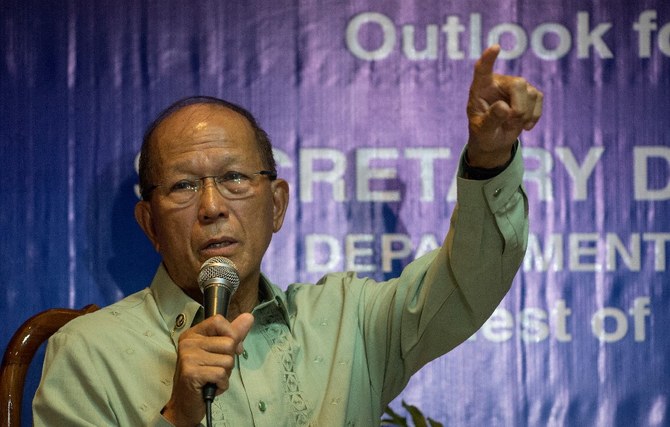
Defense Secretary Delfin Lorenzana said the shootings were “a very unfortunate incident,” adding that the dead soldiers “were just doing their jobs.”
“We don’t want this to escalate. We will get to the bottom of this,” he said.
The country’s National Bureau of Investigation was probing the incident, and Lorenzana said the findings should be released soon.
The army has accused the police of firing on the soldiers even after they identified themselves as members of the military.
The officers have been detained while the investigation is under way, said Interior Secretary Eduardo Ano.
President Rodrigo Duterte will visit police and military commanders in the south, his spokesman Harry Roque said, without specifying when.
Abu Sayyaf is based in the south and has engaged in bombings as well as kidnappings of Western tourists and missionaries for ransom since the early 1990s.
They also have ties to Daesh militants seeking to set up a caliphate in Southeast Asia.

Philippines probes deadly police shooting of soldiers
https://arab.news/b4938
Philippines probes deadly police shooting of soldiers
- Plainclothes soldiers were in pursuit of ‘bomb makers and suicide bombers’ from the Abu Sayyaf militant group
Southeast Asian countries repatriate nationals from Cambodia as thousands flee scam centers
- Almost 2,800 Indonesians have sought consular support to return home since mid-January
- Malaysia, Philippines also repatriate citizens after Cambodian PM orders crackdown on crime networks
Southeast Asian countries are repatriating their nationals from Cambodia, as thousands are estimated to have fled scam compounds over recent weeks following Phnom Penh’s pledge for a fresh crackdown on the multibillion-dollar industry.
Scam centers have flourished in parts of Southeast Asia in recent years, with hundreds of thousands of people lured to work in illicit operations in countries like Cambodia and Myanmar, according to a 2023 report by the UN Office of the High Commissioner for Human Rights.
A wave of foreign nationals who were either released or have escaped from scam compounds across Cambodia since mid-January have returned to their home countries in the past week after seeking consular support from their respective embassies, officials said.
“The number of Indonesians formerly involved with online scam syndicates who are reporting to the Indonesian Embassy in Phnom Penh continues to increase. Since Jan. 16 to Jan. 30, we have recorded 2,795 Indonesian nationals,” the Indonesian Embassy in Phnom Penh said in a statement on Saturday.
At least 36 Indonesian nationals were repatriated on Friday, while another 30 are scheduled to return to Indonesia over the weekend.
Malaysia has also “rescued and repatriated” 29 Malaysians from Cambodia who were “victims of an online syndicate,” its embassy in Phnom Penh said earlier this week, while the Philippines repatriated 13 Filipinos identified as human trafficking victims last Sunday, the Department of Migrant Workers in Manila said in a statement.
Human rights organization Amnesty International estimated that thousands of people have been released or escaped from at least 17 scamming compounds across Cambodia in recent weeks, with interviews indicating that some were “subjected to grave abuses including rape and torture.”
The survivors are also from countries beyond the region, including Brazil, Nigeria, and Bangladesh, Amnesty said, as it called out the Cambodian government for ignoring the growing humanitarian crisis.
“This mass exodus from scamming compounds has created a humanitarian crisis on the streets that is being ignored by the Cambodian government. Amid scenes of chaos and suffering, thousands of traumatized survivors are being left to fend for themselves with no state support,” said Montse Ferrer, Amnesty International’s regional research director.
“This is an international crisis on Cambodian soil. Our researchers have met people from Asia, Africa, Europe, and the Americas. They are in urgent need of consular assistance in order to help get them home and out of harm’s way.”
The latest development comes after Cambodian Prime Minister Hun Manet ordered authorities to step up efforts to eradicate online scam networks in the country, a directive that was followed with the arrest of several key figures.
Among those arrested was Chen Zhi, a Chinese-born Cambodian tycoon, who was extradited to China earlier this month.
Chen was sanctioned by the UK and the US in October last year, with the US Department of Treasury accusing him of running “a transnational criminal empire through online investment scams targeting Americans and others worldwide.”
The Global Anti-Scam Alliance estimates that $442 billion was lost to scammers in 2025.