JOLO, Philippines: A Philippine official says an Abu Sayyaf commander aligned with the Daesh group most likely plotted the suicide attacks on an army camp in the volatile south by two militants, whose identities remain unknown.
Interior Secretary Eduardo Ano cited intelligence Saturday as showing Hajjan Sawadjaan most likely harbored the two suicide bombers and plotted Friday’s attack in an army camp that killed three soldiers, two civilians and themselves. The military says 22 other soldiers and civilians were wounded.
Sawadjaan is based in the jungles of southern Sulu province.
The Daesh group said in a statement two of its fighters carried the attack with explosive belts but overstated the military casualties at about 100.
Ano said it remains unclear if the non-Arabic male attackers were Filipinos or foreigners.

Philippines: Abu Sayyaf chief likely plotted suicide attacks
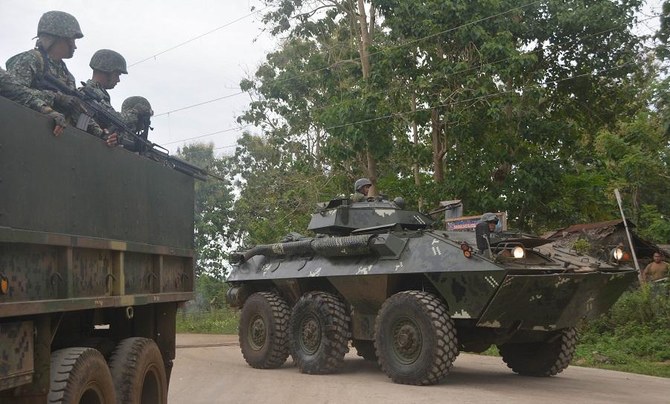
- An official said Hajjan Sawadjaan most likely harbored the two suicide bombers and plotted Friday’s attack
- The Daesh group said in a statement two of its fighters carried the attack with explosive belts
Irish farmers protest EU’s Mercosur free trade deal
- The demonstration, large by Irish standards, followed similar protests in Poland, France, and Belgium on Friday
ATHLONE, Ireland: Thousands of Irish farmers, many of whom traveled across the country on tractors, protested on Saturday against the EU’s Mercosur trade deal after a majority of EU states gave a provisional go-ahead for its largest-ever free-trade accord.
Opponents led by France, the EU’s largest agricultural producer, failed to convince enough fellow member states that the deal with South American nations would flood the market with cheap food products and undercut domestic farmers.
Under pressure from opposition parties, farming groups, and members of its own coalition, the Irish government argued that the deal lacks safeguards for what it says are weaker food safety standards in South America.
BACKGROUND
The demonstration, large by Irish standards, followed similar protests in Poland, France, and Belgium on Friday.
“It’s an absolute disgrace on behalf of the farmers and people that have put Europe where it is today,” said Joe Keogh, a farmer from the central village of Multyfarnham at the protest in the nearby town of Athlone.
“It’s going to close down the whole countryside.”
Protesters held placards reading “Don’t sacrifice family farms for German cars,” “Our cows follow the rules, why don’t theirs,” and “Sell out.”
The demonstration, large by Irish standards, followed similar protests in Poland, France, and Belgium on Friday.
While Ireland is a small exporting nation seeking to diversify beyond its reliance on the US market, it has large beef and dairy industries that are major employers.
Opponents of the deal have secured some concessions and compensation for EU farmers.
The European Parliament must approve the accord
before it takes effect, and, like France, Ireland has pledged to fight its rejection in what could be a tight vote.
“The Irish farmer is at great risk as it is. We’re a small country, we don’t have large farmers and farmers struggle to make an income from the farm as it is,” said Niamh O’Brien, a farmer who traveled from the western town of Athenry.
“But also it’s about the quality of the food we are eating. It has severe implications for both the farmer and the consumer.”


