

Southeast Asian countries repatriate nationals from Cambodia as thousands flee scam centers

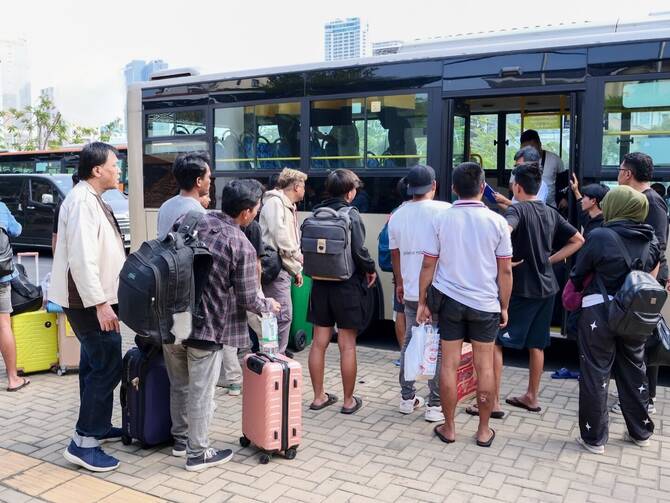
Indonesian nationals wait their turn to board a bus facilitated by Indonesian authorities in Phnom Penh in this photo released on Jan. 25, 2026. (Indonesian Embassy in Phnom Penh)
Short Url
Updated 31 January 2026
Follow

Southeast Asian countries repatriate nationals from Cambodia as thousands flee scam centers

  • Almost 2,800 Indonesians have sought consular support to return home since mid-January
  • Malaysia, Philippines also repatriate citizens after Cambodian PM orders crackdown on crime networks

Southeast Asian countries are repatriating their nationals from Cambodia, as thousands are estimated to have fled scam compounds over recent weeks following Phnom Penh’s pledge for a fresh crackdown on the multibillion-dollar industry.

Scam centers have flourished in parts of Southeast Asia in recent years, with hundreds of thousands of people lured to work in illicit operations in countries like Cambodia and Myanmar, according to a 2023 report by the UN Office of the High Commissioner for Human Rights.

A wave of foreign nationals who were either released or have escaped from scam compounds across Cambodia since mid-January have returned to their home countries in the past week after seeking consular support from their respective embassies, officials said.

“The number of Indonesians formerly involved with online scam syndicates who are reporting to the Indonesian Embassy in Phnom Penh continues to increase. Since Jan. 16 to Jan. 30, we have recorded 2,795 Indonesian nationals,” the Indonesian Embassy in Phnom Penh said in a statement on Saturday.

At least 36 Indonesian nationals were repatriated on Friday, while another 30 are scheduled to return to Indonesia over the weekend.

Malaysia has also “rescued and repatriated” 29 Malaysians from Cambodia who were “victims of an online syndicate,” its embassy in Phnom Penh said earlier this week, while the Philippines repatriated 13 Filipinos identified as human trafficking victims last Sunday, the Department of Migrant Workers in Manila said in a statement.

Human rights organization Amnesty International estimated that thousands of people have been released or escaped from at least 17 scamming compounds across Cambodia in recent weeks, with interviews indicating that some were “subjected to grave abuses including rape and torture.”

The survivors are also from countries beyond the region, including Brazil, Nigeria, and Bangladesh, Amnesty said, as it called out the Cambodian government for ignoring the growing humanitarian crisis.

“This mass exodus from scamming compounds has created a humanitarian crisis on the streets that is being ignored by the Cambodian government. Amid scenes of chaos and suffering, thousands of traumatized survivors are being left to fend for themselves with no state support,” said Montse Ferrer, Amnesty International’s regional research director.

“This is an international crisis on Cambodian soil. Our researchers have met people from Asia, Africa, Europe, and the Americas. They are in urgent need of consular assistance in order to help get them home and out of harm’s way.”

The latest development comes after Cambodian Prime Minister Hun Manet ordered authorities to step up efforts to eradicate online scam networks in the country, a directive that was followed with the arrest of several key figures.

Among those arrested was Chen Zhi, a Chinese-born Cambodian tycoon, who was extradited to China earlier this month.

Chen was sanctioned by the UK and the US in October last year, with the US Department of Treasury accusing him of running “a transnational criminal empire through online investment scams targeting Americans and others worldwide.”

The Global Anti-Scam Alliance estimates that $442 billion was lost to scammers in 2025.


US allows oil majors to broadly operate in Venezuela, new energy investments

Updated 3 sec ago
Follow

US allows oil majors to broadly operate in Venezuela, new energy investments

  • Treasury Department issues general license allowing Chevron, BP, Eni, Shell and Repsol to operate oil and gas operations in Venezuela
  • Move is the most significant relaxation of sanctions on Venezuela since US forces captured and removed President Nicolas Maduro
WASHINGTON: The US ​eased sanctions on Venezuela’s energy sector on Friday, issuing two general licenses that allow global energy companies to operate oil and gas projects in the OPEC member and for other companies to negotiate contracts to bring in fresh investments. The move was the most significant relaxation of sanctions on Venezuela since US forces captured and removed President Nicolas Maduro last month.
The Treasury Department’s Office of Foreign Assets Control issued a general license allowing Chevron, BP, Eni, Shell and Repsol to operate oil and gas operations in Venezuela. Those companies still have offices in the country and stakes in projects, and are among the main partners of state-run ‌company PDVSA.
The authorization ‌for the oil majors’ operations requires payments for royalties and Venezuelan ​taxes ‌to ⁠go through ​the US-controlled ⁠Foreign Government Deposit Fund.
The other license allows companies around the world to enter contracts with PDVSA for new investments in Venezuelan oil and gas. The contracts are contingent on separate permits from OFAC.
The authorization does not allow transactions with companies in Russia, Iran, or China or entities owned or controlled by joint ventures with people in those countries.
The licenses “invite American and other aligned companies to play a constructive role in supporting economic recovery and responsible investment, ” the US State Department said in a release. Additional authorizations may be issued “as necessary,” it said.
A spokesperson for Chevron, ⁠the only US oil firm currently operating in Venezuela, said the company welcomed ‌the new licenses.
“The new General Licenses, coupled with recent changes ‌in Venezuela’s Hydrocarbons Law, are important steps toward enabling the further development ​of Venezuela’s resources for its people and for advancing ‌regional energy security,” the spokesperson said in a statement.
Eni said it is assessing the opportunities in ‌Venezuela that the authorization opens up.

Oil law reform

The US licenses follow a sweeping reform of Venezuela’s main oil law approved last month, which grants autonomy for foreign oil and gas producers to operate, export and cash sale proceeds under existing joint ventures with PDVSA or through a new production-sharing contract model.
The US has had sanctions on Venezuela since ‌2019 when President Donald Trump imposed them during his first administration. Trump is now seeking $100 billion in investments by energy companies in Venezuela’s oil and gas sector. ⁠US Energy Secretary Chris Wright ⁠said on Thursday, during his second day of a trip to Venezuela, that oil sales from the country since Maduro’s capture have hit $1 billion and would hit another $5 billion in months.
Wright said the US will control the proceeds from the sales until Venezuela stands up a “representative government.” Since last month, the Treasury issued several other general licenses to facilitate oil exports, storage, imports and sales from Venezuela. It also authorized the provision of US goods, technology, software or services for the exploration, development or production of oil and gas in Venezuela.
The Venezuelan government expropriated assets of Exxon Mobil and ConocoPhillips in 2007 under then-President Hugo Chavez. The Trump administration is trying to get those companies to invest in Venezuela as well. At a meeting at the White House with Trump last month, Exxon Mobil CEO Darren Woods said Venezuela was “uninvestable” at ​the moment.
Wright said on Thursday that Exxon, ​which no longer has an office in Venezuela, is in talks with the government there and gathering data about the oil sector. Exxon did not immediately comment.