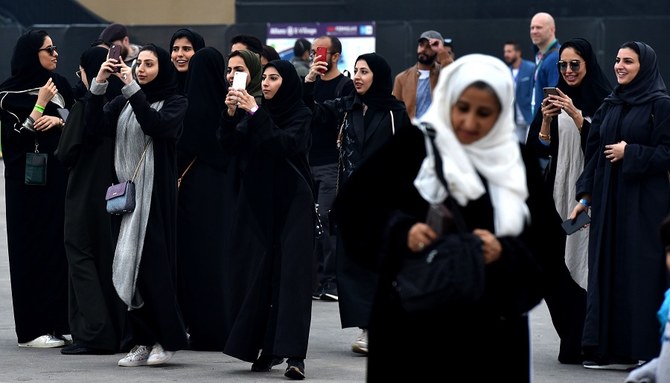

RIYADH: Not so long ago, when people thought of Saudi women all they could envision was timid females draped in black cloth from head to toe, suppressed, their rights abolished and their voices unheard.
Now, Saudi women are ambassadors, general managers, directors of private entities, government spokespersons and the list goes on. Their voices are now heard wide and clear across the world.
It is no exaggeration to say that when Mohammed bin Salman was appointed crown prince in 2017, promises were made and delivered. Women are participating in the workforce, driving on the roads and are more independent, particularly with the relaxing of the guardianship law last year. Tools such as the sexual harassment law were put in place to ensure their safety, and they found complete support from the government in facilitating their ambitions, including being appointed to high positions.
“I believe Vision 2030 supported women, both Saudis and non-Saudis, living in the Kingdom,” Basmah Al-Mayman, the UN World Tourism Organization’s regional director for the Middle East told Arab News. “More opportunities in the labor market appeared which HR departments were reluctant to appoint women for in the past.”
Al-Mayman, who assists in setting up tourism strategies, laws and development plans, noted the significance of Vision 2030 in leadership and managerial positions that have been fulfilled in some government authorities, “which were monopolized by men for a long time.”
Adding, “To be fair, both men and women are heading towards more prosperity by this ambitious economic -social strategy.”
“With Vision 2030, social acceptance, and most of all, the continuous support of the government; we’ll see a balanced leadership, in both private and public sectors, represented by both men and women. Plus, I’m very optimistic that we’ll witness, in the near future, more females in ministerial and international representations.”
------
READ MORE: Mohammed bin Salman: 3 years as Saudi Arabia’s crown prince
Neom and AlUla: A tale of two cities
------
Vision 2030 has created the opportunity to build new roles and transform older ones for women in a positive way. Dr. Maliha Hashmi, the executive director for the health and well-being sector at the mega-city project NEOM, is a leading young female health leader in the region.
“Under the visionary leadership of HRH Crown Prince Mohammad Bin Salman, Saudi Arabia has taken a giant step forward in empowering its women. While the world knows and talks about women drivers on Saudi roads, there's more to this socio-economic and cultural change than meets the eye,” Hashimi, a Harvard doctorate degree holder, told Arab News.
“Women’s talents are being highlighted in various sectors – from banking to financial to legal to health. The next wave could focus on women taking leading roles in C-suite positions and companies’ boards of directors.”
“More high-tech startups can now be owned by women. There are now female diplomats in GCC, I am super excited this has started in Saudi Arabia with Princess Reema as the first Saudi female ambassador. I am also honored to represent NEOM as one of its leading female executives. I hope this passion within me for this amazing project is contagious and is an encouragement for other young women to join, and I can serve as a great role model for them," Hashmi said.
“Taking on a position of influence in Saudi Arabia at a time when the country is forging an ambitious path is not only a source of immense honor; I feel a deep sense of responsibility to other women out there.
“My message to aspiring female leaders is to look around you. You are not alone. Use your best qualities. Find strength in each other. Look after yourselves too – your well-being is extremely important. This is especially important now during these difficult COVID times. I, like you, find it challenging. And finally, it's a marathon not a race,” Hashimi added.
Vision 2030 changed the dynamics of the Kingdom and not only opening it to the world, but also opening the world to many Saudis.
One example is Noura Al-Dossary. Orphaned at a young age and divorced with one daughter, Al-Dossary was in a predicament. Her sister and her brother-in-law helped her, but she soon realized she had to support both herself and her daughter financially.
Key Dates
-
1
The Ministry of Commerce and Investment announces that Saudi women do not need permission from a male guardian to start their own businesses.

-
2
The Ministry of Justice releases a circular to courts that would allow divorced women to automatically retain custody of their children.

-
3
The Council of Ministers approves a law making sexual harassment a crime.
-
4
Women drive for the first time on Saudi roads after a decades-long ban is lifted.

-
5
Women are allowed to travel freely without their guardians’ approval.

“Vision 2030 opened doors for me that I thought were bolted shut,” she told Arab News. Coming from a conservative background, and with limited education, she ventured into various workplaces, working at a small college. She was unsatisfied with the pay, the work atmosphere and more so the lack of insurance and benefits. That’s when an opportunity presented itself, at a 5-star hotel in the laundry department.
She was attentive to detail, eager to learn and grateful for the opportunity, “I was exposed to a different world. I met people from diverse nationalities, mixed with the opposite gender and quickly learned English on the job: something I never dreamed of.”
Al-Dossary’s workplace enrolled her in courses to not only further her career but also herself. “I felt invested in,” she said, a sentiment that many Saudi women share. “People tell me: ‘Oh, but you work in Laundry.’ But, let me tell you something: I’m proud of myself,” she said.
There are many women like Al-Dossary who have succeeded in their own right. They may not appear on headlines, but they are a vital part of society that keeps the wheel turning.
“I’m able to financially support my family, have insurance and benefits, (and I) bought a home,” said Al-Dossary. “None of this would have been possible without Vision 2030. I am independent and finally found the support I needed to realize my dreams.”