- Both sides agree to fast-track institutional mechanisms at 10th Intergovernmental Commission session in Islamabad
- Pakistan is seeking to position itself as a regional transit and trade hub linking South Asia with landlocked Central Asia
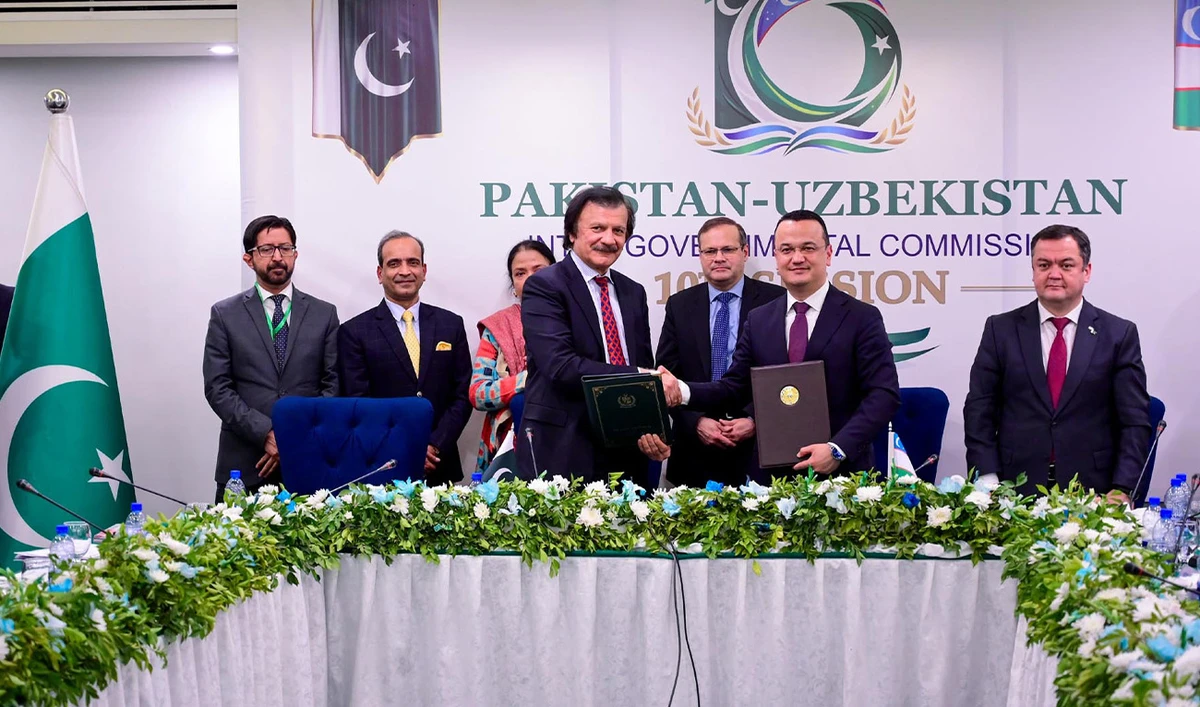
ISLAMABAD: Pakistan and Uzbekistan on Monday agreed to expedite institutional mechanisms to reach an agreed target of $2 billion in bilateral trade, as the two sides move to deepen cooperation on regional trade corridors, air connectivity, labor mobility and business engagement.
The decisions were taken during the 10th session of the Pakistan–Uzbekistan Intergovernmental Commission (IGC) on Trade, Economic and Scientific-Technical Cooperation, held in Islamabad on Feb. 2. The meeting was co-chaired by Haroon Akhtar Khan, Pakistan’s special assistant to the prime minister on industries and production, and Laziz Kudratov, Uzbekistan’s minister of investment, industry and trade.
Pakistan and Uzbekistan have steadily expanded economic ties in recent years as Islamabad seeks greater access to landlocked Central Asian markets and aims to position itself as a regional transit and trade hub linking South Asia with Central Asia.
Pakistan was the first Central Asian partner with which Uzbekistan signed a bilateral Transit Trade Agreement, alongside a Preferential Trade Agreement (PTA) covering 17 items. The PTA was signed in March 2022 and became operational in 2023.
“The parties underscored the importance of the Preferential Trade Agreement, welcomed progress under Phase II concessions and agreed to expedite institutional mechanisms to achieve the agreed target of USD 2 billion in bilateral trade,” Pakistan’s Press Information Department (PID) said in a statement.
The two sides agreed to focus on trade facilitation measures, including improved logistics, customs digitalization, transit trade cooperation and the development of regional trade corridors, the PID said. They also committed to strengthening business-to-business engagement, supported by improved visa facilitation for commercial communities.
“Both sides further agreed to establish the inaugural Joint Working Group on labor relations, tasked with addressing labor mobility, skills development, workplace safety, and practical considerations linked to employment visas,” the statement said.
“In transport and communications sector, the Commission welcomed interest in launching direct air services, reviewed progress on regional railway and connectivity projects, and agreed to advance alternative transport corridors to improve regional trade and transit connectivity.”
Beyond trade and transport, the commission also expanded cooperation across information technology, telecommunications, small and medium enterprises, industry, banking and finance.
“Agreements were reached to strengthen joint working groups, promote digitalization and innovation, support SME competitiveness, expand industrial partnerships, enhance banking cooperation, and build institutional capacity,” the PID said.
The two sides also agreed to promote joint research initiatives, faculty and student exchanges, vocational and technical training, innovation and capacity building, supported by newly signed agreements in scientific, technical and innovation-related fields.
Pakistan and Uzbekistan agreed to hold the 11th session of the Intergovernmental Commission in Tashkent, with dates to be finalized through diplomatic channels.
Uzbekistan, Central Asia’s largest consumer market and its second-largest economy, plays a central role in Pakistan’s regional connectivity strategy, particularly as Islamabad seeks to diversify trade routes and deepen economic engagement with Central Asian states.
Pakistan has increasingly pursued regional trade and investment partnerships as it seeks sustained economic growth and reduced reliance on traditional markets.