

Asian leaders make vow on trade and food supplies as coronavirus bites

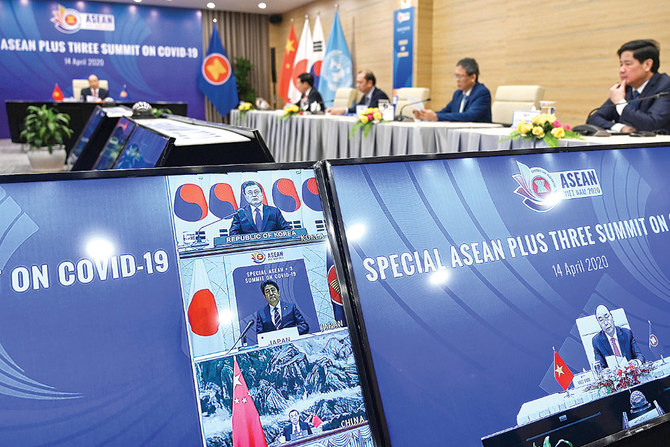
Leaders agreed to share resources and fight to limit damage to the region’s tourism and export-reliant economies at the ASEAN summit in Hanoi. (AFP)
Short Url
Updated 15 April 2020
Follow

Asian leaders make vow on trade and food supplies as coronavirus bites

HANOI: Southeast Asian leaders pledged to keep trade routes open to protect food supplies and stockpile medical equipment at a summit held online on Tuesday, as they warned of the crippling economic cost of the coronavirus.

Led by Vietnam — which chaired the Association of Southeast Asian Nations (ASEAN) meeting — leaders agreed to share resources and fight to limit further damage to the region’s tourism and export-reliant economies.

But an emergency fund proposed by Hanoi to tackle the pandemic did not appear to have been given the go-ahead.

In a joint declaration, leaders committed “to keeping ASEAN’s markets open for trade and investment . . . with a view to ensuring food security.” They also pledged to cooperate to ensure adequate supplies of personal protective equipment and diagnostic tools, as well as using “reserve warehouses to support the needs of ASEAN Member States in public health emergencies.”

China later said that it planned to set up a special fund to help ASEAN countries combat the pandemic, but declined to say how much money would be allocated.Following the summit — which was joined by leaders from China, Japan and South Korea — Chinese Premier Li Keqiang also declared his support for a $5 billion recovery package proposed by the Beijing-backed Asian Infrastructure Investment Bank (AIIB).

“We welcome the AIIB’s proposal of a COVID-19 Recovery Facility with an initial capitalization of 5 billion US dollars,” Li said, according to state media.

In opening remarks via video conference, Vietnam premier Nguyen Xuan Phuc hailed the work of ASEAN in fighting the virus.

However, he warned that the disease “has badly impacted people’s lives, their socio-economic situation . . . challenging stability and social security.”

Vietnam has had some success in containing the virus through extensive quarantines and social distancing. It has recorded 265 infections and no deaths, while Thailand has also kept its numbers relatively low with just over 2,500 cases and 40 deaths.

The situation is mixed elsewhere across the region, with fears that limited testing in Indonesia has played out into the low caseload — and under 400 deaths — for the country of 260 million.

Similarly, threadbare health systems from Myanmar to Laos are widely believed to be missing the true scale of infections.

A recent surge in cases in Singapore has raised fears the pandemic could rebound in places that had batted back the initial outbreak.

Vietnam used the summit to propose funding to deal with the pandemic, an idea backed by both Malaysia and the Philippines.

Philippines President Rodrigo Duterte warned that he was “particularly concerned with food security.”

The whole region has been hit hard by the virus.

In Vietnam many factories are still running, but, in a sign of the ongoing risks, dozens of workers at a Samsung unit in the north were ordered into quarantine after one tested positive for the virus.

The Thai economy, the second-largest in ASEAN, is expected to shrink by 5.3 percent this year — a 22-year low.


Egypt’s central bank raises economic growth forecast to 5.1 percent in current year, 5.5 percent next year

Updated 9 sec ago
Follow

Egypt’s central bank raises economic growth forecast to 5.1 percent in current year, 5.5 percent next year

RIYADH: The Central Bank of Egypt has raised its economic growth forecast to 5.1 percent for the 2025/26 fiscal year and 5.5 percent for 2026/27, up from previous projections of 4.8 percent and 5.1 percent, respectively.

The improved projection is attributed to the anticipated increase in contributions from the non-oil manufacturing and services sectors, with expectations of accelerated growth supported by the continuation of the monetary easing cycle.

This is expected to support real growth in credit extended to the private sector in the coming period, therefore boosting economic activity, according to a statement.

The revised forecast follows Egypt’s 5.3 percent gross domestic product growth in the first quarter of 2025/26, the strongest expansion in more than three years, according to the Minister of Planning and Economic Development Rania Al-Mashat in November.

At the time, Al-Mashat underlined that this acceleration was driven by improvements in productive sectors.

This also supports ministry data released in September showing that the economy expanded 4.4 percent in fiscal year 2024/25, supported by a strong fourth quarter when growth reached a three-year high of 5 percent.

The newly released report from Egypt’s central bank said: “Furthermore, forecasts are further strengthened by an anticipated stronger performance in the extractive sector, underpinned by multiple successful onshore and offshore discoveries of crude oil and natural gas, which are expected to gradually increase domestic production.”

It added: “Additionally, the growth outlook is further reinforced by a projected rebound in Suez Canal activity during the current fiscal year, assuming the normalization of maritime traffic in the Red Sea in light of the recent peace deal in Gaza, which has restored confidence and prompted the return of shipping lines through the Canal, including Maersk and CMA CGM.”

The report said continued strength in manufacturing, services, and Suez Canal activity is likely to support real GDP growth throughout the forecast horizon.

As for inflation, the analysis indicated that annual headline inflation is expected to keep slowing down throughout 2026, although it will remain slightly higher than the original forecast, before returning to the target level by the fourth quarter of 2026.

“As such, annual headline inflation is expected to average 12.5 and 9.0 percent in fiscal years 2025/26 and 2026/27, respectively,” the report said.