KARACHI: Saudi Arabia remained the largest source of overseas remittances to Pakistan in April, with workers in the Kingdom sending $841.7 million to the South Asian country, according to State Bank of Pakistan data released on Monday.
Remittances are a critical source of foreign exchange for Pakistan’s fragile economy, helping finance imports, stabilize the currency and support millions of households. The Gulf region, particularly Saudi Arabia and the United Arab Emirates, accounts for the bulk of inflows due to the large Pakistani expatriate workforce employed there.
Pakistan has seen remittances rise sharply over the past two years, with inflows reaching a record $38.3 billion in fiscal year 2025, up 26.6 percent from $30.3 billion a year earlier, according to State Bank data.
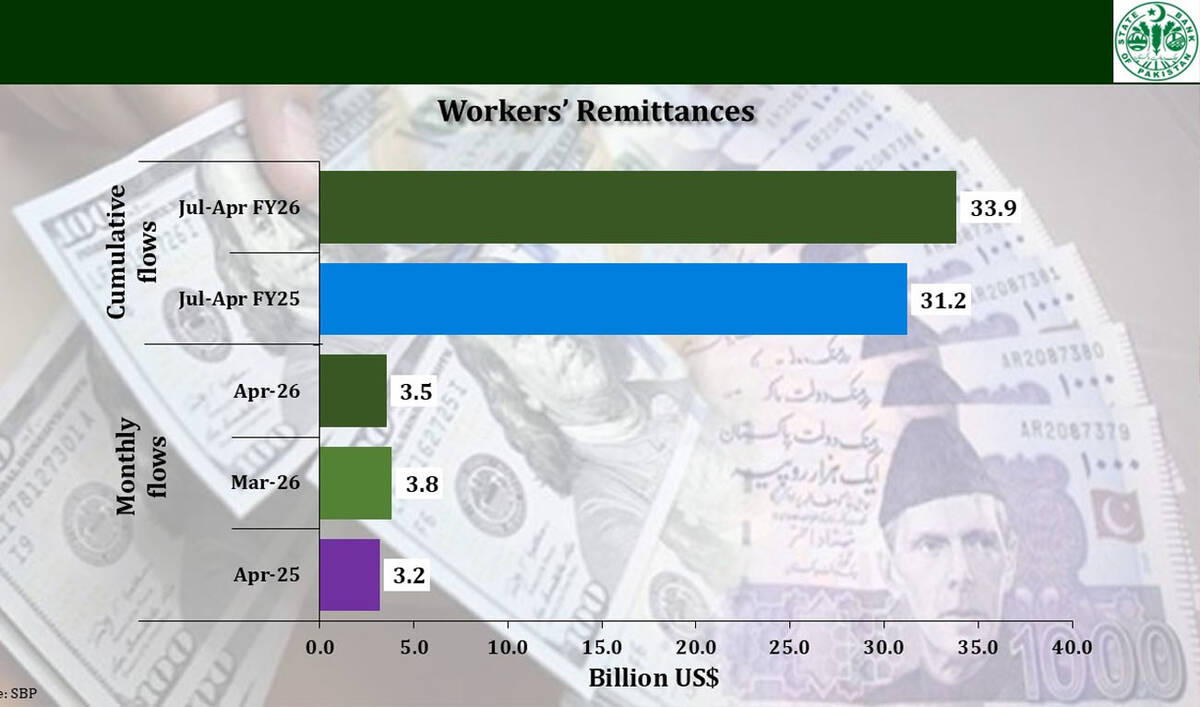
“Workers’ remittances were recorded at $3.5 billion during April 2026,” the State Bank of Pakistan said in a statement.
Source: State Bank of Pakistan/FB
“In terms of growth, remittances increased by 11.4 percent on y/y basis and decreased by 7.6 percent on m/m basis.”
Cumulatively, Pakistan received $33.9 billion in remittances during July-April FY26, compared with $31.2 billion during the same period last year, reflecting an increase of 8.5 percent, the central bank said.
After Saudi Arabia, the United Arab Emirates was the second-largest contributor in April with $734.7 million, followed by the United Kingdom with $563.7 million and the United States with $317.6 million.
Pakistan’s remittances have consistently remained above the $3 billion monthly mark in recent quarters, helping cushion the economy against external financing pressures and a widening trade deficit.
“The external account outlook remains fickle as FY26 approaches closure,” said Muhammad Waqas Ghani, head of research at JS Global Capital Ltd.
“With crude oil prices elevated and import momentum likely to persist, the current account faces material pressure that domestic production cannot offset. In this context, remittances have transitioned from a supporting buffer to an essential stabilizer.”
He warned that any slowdown in inflows, particularly from Gulf countries, could again push Pakistan’s external account into deficit.
“Should inflows weaken, particularly from the GCC region, where concentration risk is acute, the external account could slide into deficit again,” Ghani said.
“FX reserve targets has already been revised down by $1 billion, increasing reliance on external financing. The margin for error is thin.”