VIENNA: The Swiss government could increase a 20 billion Swiss francs ($21 billion) loan program to help keep companies afloat and safe jobs amidst the coronavirus crisis, the finance minister told weekly Sonntagsblick.
Like other European countries, Switzerland is pumping money into its crisis-hit economy. The government has signed off on a 20-billion-Swiss-franc emergency scheme under which companies can get state-backed, no-interest loans of up to 500,000 Swiss francs via their banks.
“It is possible that we might have to step this up,” Ueli Maurer said in an interview published on Sunday. “The 20 billion are tight.”
More than 30,000 loan applications have been submitted already, and guarantees worth more than 4 billion francs have been given on Thursday and Friday alone, the finance minister said.
Asked how much money the state was ready to provide, he said: “As much as is needed. We are borrowing to safe jobs.”
“If we do not pump money into the economy quickly, we will have tens of thousands of unemployed within weeks.”
Maurer had pointed out on Saturday that the government was happy to help with loans, but that the money must be paid back and could not cover income losses.
More than 13,000 coronavirus cases and 235 related deaths have been confirmed in the Alpine country of 8.6 million people.
The government has urged people to stay at home, imposed strict border controls and banned gatherings of more than five people to curb the epidemic’s spread.
Maurer said it was important to prepare now for how best to begin to ease the restrictions in public life. “The current situation is not sustainable in the long term, neither mentally nor economically.”

Switzerland might increase 20bn franc emergency scheme: Finance minister
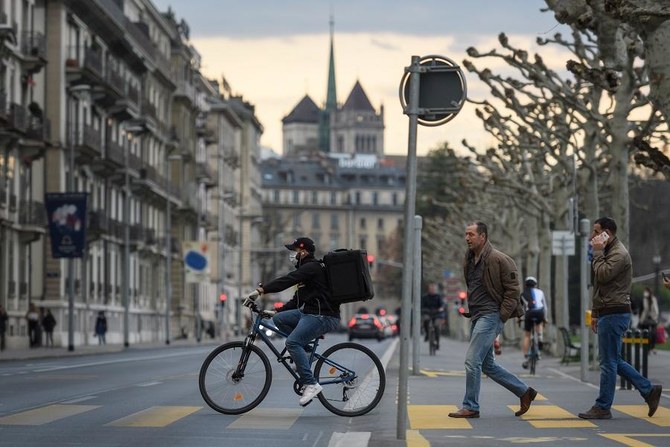
- The government has signed off on a 20-billion-Swiss-franc emergency scheme
- The government has urged people to stay at home, imposed strict border controls and banned gatherings of more than five people
Fourth Palestine Action activist ends hunger strike in UK prison
- Amy Gardiner-Gibson began eating again after 49 days of protest
- Govt rejects claims it ignored prison safety protocols
LONDON: A fourth Palestine Action activist imprisoned in the UK has ended her hunger strike.
Amy Gardiner-Gibson, who also uses the name Amu Gib, began eating again after 49 days of fasting, the campaign group Prisoners for Palestine said.
Qesser Zuhrah, another activist, ended her hunger strike last week after 48 days but said she might resume it next year, Sky News reported.
Four Palestine Action activists have now ended their hunger strikes while in prison, while four others are continuing to fast.
All of them are in prison on remand, awaiting trial for a series of high-profile alleged break-ins and criminal damage.
Palestine Action was proscribed as a terrorist organization and banned earlier this year.
On Tuesday, Swedish climate activist Greta Thunberg was arrested in central London at a rally in support of the hunger strikers.
The protesters are demanding that weapons factories in Britain with ties to Israel be shut down, as well as the removal of Palestine Action’s proscription.
They are also calling for immediate bail to be given to imprisoned pro-Palestine activists and an end to the alleged mistreatment of prisoners in custody.
Seven imprisoned members of Palestine Action have been transferred to hospital over the course of the hunger strike campaign. Doctors have highlighted concerns about the long-term impact of fasting on the activists.
Lawyers representing the group on Monday initiated legal action against the government over its alleged failure to follow prison safety regulations.
The government, however, has rejected this accusation, Sky News reported.
A Ministry of Justice spokesperson said: “Ministers do not intervene in individual cases. Where individuals are on remand, doing so would risk prejudicing ongoing legal proceedings and undermine the independence of the justice system.
“Concerns about welfare and process can be raised through established legal and administrative channels, including prison governors and ultimately the prison and probation ombudsman.
“Healthcare decisions are taken independently by qualified NHS professionals and appropriate care and oversight frameworks remain in place.”
The activists still on hunger strike include Heba Muraisi and Teuta Hoxha. Hoxha has been on remand for 13 months and her family told Sky News they feared she would die in prison.
Another of the activists, Kamran Ahmad, is believed to have been on hunger strike for 45 days and hospitalized three times.
Lewie Chiaramello, who has Type 1 diabetes, is on day 31 of his strike and taking part by fasting every other day.



