India marks ‘significant stride’ in space sector with launch of its heaviest satellite

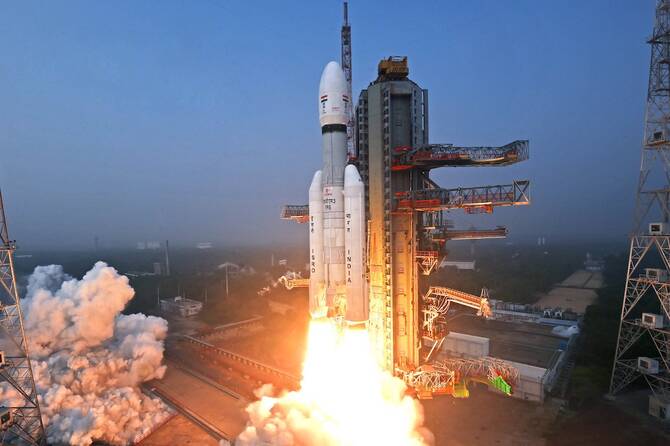
LVM3-M6 rocket successfully carried its heaviest ever payload to low earth orbit on Dec. 24, 2025. (ISRO)
Short Url
Updated 24 December 2025
Follow

India marks ‘significant stride’ in space sector with launch of its heaviest satellite

  • Wednesday’s mission also marks India’s 100th orbital launch
  • India plans to launch its first human space mission in 2027

NEW DELHI: India launched its heaviest communication satellite on Wednesday, marking the latest feat in the country’s efforts to establish itself in the global space industry.

The Indian Space Research Organization launched a LVM-3 rocket carrying the BlueBird Block-2 satellite, which weighs over 6 tonnes, from the Satish Dhawan Space Center in Sriharikota island off the Bay of Bengal at 8:55 a.m. local time.

Codenamed LVM3-M6, the mission was the ISRO’s 100th orbital launch and involved deploying the US-built satellite in low Earth orbit.

“A significant stride in India’s space sector,” Indian Prime Minister Narendra Modi said on X soon after the mission was declared successful by the ISRO.

“It strengthens India’s heavy-lift launch capability and reinforces our growing role in the global commercial launch market.”

The BlueBird Block-2 satellite was the “heaviest payload ever launched” from Indian soil, breaking a record set by the ISRO only last month, when it launched the CMS-03 communication satellite, which weighs about 4.4 tonnes.

“The successful LVM3-M6 launch of ISRO’s heaviest commercial payload to date marks a quantum leap in India’s launch capabilities, pushing the boundaries of LVM3’s performance in low Earth orbit,” Lt. Gen. (Retd) A. K. Bhatt, director-general of the Indian Space Association, said in a statement.

The mission exemplified the Indian space agency’s capability to handle “heavier payloads that cater to the global demand for advanced satellite constellations,” he added.

Under Modi, India has been making breakthroughs in the space industry.

For the past few years, the government has been creating the environment and long-term investment for the industry to flourish and involve the private sector. The ISRO has achieved significant milestones to add to India’s status as an emerging space superpower.

The achievements include a successful space docking mission in January. And the ISRO’s Chandrayaan-3 moon rover making history in 2023 by landing on the lunar surface. This made India the first country to land near the lunar south pole and the fourth to land on the moon — after the US, Soviet Union and China.

The ISRO is planning to use a modified version of the LVM-3 rocket for its future space missions, including India’s first human spaceflight program, the Gaganyaan mission, in 2027.

Its long-term space ambitions include building a modular space facility, the Bharatiya Antariksh Station, by 2035, and sending the first Indian to the moon by 2040.


France’s Le Pen insists party acted in ‘good faith’ at EU fraud appeal

Updated 3 sec ago
Follow

France’s Le Pen insists party acted in ‘good faith’ at EU fraud appeal

  • Le Pen said on her second day of questioning that even if her party broke the law, it was unintentional
  • She also argued that the passage of time made it “extremely difficult” for her to prove her innocence

PARIS: French far-right leader Marine Le Pen told an appeals trial on Wednesday that her party acted in “good faith,” denying an effort to embezzle European Parliament funds as she fights to keep her 2027 presidential bid alive.
A French court last year barred Le Pen, a three-time presidential candidate from the far-right National Rally (RN), from running for office for five years over a fake jobs scam at the European institution.
It found her, along with 24 former European Parliament lawmakers, assistants and accountants as well as the party itself, guilty of operating a “system” from 2004 to 2016 using European Parliament funds to employ party staff in France.
Le Pen — who on Tuesday rejected the idea of an organized scheme — said on her second day of questioning that even if her party broke the law, it was unintentional.
“We were acting in complete good faith,” she said in the dock on Wednesday.
“We can undoubtedly be criticized,” the 57-year-old said, shifting instead the blame to the legislature’s alleged lack of information and oversight.
“The European Parliament’s administration was much more lenient than it is today,” she said.
Le Pen also argued that the passage of time made it “extremely difficult” for her to prove her innocence.
“I don’t know how to prove to you what I can’t prove to you, what I have to prove to you,” she told the court.
Eleven others and the party are also appealing in a trial to last until mid-February, with a decision expected this summer.

- Rules were ‘clear’ -

Le Pen was also handed a four-year prison sentence, with two years suspended, and fined 100,000 euros ($116,000) in the initial trial.
She now again risks the maximum sentence of 10 years in prison and a one-million-euro ($1.16 million) fine if the appeal fails.
Le Pen is hoping to be acquitted — or at least for a shorter election ban and no time under house arrest.
On Tuesday, Le Pen pushed back against the argument that there was an organized operation to funnel EU funds to the far-right party.
“The term ‘system’ bothers me because it gives the impression of manipulation,” she said.
EU Parliament official Didier Klethi last week said the legislature’s rules were “clear.”
EU lawmakers could employ assistants, who were allowed to engage in political activism, but this was forbidden “during working hours,” he said.
If the court upholds the first ruling, Le Pen will be prevented from running in the 2027 election, widely seen as her best chance to win the country’s top job.
She made it to the second round in the 2017 and 2022 presidential polls, before losing to Emmanuel Macron. But he cannot run this time after two consecutive terms in office.