Terrorism arrests in UK surged by 660% after Palestine Action ban

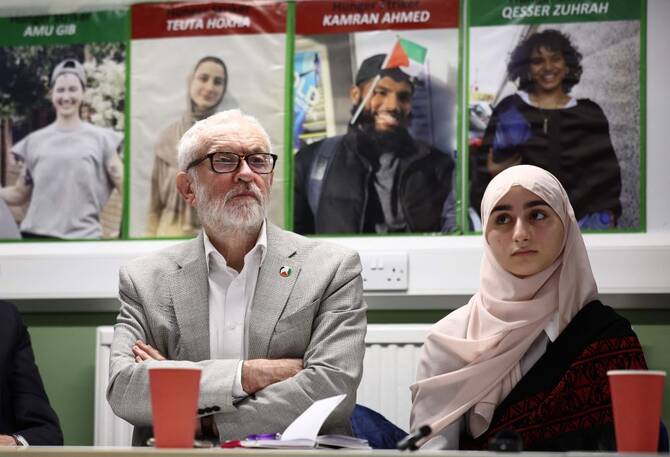
MP Jeremy Corbyn and Teuta Hoxha’s sister Rahma Hoxha - Teuta Hoxha was arrested for activism on behalf of Palestine Action - attend a press conference in London, Britain, Dec. 18, 2025. (AFP)
Short Url
Updated 18 December 2025
Follow

Terrorism arrests in UK surged by 660% after Palestine Action ban

  • Support for proscribed group was made a terror offense by govt in July
  • Extreme’ ban decision renders UK ‘an international outlier,’ says barrister

LONDON: Arrests for terrorism offenses in the UK have spiked by a massive 660 percent year-on-year due to support for Palestine Action, new government figures show.

The pro-Palestine group was listed as a terrorist organization and banned in July. Now any public demonstration of support for the group is outlawed, and hundreds of protesters — who have used the slogan “I oppose genocide, I support Palestine Action” — opposing the ban have been arrested in recent months, with the act now an offense under UK anti-terrorism legislation.

Of the 1,886 arrests in the year up to September for terrorism-related activity, 1,630 — or 86 percent — were linked to support for Palestine Action, government data released on Thursday shows.

In the previous year, 248 arrests were made in relation to incidents falling under anti-terrorism laws.

Among those arrested for supporting Palestine Action, protesters were 4.4 times more likely to be female, and were remarkably older, on average, than people typically arrested for alleged terror offenses.

The average age of those arrested in relation to Palestine Action was 57, compared to 30 among those arrested for all unrelated terror offenses.

Before the banning of Palestine Action, there were 63 arrests for terror-related activity between April and June this year.

Following the ban, the number of arrests within the category surged by 2,608 percent, with 1,706 arrests recorded from July to September.

The group’s proscription has been challenged in the High Court by co-founder Huda Ammori, whose barristers have argued that the ban’s impact was “dramatic, severe, widespread and potentially lifelong.”

Then-Home Secretary Yvette Cooper’s decision to ban the group was “novel and unprecedented,” Raza Husain KC told judges, adding: “This is the first direct action civil disobedience organization that does not advocate for violence ever to be proscribed as terrorism.”

The government’s decision in July was “so extreme as to render the UK an international outlier,” he said.

Cooper’s government body, the Home Office, was advised by the Foreign Office that Palestine Action’s “activity is largely viewed by international partners as activism and not extremism or terrorism.”

Representing the government, Sir James Eadie KC argued that Parliament reserved the right to decide what constitutes terrorism.


Kremlin welcomes US sanctions waiver says US and Russia share interest in stable energy markets

Updated 6 sec ago
Follow

Kremlin welcomes US sanctions waiver says US and Russia share interest in stable energy markets

DUBAI: Russia sees ​a U.S. sanctions waiver on its oil as ‌an ‌attempt ​by ‌Washington ⁠to stabilise ​global energy ⁠markets, and the two countries ⁠have a shared ‌interest ‌in ​this, ‌Kremlin ‌spokesman Dmitry Peskov said on Friday.

"We see ‌actions by the United States aimed ‌at trying to stabilise energy markets. In this respect, our interests coincide," he said.

US Treasury Secretary Scott Bessent announced a temporary authorisation allowing countries around the world to purchase Russian oil currently stranded at sea on Thursday extending a measure that had previously been granted only to Indian refiners.

Bessent stressed in a post on X that the authorisation would not provide significant financial benefit to the Russian government. 

“This narrowly tailored, short-term measure applies only to oil already in transit and will not provide significant financial benefit to the Russian government, which derives the majority of its energy revenue from taxes assessed at the point of extraction,” Bessent said on a post on X. 

However, the measure received mix reviews in European capitals, with many fearing it could help replenish Russia's assualt on Ukraine. 

"I am concerned that we are further filling Putin's war chest," German Economy Minister Katherina Reiche said in Berlin on Friday.

Reiche said that she saw both sides to the United States' decision to issue ‌a 30-day ‌waiver ​for ‌the purchase ⁠of ​Russian oil ⁠products, understanding the increasing ecnomic and political turnout from the oil crisis, particurlarly in South Korea and Japan. 

"It seems to me that domestic political pressure in the United ⁠States is very, ‌very ‌high," ​Reiche said.

German ​Chancellor Friedrich Merz was more direct, saying on Friday that it was ‌wrong to ‌ease ​sanctions against ‌Russia ⁠for ​whatever reason. The sentiment was echoed by Norway’s Prime Minister, who also said sanctions should not be eased. 

Oil prices held gains above $100 Friday and most equity markets dropped after Iran's leader called for the blocking of the crucial Strait of Hormuz and the opening up of new fronts in the war against the United States and Israel.

With the conflict heading towards its third week and showing no signs of ending, investors are growing increasingly worried about an extended crisis that could fan inflation and hammer the global economy.