

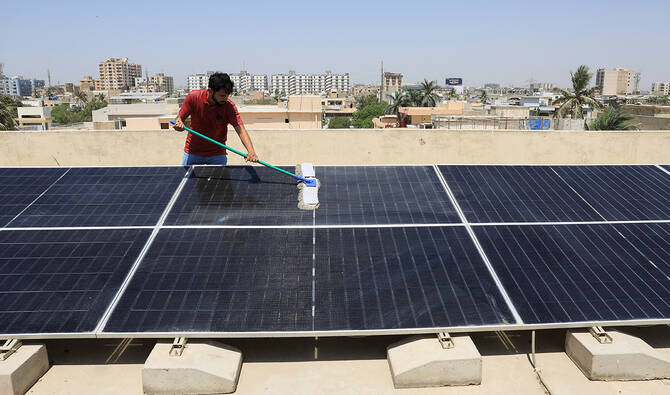

ISLAMABAD: Pakistan’s government is considering replacing its net metering policy for rooftop solar with a net billing mechanism for solar consumers across the country, an official confirmed on Wednesday, as Islamabad looks to ease financial strain on the struggling power sector.
Under the proposed framework for the net billing system, electricity generated by rooftop solar systems and exported to the national grid by consumers would be bought at a rate 60 percent lower than the previous price of electricity. Consumers, on the other hand, will continue to buy power from the national grid at the prevailing commercial rates. Net metering, on the other hand, allows power consumers to offset exported units directly against imported electricity at the same price.
Government officials say the policy change is aimed at easing mounting financial pressure on Pakistan’s power sector, where rapid solar adoption has reduced revenues for distribution companies even as fixed capacity payments to power producers continue to rise.
Pakistan has seen a surge in residential and commercial solar systems in recent years as soaring electricity prices drive inflation and power outages increase in the country.
“Under the proposed regulations, net billing will apply to both old and new customers who will have to pay full commercial tariffs for all imported units,” a National Electric Power Regulatory Authority (NEPRA) official told Arab News on condition of anonymity as he was not authorized to speak to the media.
However, he clarified the new rules would be implemented after a public hearing and NEPRA obtains feedback from stakeholders.
Commercial electricity tariffs range between Rs30 and Rs50 per unit depending on consumption slabs, taxes, fixed charges and Time of Use (TOU) rates. The official said the average energy price stands at Rs10–12 per unit, while the average Power Purchase Price (PPP) stands at around Rs25 per unit.
As per the government’s proposal, which is available on NEPRA’s website, new solar consumers would get the lower average energy price while existing customers would continue receiving the higher PPP rates until the expiry of their seven-year contracts.
Pakistan Energy Minister Sardar Awais Leghari told Arab News the government would present its position during NEPRA’s public hearing expected next month.
“Contractual obligations will be fulfilled for existing consumers while new consumers will receive energy rates for their produced units as per NEPRA’s proposal,” Leghari said, adding that consultations would continue for at least a month.
Asked whether the policy could be revised, Leghari said: “Only if the regulator approves.”
The government’s proposal has sparked strong concerns among consumers, energy experts and industry stakeholders, who warn the plan could slow the adoption of renewable energy as Pakistan struggles with climate vulnerability, rising fuel import bills and deepening circular debt in the power sector.
Hasnat Ahmad Khan, senior vice president of the Pakistan Solar Association (PSA), told Arab News that consumers would suffer if the new regulations are approved.
“People have invested their hard-earned money to install solar systems and many have even taken loans,” Khan noted. “The new rules will make it difficult for them to recover their investment.”
Khan said industry representatives recently met NEPRA officials, urging them to protect existing consumers and allow new solar users to sell surplus electricity at the PPP rates of around Rs25 per unit instead of lower energy rates.
“This is green energy and it should be encouraged,” he said. “If change is unavoidable, existing consumers must be protected and new consumers should at least be given PPP rates.”
Khan warned that the new regulations would benefit only power distribution companies.
“They will buy solar energy at very low rates and sell it to non-solar neighbors at much higher tariffs,” he noted.
The PSA official said utilities should pay more for solar power since it is supplied without transmission losses.
Pakistan, one of the countries most affected by climate change, has repeatedly pledged to increase its share of renewable energy in its power mix.
Critics argue that weakening incentives for rooftop solar risks undermining those commitments and could place an additional burden on consumers already suffering from inflation and rising utility costs.


