

Thousands flock to Bethlehem to revive Christmas spirit after Gaza war

1 / 6
Cardinal Pierbattista Pizzaballa, Latin Patriarch of Jerusalem, greets a Palestinian, who is dressed as Santa Claus on Christmas Eve, in the Old City of Bethlehem in the Israeli-occupied West Bank. (Reuters)
2 / 6
Palestinian scouts march near the Church of the Nativity, in Bethlehem, in the Israeli-occupied West Bank, on Christmas Eve. (Reuters)
3 / 6
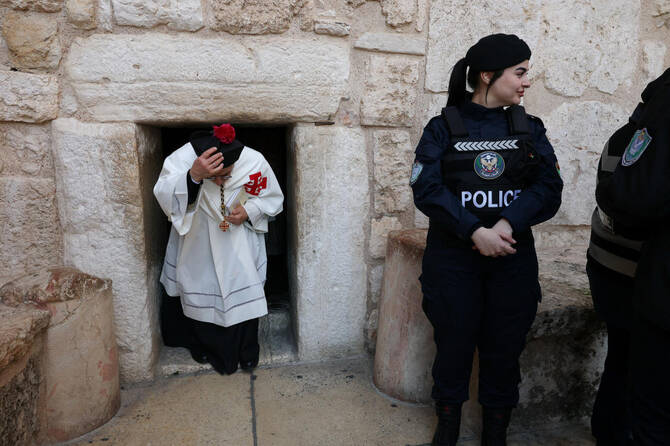
A clergy member exits the Church of the Nativity via the 'Door of Humility', on the day Latin Patriarch of Jerusalem, Cardinal Pierbattista Pizzaballa attends Christmas celebrations in Bethlehem. (Reuters)
4 / 6
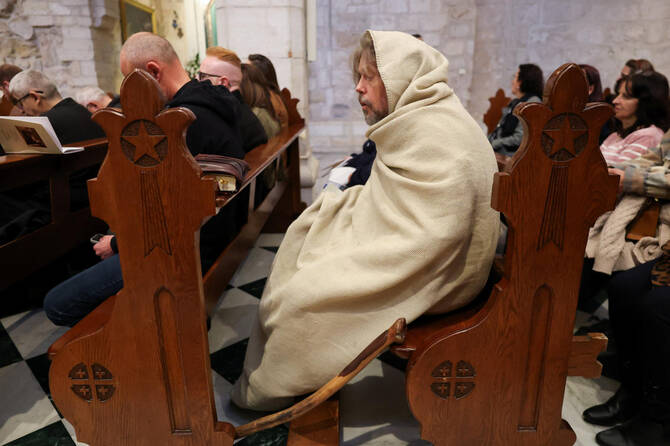
Faithful attend a Christmas service, which is led by Latin Patriarch of Jerusalem, Cardinal Pierbattista Pizzaballa, at the Church of the Nativity, in Bethlehem, in the Israeli-occupied West Bank, on Christmas Eve. (Reuters)
5 / 6
Palestinian scout bands parade at the Manger Square near the Church of the Nativity in Bethlehem on Christmas Eve. (AP)
6 / 6
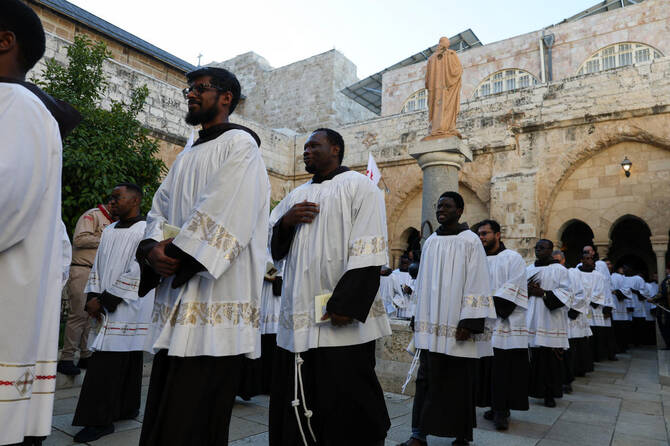
Clergy members attends Christmas celebrations in Bethlehem on Christmas Eve. (Reuters)
Short Url
Updated 24 December 2025
Follow

Thousands flock to Bethlehem to revive Christmas spirit after Gaza war

  • Bethlehem canceled celebrations the past two years due to the Israel-Hamas war
  • The city where Christians believe Jesus was born relies heavily on tourism that has been severely impacted

BETHLEHEM, West Bank: Thousands of people flocked to Bethlehem’s Manger Square on Christmas Eve as families heralded a much-needed boost of holiday spirit. The giant Christmas tree that was absent during the Israel-Hamas war returned on Wednesday, overlooking a parade of scouts playing songs on bagpipes.
The city where Christians believe Jesus was born canceled Christmas celebrations for the past two years. Manger Square had instead featured a nativity scene of baby Jesus surrounded by rubble and barbed wire in homage to the situation in Gaza.
Cardinal Pierbattista Pizzaballa, the top Catholic leader in the Holy Land, kicked off this year’s celebrations during the traditional procession from Jerusalem to Bethlehem, calling for “a Christmas full of light.”
Arriving in Manger Square, Pizzaballa said he came bearing greetings from Gaza’s tiny Christian community, where he held a pre-Christmas Mass on Sunday. Among the devastation, he saw a desire to rebuild.
“We, all together, we decide to be the light, and the light of Bethlehem is the light of the world,” he told thousands of people, Christian and Muslim.
Despite the holiday cheer, the impact of the war in the Israeli-occupied West Bank is acute, especially in Bethlehem, where around 80 percent of the Muslim-majority city’s residents depend upon tourism-related businesses, according to the local government.
The vast majority of people celebrating were residents, with a handful of foreigners in the crowd. But some residents said they are starting to see signs of change as tourism slowly returns.

Loss of tourism 

“Today is a day of joy, a day of hope, the beginning of the return of normal life here,” said Bethlehem resident Georgette Jackaman, a tour guide who has not worked in more than two years.
She and her husband, Michael Jackaman, another guide, are from established Christian Bethlehem families that stretch back generations. This is the first real Christmas celebration for their two children, aged 2 1/2 and 10 months.
During the war, the Jackamans pivoted to create a website selling Palestinian handicrafts to try to support others who have lost their livelihoods.
During the Gaza war, the unemployment rate in the city jumped from 14 percent to 65 percent, Bethlehem Mayor Maher Nicola Canawati said earlier this month.
A visitor from France, Mona Riewer, said that “I came because I wanted to better understand what people in Palestine are going through, and you can sense people have been through a very hard time.”
Although friends and family cautioned her against coming due to the volatile situation, Riewer said being in Bethlehem helped her appreciate the meaning of the holiday.
“Christmas is like hope in very dark situations, a very vulnerable child experiencing harshness,” she said.
Despite the Gaza ceasefire that began in October, tensions remain high across much of the West Bank.
Israel’s military continues to carry out frequent raids in what it says is a crackdown on militants. Attacks by Israeli settlers against Palestinians have reached their highest level since the United Nations humanitarian office started collecting data in 2006. Israel captured the West Bank in the 1967 Mideast war.
The internationally recognized Palestinian Authority has limited autonomy in parts of the territory, including Bethlehem. Palestinian President Mahmoud Abbas is expected to attend midnight Mass for the first time in two years, the mayor said.
As poverty and unemployment have soared, about 4,000 people have left Bethlehem in search of work, the mayor said. It’s part of a worrying trend for Christians, who are leaving the region in droves.
Christians account for less than 2 percent of the West Bank’s roughly 3 million residents. Across the Middle East, the Christian population has steadily declined as people have fled conflict and attacks.

Return to normal life

Fadi Zoughbi, who previously worked overseeing logistics for tour groups, said his children were ecstatic to see marching bands streaming through Bethlehem’s streets.
The scouts represent cities and towns across the West Bank, with Palestinian flags and tartan draped on their bagpipes, drummers spinning mallets adorned with pompoms. For the past two years, the scouts marched silently as a protest against the war.
Irene Kirmiz, who grew up in Bethlehem and now lives in Ramallah, said the scout parade is among her favorite Christmas traditions. Her 15-year-old daughter plays the tenor drum with the Ramallah scouts.
But her family had to wake up at 5 a.m. to arrive in time for the parade and waited upwards of three hours at Israeli checkpoints. The drive previously took 40 minutes without the checkpoints that have increasingly made travel difficult for Palestinians, she said.
“It’s very emotional seeing people trying to bounce back, trying to celebrate peace and love,” Kirmiz said.
The Israeli Ministry of Tourism estimates 130,000 tourists will visit Israel by the end of December, including 40,000 Christians. In 2019, a banner year for tourism before the pandemic, the tourism ministry said 150,000 Christian tourists visited during Christmas week alone.
During the previous two years, the heads of churches in Jerusalem urged congregations to forgo “any unnecessarily festive activities.” They encouraged priests and the faithful to focus on Christmas’ spiritual meaning and called for “fervent prayers for a just and lasting peace for our beloved Holy Land.”


Historic decree seeks to end decades of marginalization of Syria’s Kurds

Updated 4 sec ago
Follow

Historic decree seeks to end decades of marginalization of Syria’s Kurds

DAMASCUS/RIYADH: A decree issued by President Ahmad Al-Sharaa on Friday marks a historic end to decades of marginalization of Syria’s Kurdish minority and seeks to open a new chapter based on equality and full citizenship in post-liberation Syria.

The presidential action, officially known as Decree No. 13, affirms that Syrian Kurds are an integral part of the national fabric and that their cultural and linguistic identity constitutes an inseparable element of Syria’s inclusive, diverse, and unified national identity.

Al-Sharaa’s move seeks to address the consequences of outdated policies that distorted social bonds and divided citizens.

The decree for ⁠the first time grants Kurdish Syrians rights, including recognition of Kurdish identity as part of Syria’s national fabric. It designates Kurdish as a national language alongside Arabic and allows schools to teach it.

Al-Sharaa’s decree came after fierce clashes that broke out last week in the northern city of Aleppo, leaving at least 23 people dead, according to Syria’s health ministry, and forced more than 150,000 to flee the two Kurdish-run pockets of the city. The clashes ended ⁠after Kurdish fighters withdrew.

The Syrian government and the Kurdish-led Syrian Democratic Forces (SDF), that controls the country’s northeast, have engaged in months of talks last year to integrate Kurdish-run military and civilian bodies into Syrian state institutions by the end of 2025, but there has been little progress.

The end of an era of exclusion

For more than half a century, Kurds in Syria were subjected to systematic discriminatory policies, most notably following the 1962 census in Hasakah Governorate, which stripped thousands of citizens of their nationality and deprived them of their most basic civil and political rights.

These policies intensified after the now-dissolved Baath Party seized power in 1963, particularly following the 1970 coup led by criminal Hafez al-Assad, entrenching a state of legal and cultural exclusion that persisted for 54 years.

With the outbreak of the Syrian revolution in March 2011, Syrian Kurds actively participated alongside other segments of society. However, the ousted regime exploited certain separatist parties, supplying them with weapons and support in an attempt to sow discord and fragment national unity.

Following victory and liberation, the state moved to correct this course by inviting the Kurdish community to fully integrate into state institutions. This approach was reflected in the signing of the “March 10 Agreement,” which marked an initial milestone on the path toward restoring rights and building a new Syria for all its citizens.

Addressing a sensitive issue through a national approach

Decree No. 13 offers a balanced legal and political response to one of the most sensitive issues in modern Syrian history. It not only restores rights long denied, but also redefines the relationship between the state and its Kurdish citizens, transforming it from one rooted in exclusion to one based on citizenship and partnership.

The decree shifts the Kurdish issue from a framework of conflict to a constitutional and legal context that guarantees meaningful participation without undermining the unity or territorial integrity of the state. It affirms that addressing the legitimate demands of certain segments strengthens, rather than weakens, the state by fostering equal citizenship, respecting cultural diversity, and embracing participatory governance within a single, centralized state.

Core provisions that restore dignity

The decree commits the state to protecting cultural and linguistic diversity, guaranteeing Kurdish citizens the right to preserve their heritage, develop their arts, and promote their mother tongue within the framework of national sovereignty. It recognizes the Kurdish language as a national language and permits its teaching in public and private schools in areas with significant Kurdish populations, either as an elective subject or as part of cultural and educational activities.

It also abolishes all laws and exceptional measures resulting from the 1962 Hasakah census, grants Syrian nationality to citizens of Kurdish origin residing in Syria, including those previously unregistered, and guarantees full equality in rights and duties. In recognition of its national symbolism as a celebration of renewal and fraternity, the decree designates Nowruz Day (21 March) as a paid official holiday throughout the Syrian Arab Republic.

A call for unity and participation

In a speech following the issuance of the decree, President Ahmad al-Sharaa addressed the Kurdish community, urging them not to be drawn into narratives of division and calling on them to return safely to full participation in building a single homeland that embraces all its people. He emphasized that Syria’s future will be built through cooperation and solidarity, not through division or isolation.

The decree presents a pioneering national model for engaging with diversity, grounded not in narrow identities but in inclusive citizenship, justice, and coexistence. The decree lays the foundations for a unified and strong Syria that respects all its components and safeguards its unity, sovereignty, and territorial integrity.