Saudi retail giant BinDawood reports 200% growth in online sales amid coronavirus pandemic

App installations of BinDawood Holding’s two e-commerce platforms – Danube and BinDawood Online – topped 400 percent. (Supplied)
Short Url
Updated 27 March 2020
Follow

Saudi retail giant BinDawood reports 200% growth in online sales amid coronavirus pandemic

DUBAI: Saudi Arabian retailer BinDawood Holding has seen a 200 percent increase in its online sales since the escalation of the coronavirus crisis.

BinDawood Holding’s two e-commerce platforms – Danube and BinDawood Online – have recorded a “significant upturn in organic growth the last few weeks”, according to Majed M. Al-Tahan, the co-founder and managing director of Danube Online.

“Our average sales on a 10-day basis has shot up 200 percent, with our average order value up 50 percent and our app installations topping 400 percent,” Al-Tahan said. “The demand has been so great that we are adding jobs [such as packers and drivers]. It has been an incredibly busy period.”

Ahmad AR. BinDawood, chief executive of Danube & BinDawood, BinDawood Holding, said all its stores remain open in the Kingdom, with additional stringent sanitization measures to protect its customers and staff.

“All our 72 stores remain open and we continue to provide effective customer service as we play an important role in serving the communities across the kingdom,” BinDawood said.

“This week, as planned, the newest Danube store opened in Al Andalus in Riyadh, with the support of the government, to cope with the demand that is happening,” he added.


Education spending surges 251% as students return from autumn break: SAMA

Updated 12 December 2025
Follow

Education spending surges 251% as students return from autumn break: SAMA

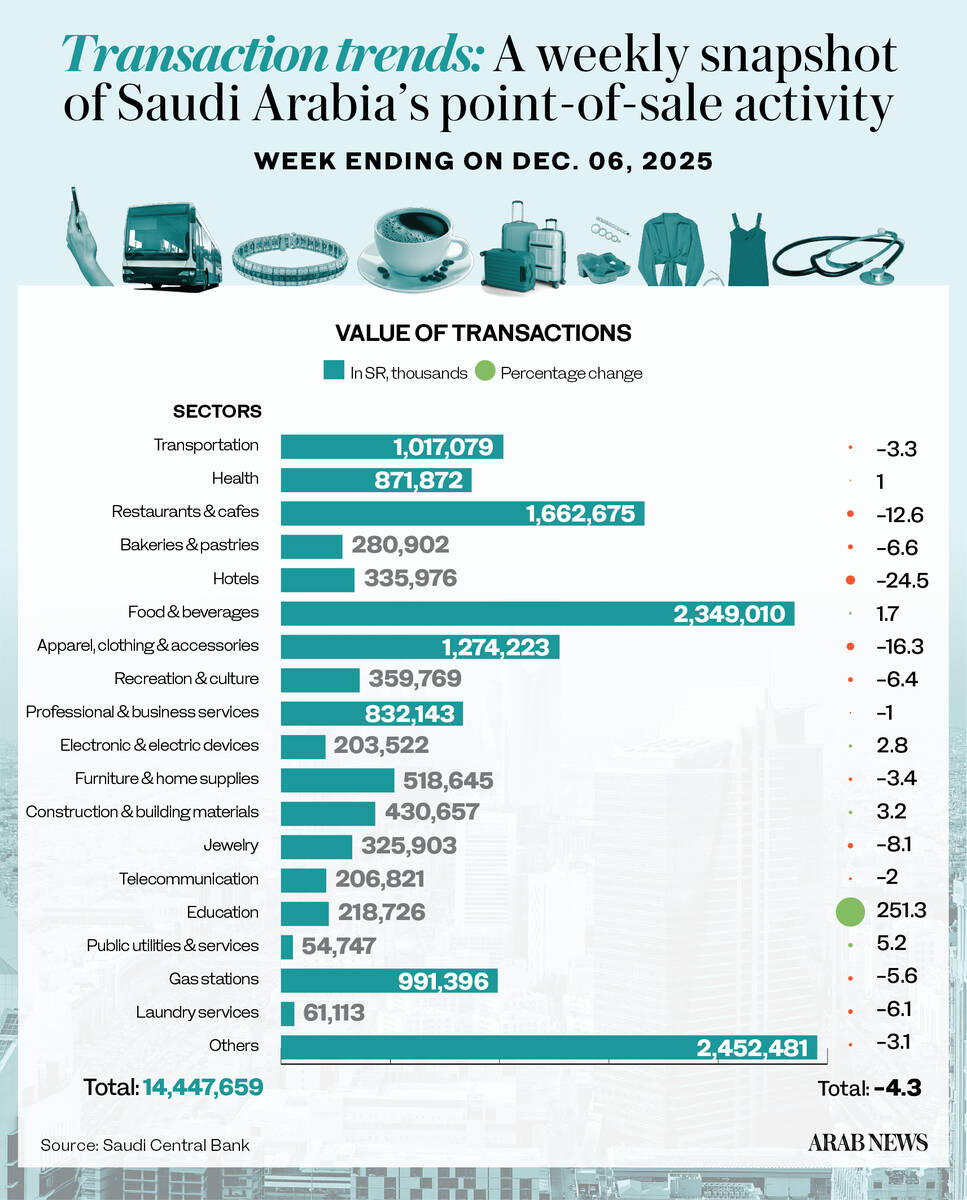
RIYADH: Education spending in Saudi Arabia surged 251.3 percent in the week ending Dec. 6, reflecting the sharp uptick in purchases as students returned from the autumn break.

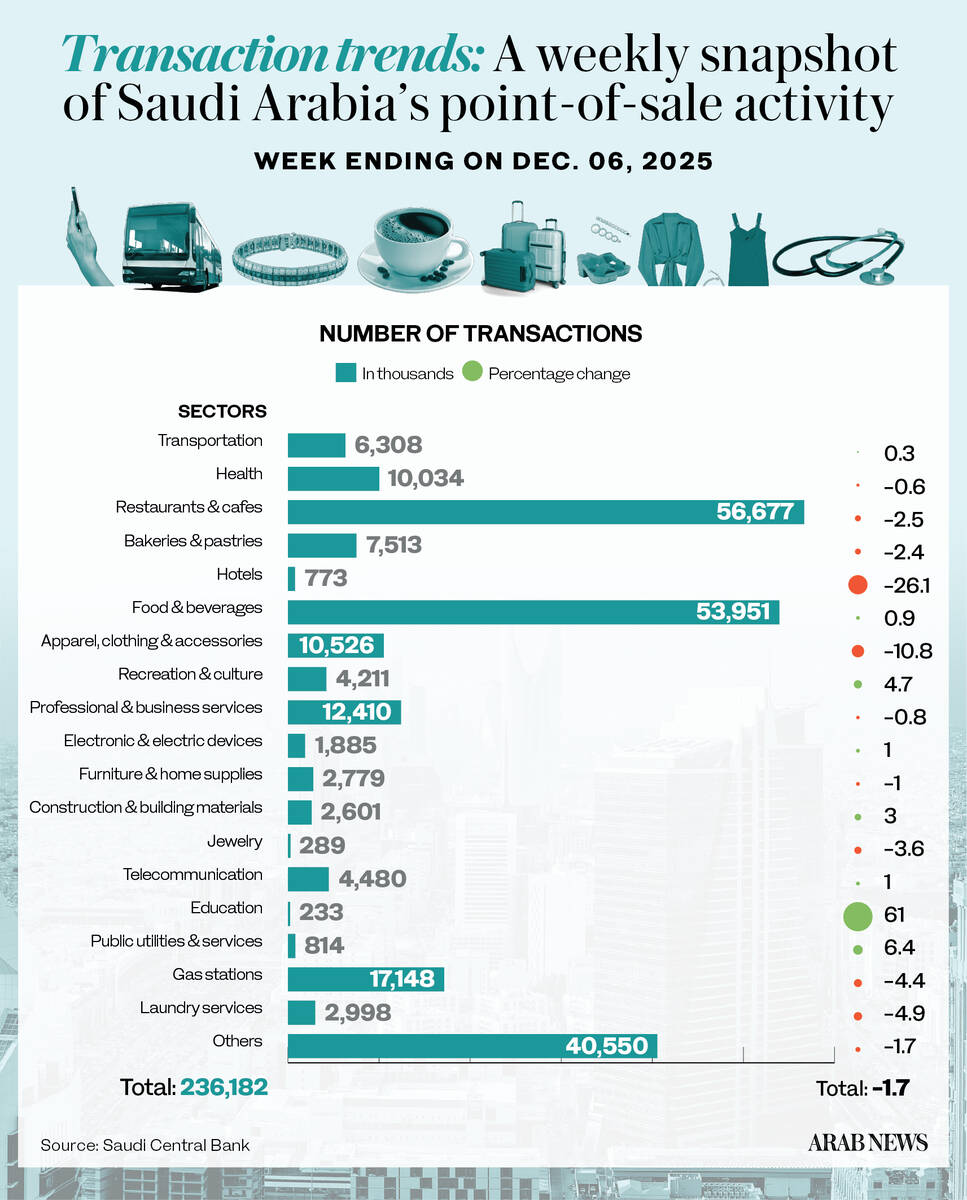
According to the latest data from the Saudi Central Bank, expenditure in the sector reached SR218.73 million ($58.2 million), with the number of transactions increasing by 61 percent to 233,000.

Despite this surge, overall point-of-sale spending fell 4.3 percent to SR14.45 billion, while the number of transactions dipped 1.7 percent to 236.18 million week on week.

The week saw mixed changes between the sectors. Spending on freight transport, postal and courier services saw the second-biggest uptick at 33.3 percent to SR60.93 million, followed by medical services, which saw an 8.1 percent increase to SR505.35 million.

Expenditure on apparel and clothing saw a decrease of 16.3 percent, followed by a 2 percent reduction in spending on telecommunication.

Jewelry outlays witnessed an 8.1 percent decline to reach SR325.90 million. Data revealed decreases across many other sectors, led by hotels, which saw the largest dip at 24.5 percent to reach SR335.98 million. 

Spending on car rentals in the Kingdom fell by 12.6 percent, while airlines saw a 3.7 percent increase to SR46.28 million.

Expenditure on food and beverages saw a 1.7 percent increase to SR2.35 billion, claiming the largest share of the POS. Restaurants and cafes retained the second position despite a 12.6 percent dip to SR1.66 billion.

Saudi Arabia’s key urban centers mirrored the national decline. Riyadh, which accounted for the largest share of total POS spending, saw a 3.9 percent dip to SR4.89 billion, down from SR5.08 billion the previous week.

The number of transactions in the capital settled at 74.16 million, down 1.4 percent week on week.

In Jeddah, transaction values decreased by 5.9 percent to SR1.91 billion, while Dammam reported a 0.8 percent surge to SR713.71 million.

POS data, tracked weekly by SAMA, provides an indicator of consumer spending trends and the ongoing growth of digital payments in Saudi Arabia. 

The data also highlights the expanding reach of POS infrastructure, extending beyond major retail hubs to smaller cities and service sectors, supporting broader digital inclusion initiatives. 

The growth of digital payment technologies aligns with the Kingdom’s Vision 2030 objectives, promoting electronic transactions and contributing to the nation’s broader digital economy.