


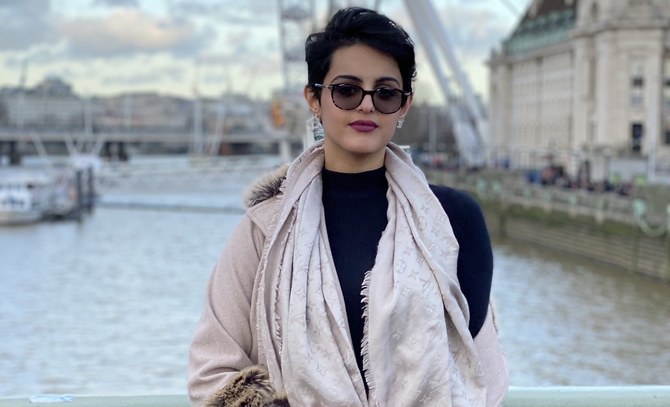

LONDON: A Qatari woman seeking asylum in the UK has told of her fear that despite fleeing her abusive family, she is still not safe from their reach.
Aisha Al-Qahtani, 22, fled to London in December 2019 while on a trip to Kuwait with her brother, but has been forced to move constantly since landing in Britain, and has faced harassment from relatives and Qatari officials.
“In Doha, a woman is a second-class human,” she told The Times of London.
“People are not free to speak.” Al-Qahtani, the youngest daughter of a powerful figure in the Qatari military, described a life of seclusion and violence, saying she lived in a room with bars across the window, had tracking software installed on her mobile phone, and had been promised in marriage to a hardline religious scholar.
She detailed how she was repeatedly beaten for “disobedience,” including an incident where a vase was smashed on her by a relative because she had cut her hair. “How can you be human when you can’t even protect yourself from being abused?” she told The Times. “I felt like I had lost my humanity and I told myself ‘I will gain it back.’ But there is no way I could have done that in Qatar.”
She took the opportunity to flee the abuse while out of the country, slipping past her brother’s hotel room one night and getting a taxi straight to the airport.
Opinion
This section contains relevant reference points, placed in (Opinion field)
It was something that would have been impossible in Doha: Qatari law forbids women under the age of 25 from leaving the country without the consent of a male guardian. But even after arriving in Britain, her troubles were not at an end. Within 24 hours of arriving in London, the police informed her that a male relative had been stopped by immigration officials at Heathrow Airport.
Al-Qahtani claims that since then, other family members have tried to track her down, with one even suggesting he had bribed a UK Home Office worker to hand over details of a secret address she had been staying at. “The asylum protection people led me to you,” he told her. “Everything in London gets done with money.”
Al-Qahtani doubts that this happened, and that her family were actually tipped off by another asylum seeker. But such tactics are designed to intimidate and make her feel as if there is nowhere she will be safe. It is a feeling reinforced by reminders of Qatari soft power around the world, including in the UK.
Al-Qahtani cites the Shard — the imposing Qatari-owned skyscraper that towers over central London — as an example of the Gulf state’s reach. “It is a manifestation of how far they will go to seek validation from the West. They keep producing this perfect, polished image of Qatar,” she said.
Officials from the Qatari government have also tried to make contact. “They were promising me that nothing is going to happen back home, but they just want me to shut up,” she said. “If I go back, I will go to prison or my family will kill me. I have brought shame on the family — even if I was silent, I have removed my niqab and revealed my face. I have spoken. I have destroyed their reputation.”
Al-Qahtani, an English literature and philosophy graduate with a love of art, grew up listening to the Beatles and Bach, and risked her family’s wrath by reading Western novels. She said she “questioned everything” as a child.
Now she lives in the world that spawned the creative spirit that prompted her to break free. Yet she must still question everything: She has cut off contact with everyone she knew in Qatar, has changed her SIM, uses private networks to communicate and access the internet, and cannot reveal her location for fear of being traced. “I ran away to be free,” she said, “but at the same time there is this fear, so it is not full freedom.”
Yet she hopes her actions will perhaps lead to change in Qatar, where women under 25 are controlled by guardians, wives must defer to their husbands and cannot even leave the house without their consent, and domestic violence against women is not a criminal offense.
“When I walked out of that hotel (in Kuwait) it was the first time in my life that I opened a door without permission,” she said.
“The law (in Qatar) doesn’t offer basic human rights for women. They have allowed this crazy, barbaric behavior. Every second I remember how abused I was,” she added. “I am optimistic — that’s how I’ve got this far. If I wasn’t, I wouldn’t have gone through this crazy journey in the hope of finding a better life.”


