

Pakistan urges Hajj pilgrims to complete Saudi biometrics till Sunday

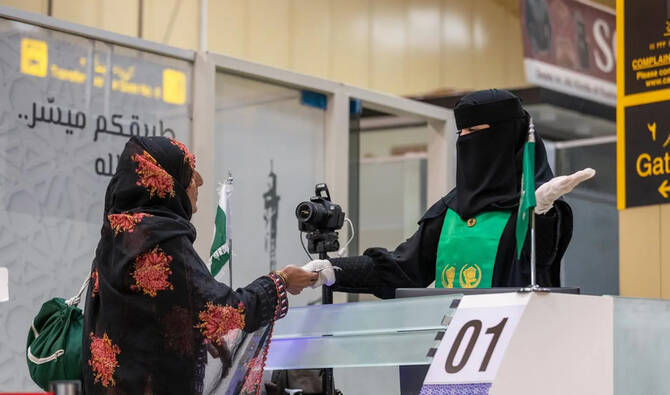
A Saudi officer hands a Pakistani pilgrim her passport at the Makkah Route immigration counter at the Jinnah International Airport in Karachi, Pakistan on May 15, 2025. (SPA)
Short Url
Updated 07 February 2026
Follow

Pakistan urges Hajj pilgrims to complete Saudi biometrics till Sunday

  • Saudi Arabia has allocated Pakistan a quota of 179,210 pilgrims for this year’s Hajj
  • Saudi biometric verification is mandatory for issuance of Hajj visas, ministry says

ISLAMABAD: The Pakistani religious affairs ministry has urged aspiring Hajj pilgrims to complete mandatory Saudi biometric verification for Hajj visas by Sunday, Pakistani state media reported, with preparations for the 2026 pilgrimage gathering pace following stricter oversight of the Hajj process.

Saudi Arabia has allocated Pakistan a quota of 179,210 pilgrims for Hajj 2026, with the majority of seats reserved under the government scheme and the remainder allocated to private tour operators.

Regulations for private Hajj operators have been tightened and their quota reduced following widespread complaints last year, when tens of thousands of pilgrims were unable to travel under the private Hajj scheme.

The Pakistani religious affairs ministry said last month that Saudi biometric verification is mandatory for the issuance of Hajj visas and pilgrims should complete it at home using the ‘Saudi Visa Bio’ app.

“Hajj visas will not be issued without biometrics, however pilgrims over 80 years of age are exempted from biometrics,” the Radio Pakistan broadcaster reported, citing the religious affairs ministry.

Pakistan has been steadily implementing digital and procedural requirements for pilgrims ahead of Hajj 2026, including mandatory training sessions, biometric checks and greater use of mobile applications, as part of efforts to reduce mismanagement.

Pilgrims who were unable to complete biometric verification through the mobile application should visit designated Saudi Tasheer centers before Feb. 8, according to the religious affairs ministry.

Details of the centers are available on Pakistan’s official Hajj mobile application. Tasheer centers will remain open from 9am to 5pm today and on Sunday to facilitate Hajj pilgrims, it added.



Pakistan capital market transitions to T+1 settlement cycle ahead of multiple advanced markets

Updated 7 sec ago
Follow

Pakistan capital market transitions to T+1 settlement cycle ahead of multiple advanced markets

  • A T+1 settlement cycle means that securities transactions are finalized and settled one business day after trade date
  • Effective from Feb. 9, all eligible trades at the PSX are now settled on a T+1 basis, replacing the previous T+2 cycle

KARACHI: Pakistan’s capital market has officially transitioned to the Trade plus one (T+1) settlement cycle, a landmark reform that strengthens efficiency, reduces risk and aligns the country with international best practices, the Pakistan Stock Exchange (PSX) said on Tuesday.

A T+1 settlement cycle means that securities transactions are finalized and settled one business day after the trade date, which reduces counterparty risk and improves capital efficiency in the exchange of funds and securities. 

Effective from Feb. 9, all eligible trades at the PSX are now settled on a T+1 basis, replacing the previous T+2 cycle. The transition was implemented under the guidance of the Securities and Exchange Commission of Pakistan (SECP) through close collaboration among all stakeholders, according to the PSX.

It aligns Pakistan’s capital market with leading markets such as the United States, Canada, Mexico, Argentina, Jamaica and China, which have already adopted shorter settlement cycles. Europe, the UK and Switzerland are set to follow by 2027. By moving early, Pakistan has demonstrated its commitment to modernization and investor protection.

“The transition to the T+1 settlement cycle brings important advantages for Pakistan’s capital market. It enables faster access to funds and securities, improving liquidity, while reducing settlement and counterparty risk through shorter exposure periods,” the PSX said.

“Quicker trade finalization enhances efficiency and the reform strengthens investor confidence, particularly among institutional and foreign investors. Together, these benefits support a stronger and more resilient market aligned with global best practices.”

Pakistan’s stock market has touched historic highs in recent months as broad institutional buying boosted investor confidence amid ongoing economic reforms under international lending programs. Pakistani state media reported in Jan. around 135,000 new investors had joined the PSX over the last 18 months.

SECP Chairman Dr. Kabir Ahmed Sidhu commended the PSX, the Central Depository Company and the National Clearing Company of Pakistan for the successful implementation of the T+1 settlement system.

“The reform brings Pakistan’s capital market at par with modern jurisdictions by accelerating trade settlement, reducing counterparty and market risks, and enhancing liquidity,” he was quoted as saying by the PSX.

“The adoption of T+1 will strengthen investor confidence and align Pakistan’s capital market with evolving international standards and global best practices.”