

Terror at Friday prayers: witnesses describe blast rocking Islamabad mosque

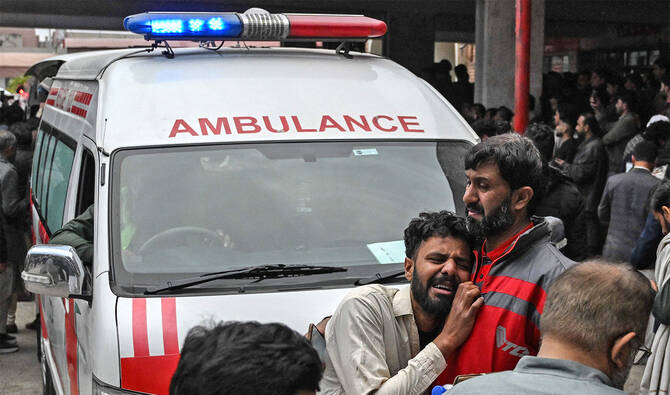
People mourn the death of their relatives following a suicide bombing at a Shiite mosque, outside a hospital in Islamabad on February 6, 2026. (AFP)
Short Url
Updated 07 February 2026
Follow

Terror at Friday prayers: witnesses describe blast rocking Islamabad mosque

  • ’Extremely powerful’ explosion ripped through Imam Bargah Qasr-e-Khadijatul Kubra just after Friday prayers started, worshipper says
  • The attack was the deadliest in the Pakistani capital since September 2008, when 60 people were killed in a suicide truck bomb blast

ISLAMABAD: A worshipper at the Shiite mosque in Islamabad where dozens of people were killed in a suicide blast on Friday described an “extremely powerful” explosion ripping through the building just after prayers started.

Muhammad Kazim, 52, told AFP he arrived at the Imam Bargah Qasr-e-Khadijatul Kubra mosque shortly after 1:00 p.m. (0800 GMT) on Friday and took up a place around seven or eight rows from the Imam.

“During the first bow of the Namaz (prayer ritual), we heard gunfire,” he told AFP outside the Pakistan Institute of Medical Sciences (PIMS) hospital, where many of the wounded were brought for treatment.

“And while we were still in the bowing position, an explosion occurred,” he said.

Kazim, who is from Gilgit-Baltistan in northern Pakistan and lives in Islamabad, escaped unharmed, but accompanied his wounded friend to the PIMS hospital for treatment.

“It was unclear whether it was a suicide bombing, but the explosion was extremely powerful and caused numerous casualties,” Kazim said.

“Debris fell from the roof, and windows were shattered,” he added. “When I got outside, many bodies were scattered... Many people lost their lives.”

The Daesh (Islamic State) group has claimed responsibility for the attack, according to the SITE Intelligence Group, which monitors such communications.

Another worshipper, Imran Mahmood, described a gunfight between the suicide bomber, a possible accomplice and volunteer security personnel at the mosque.

“The suicide attacker was trying to move forward, but one of our injured volunteers fired at him from behind, hitting him in the thigh,” Mahmood, in his fifties, told AFP.

“He fell but got up again. Another man accompanying him opened fire on our volunteers,” he said, adding the attacker “then jumped onto the gate and detonated the explosives.”

As of Saturday morning, the death toll stood at 31, with at least 169 wounded.

The attack was the deadliest in the Pakistani capital since September 2008, when 60 people were killed in a suicide truck bomb blast that destroyed part of the five-star Marriott hotel.

LAX SECURITY

Describing the aftermath of the attack, Kazim said unhurt worshippers went to the aid of those wounded.

“People tried to help on their own, carrying two or three bodies in the trunks of their vehicles, while ambulances arrived about 20 to 25 minutes later,” he told AFP.

“No one was allowed near the mosque afterwards.”

Kazim, who has performed Friday prayers at the mosque “for the past three to four weeks,” said security had been lax.

“I have never seen proper security in place,” he told AFP.

“Volunteers manage security on their own, but they lack the necessary equipment to do it effectively,” he said.

“Shiite mosques are always under threat, and the government should take this seriously and provide adequate security,” he added.

Pakistan launches $136 million Ramadan relief package for 12.1 million families

Updated 8 sec ago
Follow

Pakistan launches $136 million Ramadan relief package for 12.1 million families

  • Rs13,000 per family to be transferred via bank accounts, mobile wallets under cashless system
  • Pakistan’s national space agency says the Muslim fasting month is likely to begin from Feb. 19

ISLAMABAD: Prime Minister Shehbaz Sharif on Saturday launched a Rs38 billion ($136 million) Ramadan relief package, pledging direct digital cash transfers of Rs13,000 ($47) each to 12.1 million low-income families across Pakistan.

Pakistan’s national space agency announced a day earlier the Ramadan crescent would likely be visible on Feb. 18, with the first fast expected to fall on Feb. 19, subject to official confirmation.

The government will distribute the relief package through bank accounts and regulated mobile wallet platforms, fully replacing the previous utility store-based subsidy model with a digital payment mechanism overseen by the State Bank of Pakistan.

“This year, Rs38 billion have been allocated ... that will not only be distributed to the rightful people in all four provinces, but also to Gilgit-Baltistan and Azad Kashmir through these wallets and digital bank accounts,” the prime minister said during a ceremony in the federal capital, adding that 12.1 million families would benefit.

The allocation marks a sharp increase from last year’s Rs 20 billion ($72 million) Ramadan program, as the government expands coverage and deepens its shift toward cash-based targeted subsidies.

Officials said Rs28 billion ($101 million) has been earmarked for families not currently receiving support under any federal income assistance program, while an additional Rs10 billion ($36 million) will go to those already registered under existing social protection schemes.

Syed Imran Shah, federal minister for poverty alleviation and social security, said the digital framework would allow transfers to be made in a “safe, effective and easy way,” reducing leakages and preserving beneficiaries’ dignity by eliminating long queues and physical distribution centers.

Amir Ali Ahmed, secretary of the Benazir Income Support Program (BISP), said the 2026 rollout builds on last year’s digital transition, when around two million beneficiaries received payments electronically.

A third-party validation report issued in December 2025 confirmed the transparency and operational effectiveness of the system, he added.

The prime minister said he would personally oversee periodic reviews of the program to ensure timely disbursement.

The government had scrapped the Utility Store-based Ramadan subsidy system last year, arguing that it led to quality concerns, long queues and administrative inefficiencies.

The digital transfer model aims to move toward a targeted subsidy regime aligned with broader efforts to expand financial inclusion and reduce cash-based leakages.