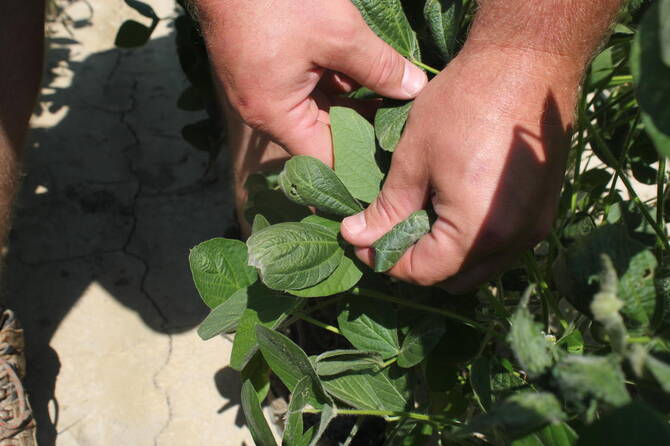
WASHINGTON: US President Donald Trump’s administration on Friday re-approved the use of pesticide dicamba for spraying on top of genetically modified cotton and soybean crops, drawing swift backlash from environmental groups and the Make America Healthy Again movement.
The move comes despite federal courts in 2020 and 2024 striking down the Environmental Protection Agency’s previous approvals of the contentious weedkiller.
“This decision responds directly to the strong advocacy of America’s cotton and soybean farmers, particularly growers across the Cotton Belt, who have been clear and consistent about the critical challenges they face without access to this tool for controlling resistant weeds in their growing crop,” the EPA said in a statement.
A persistent concern about dicamba is “drift“: when the chemical volatilizes in high heat it can spread for miles, poisoning other farms, home gardens as well as trees and plants.
The 2020 court ruling that first overturned dicamba’s approval found it caused damage across millions of acres and “has torn apart the social fabric of many farming communities.”
The EPA acknowledged this concern as real but said that by imposing certain restrictions, such as reducing the amount used and avoiding application in higher temperatures, it was safe.
Agricultural industry giant Bayer, which acquired dicamba when it bought Monsanto, welcomed the news and said the chemical would be marketed under the name “Stryax.”
“With a federal registration in hand, we’ll begin the process of seeking state approvals,” said Ty Witten, the company’s vice president of commercial stewardship, in a statement.
“In the coming weeks, we’ll launch applicator training opportunities, and stewardship education to help ensure that growers and applicators have the best experience possible with Stryax herbicide.”
Lobbyists turned regulators
Environmental advocates dismissed the safeguards as insufficient — pointing out, for example, the new approval allowed year-round use, including in the hottest summer months.
“They’re clearly looking out for the interests of polluting companies much more than the interests of the public, and this is because this office is being run by former industry lobbyists,” Nathan Donley, environmental health science director for the Center for Biological Diversity, said.
Kyle Kunkler, a former lobbyist for the American Soybean Association, is now the deputy assistant administrator for pesticides in the EPA’s Office of Chemical Safety and Pollution Prevention.
The decision also rattled MAHA activists — supporters of Health Secretary Robert F. Kennedy Jr.
Kelly Ryerson, who last year started a petition calling for EPA administrator Lee Zeldin to resign over pesticide approvals, said she was “very disappointed.”
“This is clearly the work of the chemical lobbyists who now are staffed throughout the EPA and are not aligned with the MAHA movement or with President Trump’s mandate,” she said.
Alexandra Munoz, a molecular toxicologist who works at times with the MAHA movement, also criticized the move.
“EPA’s approval for over-the-top application of dicamba will result in poisonous drift that will damage American farmland, moving us farther away from a future where regenerative agriculture can thrive.”
“This decision is not what is needed to make America healthy again,” she said.

Trump administration re-approves twice-banned pesticide
https://arab.news/8g4t4
Trump administration re-approves twice-banned pesticide
- Draws swift backlash from environmental groups and the Make America Healthy Again movement
- The move comes despite federal courts in 2020 and 2024 striking down previous approvals
France and India hail growing ties as Modi hosts Macron
- A potential multibillion dollar fighter jet deal is also on the table
- Macron said the “remarkable acceleration” of ties with India came in response to the “changing international order“
MUMBAI: France and India celebrated their ties as a force for global stability, as President Emmanuel Macron kicked off a three-day visit focused on technology and defense cooperation on Tuesday.
A potential multibillion dollar fighter jet deal is also on the table, with officials traveling with Macron expressing confidence that a contract for 114 Rafales can be finalized.
Speaking to reporters after his meeting with Macron in Mumbai, India’s Prime Minister Narendra Modi said that “in today’s turbulent world, this is a partnership for global stability.”
Macron said the “remarkable acceleration” of ties with India came in response to the “changing international order.”
Both leaders had earlier referred to each other as their “dear friend,” in posts on social media.
Macron is on his fourth visit to India since taking office in 2017, accompanied by his wife Brigitte.
He began his trip in India’s financial capital, honoring the victims of the 2008 Mumbai attacks and meeting Bollywood film stars before sitting down with Modi.
The visit follows New Delhi’s confirmation last week that it intends to place a major order for Dassault Rafale jets, as well as the signing of a landmark free trade agreement between India and the European Union in January.
Macron will travel to New Delhi for an artificial intelligence summit on Wednesday and Thursday.
- ‘Contract of the century’ -
New Delhi has sought over the past decade to reduce its dependence on Russia, its traditional main supplier of military equipment, turning to other countries while also pushing for more domestic production.
An Indian defense ministry statement last week said the proposed purchase of Rafale jets had been cleared — with “the majority” of them to be manufactured in India.
Christophe Jaffrelot, an India specialist at Sciences Po Center for International Studies in Paris, described the potential 30-billion-euro ($35-billion) deal for 114 Rafales as the “contract of the century.”
If finalized, the jets would add to the 62 Rafales that India has already purchased.
The French presidency has voiced optimism that what it calls a “historic” agreement could be reached.
Modi and Macron also inaugurated via videoconference India’s first helicopter final assembly line, a joint venture between India’s Tata Group and Airbus.
The facility in Vemagal, in the southern state of Karnataka near the tech hub of Bengaluru, will manufacture the Airbus H125, the company’s best-selling single-engine helicopter.
- ‘Good chemistry’ -
France has emerged as one of India’s most important defense and economic partners in the last decade.
“Through this visit, we seek to further strengthen cooperation” with India, and to “diversify” France’s economic and trade partnerships, Macron’s office said.
India, the world’s most populous country with 1.4 billion people, is on track to become the fourth-largest economy globally.
This week’s talks are also expected to address global economic uncertainty triggered by tariff policies under US President Donald Trump, as well as China’s influence in the region.
Bilateral trade between France and India, driven largely by defense and aerospace — India’s commercial fleet includes a substantial number of Airbus aircraft — stands at around $18 billion annually.
French foreign direct investment in India totals nearly $15 billion.
The two leaders will also be keen to nurture close personal ties.
“There is apparently a good chemistry, a good personal rapport,” Jaffrelot said.
One sensitive issue remains Ukraine: India has not condemned Russia’s 2022 invasion and has continued buying oil from Moscow.
US President Donald Trump has said India had committed to halting the purchases, though that has not been formally confirmed by New Delhi.
Macron, speaking alongside Modi in Mumbai, urged him to “support the establishment of an immediate and lasting moratorium on attacks against civilians and civilian infrastructure” in Ukraine.


