

Daesh claims suicide blast at Islamabad mosque that killed at least 31

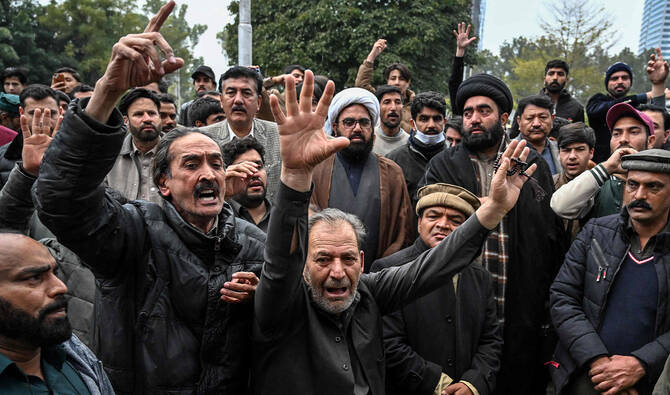
Shiite Muslims shout anti-government slogans outside a hospital following a suicide bombing at a Shiite mosque in Islamabad on February 6, 2026. (AFP)
Short Url
Updated 07 February 2026
Follow

Daesh claims suicide blast at Islamabad mosque that killed at least 31

  • Authorities said 169 others were injured, several of them critically, in the incident in Islamabad’s Tarlai Kallan area
  • Friday’s attack followed a suicide bombing outside a district court complex in Islamabad in Nov, amid a surge in militancy

ISLAMABAD: The Daesh (Islamic State) group has claimed responsibility for a suicide blast at a Shiite mosque in the Pakistani capital of Islamabad that killed 31 people on Friday, according to the SITE Intelligence Group, which monitors such communications.

The suicide blast targeted Imam Bargah Qasr-e-Khadijatul Kubra mosque in the Tarlai Kallan area at the time of Friday prayers, when mosques are packed with worshippers.

Islamabad’s district administration said 169 others were injured, several of them critically, in the incident and were being treated at different hospitals in the city.

Daesh said one of its militants had targeted the congregation, detonating an explosive vest and “inflicting a large number of deaths and injuries,” according to the SITE Intelligence Group.

“We have now received information about the terrorist who carried out the suicide bombing here,” Tallal Chaudhry, Pakistan’s minister of state for interior, told reporters in Islamabad, adding the attack was carried out by militants sponsored by India and supported by Afghanistan.

“He is not an Afghan national, but details of how many times he traveled to Afghanistan have been obtained.”

Islamabad has long accused Kabul of allowing its soil to be used by militant groups and New Delhi of backing their cross-border attacks against Pakistani civilians and security forces. The Afghan and Indian governments have consistently denied the allegations.

India also issued a statement during the day, condemning the attack and condoling the loss of life while calling Islamabad’s accusation against it “as baseless as it is pointless.”

Friday’s attack came amid a renewed surge in militant violence in Pakistan and followed a suicide bombing outside a district court complex in Islamabad in November last year that killed at least 12 people and wounded dozens, underscoring growing security concerns even in heavily guarded urban centers.

“Be assured that the previous terrorists and their handlers involved in Islamabad attacks were arrested and are being dealt with according to the law,” Chaudhry told reporters, reassuring that those responsible for the mosque blast would also be arrested.


In Karachi, a café where Ramadan means feeding anyone who arrives hungry

Updated 10 sec ago
Follow

In Karachi, a café where Ramadan means feeding anyone who arrives hungry

  • Karachi’s Cafe Mehmood has offered free meals to the needy for nearly four decades
  • Restaurant owners say paying customers and charity diners receive the same quality food

KARACHI: As the call to Maghrib prayer echoes through Karachi’s Sindhi Muslim Housing Society, long rows of people seated along a busy roadside begin to break their fast. Plates of fruit, samosas and glasses of the rose-flavored drink Rooh Afza move down the line as men, women and children share the evening meal after a long day of fasting in the city’s humid heat.

The gathering is a familiar Ramadan scene outside Cafe Mehmood, a modest restaurant in Pakistan’s largest city that has quietly sustained one of Karachi’s longest-running traditions of feeding the hungry.

Operating since the 1980s, the eatery is well known not only for its food but for a daily dastarkhwan, a communal meal spread laid out for anyone who arrives hungry. Donations collected from visitors and well-wishers help fund the initiative, allowing the restaurant to provide meals throughout the year to people who cannot afford to pay.

The tradition reflects a wider culture of charitable food distribution in Pakistan, particularly during Ramadan, when mosques, community groups and businesses organize iftar meals for fasting Muslims. In Karachi, a sprawling city of more than 20 million people, such initiatives often fill gaps in a fragile social safety net.

“Around 12,000 people come to this dastarkhwan daily and derive benefit from it,” said Imran Khan, the eldest son of one of the restaurant’s founders.

Pakistan, a country of more than 240 million people, has struggled with rising living costs in recent years following economic turmoil marked by inflation, currency depreciation and higher energy prices. For many families dependent on daily wages or informal employment, free community meals can provide an essential lifeline.

Cafe Mehmood’s story began in 1985, when three brothers opened the restaurant and named it after one of them, Mehmood. The charitable meals started modestly when the founders began serving food to a handful of people sitting on the footpath outside the restaurant.

Over time, word spread and more people began arriving. Donations from visitors and well-wishers helped expand the effort into a large-scale operation feeding thousands each day.

Communal meal spreads are common across Karachi, particularly during Ramadan, but the scale and schedule of the dastarkhwan outside Cafe Mehmood sets it apart.

“There are no specific [meal] timings,” Khan said. “It starts at seven in the morning and runs until 12 at midnight. During that period if anyone comes empty stomach, they are fed well.”

During Ramadan, however, the restaurant focuses its efforts on iftar and the meals that continue until the pre-dawn suhoor.

The service runs throughout the year, pausing only on three days annually: Eid Al-Fitr and the first two days of Eid Al-Adha. 

According to Khan, the restaurant prepares iftar for around 2,000 to 2,500 people each day, followed by dinner for roughly the same number.

To manage the demand, Cafe Mehmood operates a separate kitchen dedicated to preparing food for the charity meals. Inside the restaurant, customers who pay for their meals sit at tables, while outside, those who cannot afford to pay are served at long communal spreads laid out on the street.

Yet the owners say the difference is only in where the food is served, not in its quality.

“We make sure there is no compromise on quality while the taste, hygiene and service is similar to what we offer to our customers,” said Ismail Saeed, one of the founders’ grandsons who joined the family business five years ago.

Today, the restaurant and its charitable kitchen are run by the next generation: six members of the founding families and their nine sons.

Saeed said he had long wanted to take part in continuing the tradition.

“It has been a part of our genes since the beginning to help the needy, not just in terms of food but otherwise as well,” he said.

“We were provided with a platform through which we could do it, so I was always very keen about it.”

The charity meals are sustained through a combination of restaurant contributions and public donations. Visitors frequently stop by to give cash, while others transfer money online after learning about the initiative.

For those who cannot attend the communal meal spreads in person, the restaurant also distributes food parcels, particularly to women and people registered as deserving beneficiaries.

A typical meal served through the charity program includes chicken or beef gravy with two flatbreads, costing around Rs110 (about $0.39) per serving.

Despite its popularity, Cafe Mehmood historically avoided promoting its charitable work. For the family that runs the joint, the goal has remained simple: that no one who comes to their door leaves hungry.

“It was also the need of the hour,” Saeed said.