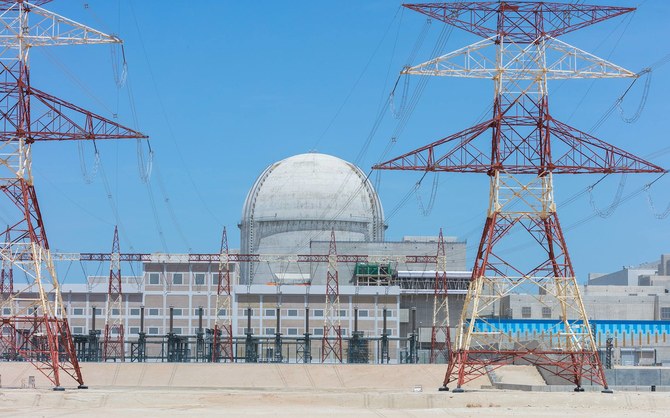
UAE issues reactor license for first Arab nuclear power plant

The UAE nuclear regulator ‘has approved the issuance’ of the operating license for the first of four reactors at the plant. (Emirates Nuclear Energy Corporation)
Short Url
Updated 17 February 2020
Follow

UAE issues reactor license for first Arab nuclear power plant

ABU DHABI: The United Arab Emirates has issued an operating license for the first reactor at the Arab world’s first nuclear power plant, a senior official at the nuclear regulator said on Monday, paving the way for it to start production later this year.

The Barakah nuclear power plant in Abu Dhabi, which is being built by Korea Electric Power Corporation (KEPCO), was originally due to open in 2017, but the start-up of its first reactor has been delayed several times.

The license granted to the plant’s operator Nawah Energy Company will be for 60 years, Hamad Al-Kaabi, deputy chairman of Federal Authority for Nuclear Regulation (FANR) told a news conference.

Nawah can now start preparing for commercial operations as trials will last for a few months, Kaabi said.

When completed Barakah will have four reactors with a total capacity of 5,600 megawatts (MW).

“Today marks a new chapter in our journey for the development of peaceful nuclear energy with the issuing of the operating license for the first (unit of) Barakah plant,” Abu Dhabi Crown Prince Sheikh Mohammed bin Zayed wrote on his official twitter account.

Kaabi said that construction of the second reactor was “95% finished” and that FANR has started looking into an operating license for it.

Last month, state news agency WAM reported that an operational readiness assessment performed by the Atlanta Center of the World Association of Nuclear Operators concluded that the first of the four planned reactors was fit for its start-up phase.


Syrian leader to meet Putin, Russia seeks deal on military bases

Updated 44 min 57 sec ago
Follow

Syrian leader to meet Putin, Russia seeks deal on military bases

  • Russia’s continued sheltering of Assad and his wife since their ouster remains a thorny issue

MOSCOW: Syrian President Ahmed Al-Sharaa will meet Russian counterpart Vladimir Putin in Moscow on Wednesday, as the Kremlin seeks to secure the future of its military bases in the country.
Putin and Sharaa struck a conciliatory tone at their previous meeting in October, their first since Sharaa’s rebel forces toppled Moscow-ally Bashar Assad in 2024.
But Russia’s continued sheltering of Assad and his wife since their ouster remains a thorny issue. Sharaa has repeatedly pushed Russia for their extradition.
Sharaa, meanwhile, has embraced US President Donald Trump, who on Tuesday praised the Syrian leader as “highly respected” and said things were “working out very well.”
Putin, whose influence in the Middle East has waned since Assad’s ouster, is seeking to maintain Russia’s military footprint in the region.
Russia withdrew its forces from the Qamishli airport in Kurdish-held northeast Syria earlier this week, leaving it with only the Hmeimim air base and Tartus naval base on Syria’s Mediterranean coast — its only military outposts outside the former Soviet Union.
“A discussion is planned on the status of bilateral relations and prospects for developing them in various fields, as well as the current situation in the Middle East,” the Kremlin said of the upcoming meeting in a statement on Tuesday.
Russia was a key ally of Assad during the bloody 14-year Syrian civil war, launching air strikes on rebel-held areas of Syria controlled by Sharaa’s Islamist forces.
The toppling of Assad dealt a major blow to Russia’s influence in the region and laid bare the limits of Moscow’s military reach amid the Ukraine war.
The United States, which cheered Assad’s demise, has fostered ever-warmer ties with Sharaa — even as Damascus launched a recent offensive against Kurdish forces long backed by the West.
Despite Trump’s public praise, both the United States and Europe have expressed concern that the offensive in Syria’s northeast could precipitate the return of Islamic State forces held in Kurdish-held jails.