ISMAILIA, Egypt: One hundred and fifty years after the Suez Canal opened, the international waterway is hugely significant to the economy of modern-day Egypt, which nationalized it in 1956.
The canal, which links the Mediterranean to the Red Sea, was opened to navigation in 1869 and was expanded in 2015 to accommodate larger ships.
Dug in the 19th century using “rudimentary tools,” the canal has today become “a lifeline for Egypt and countries around the world,” Admiral Osama Rabie, head of the Suez Canal Authority, said in a rare interview.
“We give credit to Ferdinand de Lesseps for putting forward the idea,” he said, referring to the French diplomat who masterminded the waterway dug over a decade between 1859 to 1869.
But he insisted it was thanks to the “genius” of the Egyptian people that the project really came to life.
“It was a miracle by all accounts to excavate a 164-kilometer-long canal in 10 years with rudimentary tools,” he said.
“A quarter of Egyptians took part in the excavations, that was about a million citizens out of the population of 4.5 million people at that time.”
“Between 100,000 to 120,000 died,” Rabie added, highlighting that many succumbed to disease. Experts however dispute those figures saying the fatalities were poorly documented.
In 2015, Egyptians threw their support behind President Abdel Fattah El-Sisi’s project to expand the canal, “purchasing 64 billion Egyptian pounds ($3.8 million) of investment certificates within eight days.”
Thanks to that project, transit time has now been cut from 22 to 11 hours, and the number of vessels crossing daily has increased from an average of 40-45 to 60-65 giant tankers, he said.
Nowadays, container ships account for more than half of the canal’s total traffic, with some of them being among the largest in the world reaching a capacity of up to 23,000 TEU (twenty-foot equivalent unit).
Giant oil tankers carrying more than 200,000 tons can now transit through the canal as well.
Authorities have also sought to develop the Sinai Peninsula, which lies on the eastern edge of the canal.
“We have also dug six tunnels under the Suez Canal to facilitate movement crossing to and from the Sinai,” Rabie said.
“Before we used to talk about developing the Sinai Peninsula without any serious decisions having been taken. Now access is easy for people and investors.”
Egypt is also developing a free-zone trade hub spanning 461 square kilometers (178 square miles) known as “the Suez Canal Economic Zone.”
“Many projects exist along the banks,” said Rabie, citing ship supply zones, pharmaceutical factories and car assembly plants.
He maintained also that the canal “is perfectly secured” under the command of the Egyptian armed forces.
Ongoing fighting between the Egyptian army against the Islamist insurgents in North Sinai “has not affected” the canal or trade, he stressed.


Suez Canal is ‘lifeline’ for Egypt a century and half on

Suez Canal is ‘lifeline’ for Egypt a century and half on

- The canal, which links the Mediterranean to the Red Sea, was opened to navigation in 1869 and was expanded in 2015 to accommodate larger ships
- Giant oil tankers carrying more than 200,000 tons can now transit through the canal as well

Syrian leader to meet Putin, Russia seeks deal on military bases
- Russia’s continued sheltering of Assad and his wife since their ouster remains a thorny issue
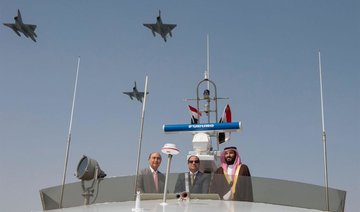
MOSCOW: Syrian President Ahmed Al-Sharaa will meet Russian counterpart Vladimir Putin in Moscow on Wednesday, as the Kremlin seeks to secure the future of its military bases in the country.
Putin and Sharaa struck a conciliatory tone at their previous meeting in October, their first since Sharaa’s rebel forces toppled Moscow-ally Bashar Assad in 2024.
But Russia’s continued sheltering of Assad and his wife since their ouster remains a thorny issue. Sharaa has repeatedly pushed Russia for their extradition.
Sharaa, meanwhile, has embraced US President Donald Trump, who on Tuesday praised the Syrian leader as “highly respected” and said things were “working out very well.”
Putin, whose influence in the Middle East has waned since Assad’s ouster, is seeking to maintain Russia’s military footprint in the region.
Russia withdrew its forces from the Qamishli airport in Kurdish-held northeast Syria earlier this week, leaving it with only the Hmeimim air base and Tartus naval base on Syria’s Mediterranean coast — its only military outposts outside the former Soviet Union.
“A discussion is planned on the status of bilateral relations and prospects for developing them in various fields, as well as the current situation in the Middle East,” the Kremlin said of the upcoming meeting in a statement on Tuesday.
Russia was a key ally of Assad during the bloody 14-year Syrian civil war, launching air strikes on rebel-held areas of Syria controlled by Sharaa’s Islamist forces.
The toppling of Assad dealt a major blow to Russia’s influence in the region and laid bare the limits of Moscow’s military reach amid the Ukraine war.
The United States, which cheered Assad’s demise, has fostered ever-warmer ties with Sharaa — even as Damascus launched a recent offensive against Kurdish forces long backed by the West.
Despite Trump’s public praise, both the United States and Europe have expressed concern that the offensive in Syria’s northeast could precipitate the return of Islamic State forces held in Kurdish-held jails.


