Escape tunnel underneath Berlin Wall opens to public

1 / 2
People line up to see an escape tunnel, underneath the Berlin Wall, and was make visible for public for the first time, in Berlin, Germany on Thursday. (AP)
2 / 2
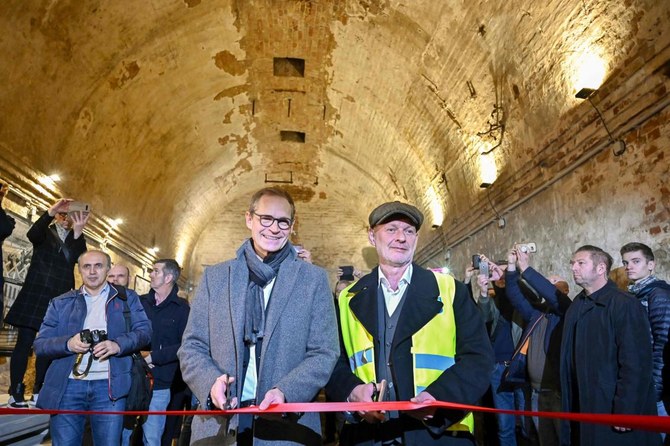
Berlin's mayor Michael Mueller and Axel Klausmeier, historian and director of the Berlin Wall Foundation, cut the ribbon of the escape tunnel underneath Berlin Wall on Thursday. ( AFP)
Updated 07 November 2019
Follow

Escape tunnel underneath Berlin Wall opens to public

  • The newly opened tunnel at Bernauer Strasse can be reached through an access tunnel built by the Underworlds Association
  • Through two windows visitors can peek into the dimly lit 1970 tunnel but not get inside

BERLIN: An escape tunnel underneath the Berlin Wall opened to the public on Thursday for the first time amid celebrations of the 30-year anniversary of the opening of communist East Germany’s border.
The tunnel at Bernauer Strasse, near the city’s main Wall memorial, was opened by Mayor Michael Mueller. He thanked those who started digging the 100-meter (yard) tunnel in late 1970, nine years after East Germany sealed its border.
“It’s great to see that the battle for freedom was also taken underground,” Mueller said before he took a tour of the new exhibit.
“One can authentically experience ... the courage of the women and men who tried to take people to freedom and resisted the East German regime,” he added.
The tunnel was built by a group of people who had escaped earlier to West Berlin. They wanted to help friends and family to flee to the West but, days before it was finished, somebody informed East German officials about it.
East German authorities then found the tunnel by using ultrasound tracking and partially destroyed it.
Built in 1961, the Wall stood at the front line of the Cold War. It cut off East Germans from the supposed ideological contamination of the West and stemmed the tide of people fleeing the country.
In the 28 years that the Wall divided the city , more than 70 tunnels were built underneath the 156.4-kilometer (97.2-mile) barrier and around 300 people managed to escape through them, according to the Berlin Underworlds Association, which conducts tours of the city’s historic bunkers and tunnels.
Most tunnels were dug from the West to the East. Bernauer Strasse in the city’s Mitte neighborhood was one of the most popular spots for tunnel diggers because of the high amount of clay in the soil — seven tunnels were built underneath the wall on a 350-meter (yard) stretch here.
Not all tunnel projects were successful. Some collapsed before they could be used, while others were discovered by East Germany’s secret police, the Stasi.
The newly opened tunnel at Bernauer Strasse can be reached through an access tunnel built by the Underworlds Association.
Through two windows, 7.5 meters (24.6 feet) under the ground, visitors can peek into the dimly lit 1970 tunnel but not get inside.
The original tunnel is so narrow that the men who built it could only crawl through it. It led from the basement of a corner building on the western side of the Wall to another building on the eastern side.
Ulrich Pfeifer, a civil engineer and one of the builders of the tunnel, made calculations and created maps for the project.
Pfeifer fled to West Berlin through the sewerage system just a few weeks after the Wall was erected in August 1961.
“As a Berliner this wall was inconceivable,” the 84-year-old said. “It was tearing apart families, it was separating all of us.”
He said his motivation to dig escape tunnels was “the conviction of my girlfriend, who got seven years in prison.”
“She was 22 years old and was sentenced for nothing other than an escape attempt,” he said, still angry with the East German regime 30 years after its collapse.
Trying to flee East Germany was dangerous. Researchers estimate that 140 people died trying to cross the Wall by flying over it, escaping through the sewerage system or jumping from buildings adjacent to the border.
It is not clear how many people died trying to escape specifically through the tunnels.


Anger as branch of ICE to help with security at Winter Olympics

Updated 52 min 21 sec ago
Follow

Anger as branch of ICE to help with security at Winter Olympics

ROME: A branch of the US Immigration and Customs Enforcement (ICE) will help with security for the Winter Olympics in Italy, it confirmed Tuesday, sparking anger and warnings they were not welcome.
Reports had been circulating for days that the agency embroiled in an often brutal immigration crackdown in the United States could be involved in US security measures for the February 6-22 Games in northern Italy.
In a statement overnight to AFP, ICE said: “At the Olympics, ICE’s Homeland Security Investigations (HSI) is supporting the US Department of State’s Diplomatic Security Service and host nation to vet and mitigate risks from transnational criminal organizations.
“All security operations remain under Italian authority.”
It’s not known whether the HSI has in the past been involved in the Olympics, or whether this is a first.
According to the ICE website, the HSI investigates global threats, investigating the illegal movement of people, goods, money, contraband, weapons and sensitive technology into, out of, and through the United States.
ICE made clear its operations in Italy were separate from the immigration crackdown, which is being carried out by the Enforcement and Removal Operations (ERO) department.
“Obviously, ICE does not conduct immigration enforcement operations in foreign countries,” it said.
The protection of US citizens during Olympic Games overseas is led by the State Department’s Diplomatic Security Service (DSS).
Yet the outrage over ICE immigration operations in the United States is shared among many in Italy, following the deaths of two civilians during an immigration crackdown in Minneapolis.
The leftist mayor of Milan, which is hosting several Olympic events, said ICE was “not welcome.”
“This is a militia that kills... It’s clear that they are not welcome in Milan, there’s no doubt about it, Giuseppe Sala told RTL 102.5 radio.
“Can’t we just say no to (US President Donald) Trump for once?“
Alessandro Zan, a member of the European Parliament for the center-left Democratic Party, condemned it as “unacceptable.”
“In Italy, we don’t want those who trample on human rights and act outside of any democratic control,” he wrote on X.

Monitoring Vance 

Italian authorities initially denied the presence of ICE and then sought to downplay any role, suggesting they would help only in security for the US delegation.
US Vice President JD Vance and Secretary of State Marco Rubio are attending the opening ceremony in Milan on February 6.
On Monday, the president of the northern Lombardy region, said their involvement would be limited to monitoring Vance and Rubio.
“It will be only in a defensive role, but I am convinced that nothing will happen,” Attilio Fontana told reporters.
However, his office then issued a statement saying he did not have any specific information on their presence, but was responding to a hypothetical question.
Interior Minister Matteo Piantedosi was quoted as saying late Monday that “ICE, as such, will never operate in Italy.”
The International Olympic Committee when contacted by AFP about the matter replied: “We kindly refer you to the USOPC (the United States Olympic and Paralympic Committee).”
Thousands of ICE agents have been deployed by President Donald Trump in various US cities to carry out a crackdown on illegal immigration.
Their actions have prompted widespread protests, and the recent killings of US citizens Renee Good and Alex Pretti, both 37, on the streets of Minneapolis sparked outrage.