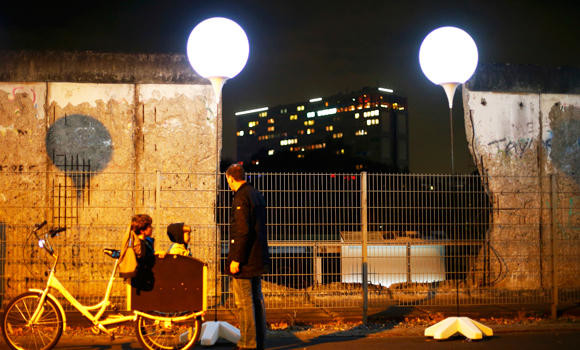
BERLIN: From Seoul to the Vatican, the archipelago of Tonga to Los Angeles, remnants of the Berlin Wall have been installed around the world as paradoxical symbols of freedom 25 years after its fall.
As late as January 1989, communist East Germany’s leader Erich Honecker confidently declared the Wall, officially built as an “Anti-Fascist Protection Rampart” 28 years earlier, would still be standing in 50 or even 100 years’ time. Ten months later, it would be gone, figuratively at least, and people armed with chisels would gleefully set to work literally chipping away at the graffiti-covered concrete slabs that had cruelly divided Berliners.
“Aspirations of freedom, of democracy and of unity were so strong, it was necessary to make the traces of the thing recalling this terrible history disappear,” said Anna Kaminsky, who compiled the photographic book, “Die Berliner Mauer In Der Welt” (The Berlin Wall in the World).
But after the turn of the millennium Berlin city officials became mindful that what still remained of the Cold War symbol should be preserved as a historical monument.
The so-called East Side Gallery, which artists covered with murals in early 1990 including the famous “Fraternal Kiss” depicting Soviet leader Leonid Brezhnev and Honecker, is the longest remaining stretch of Wall, at 1.3 km (nearly one mile).
The threatened removal of a segment of that stretch as part of development plans nearby last year sparked a major opposition campaign. Hundreds of often brightly-colored and weighty segments of the Wall are now scattered around the world, recalling “victory over the division of the world and the fight for liberty and democracy,” Kaminsky said.
There has also been a movement to reclaim and preserve slabs of the Wall that were knocked down after 1989.
French painter Thierry Noir, known for brightly-colored, big-lipped figures, is credited with being the first artist to have painted the Wall as early as 1984.
Noir is part of a project based on the banks of Berlin’s Spree river which offers people the chance to decorate and own an original 3.6-meter (12-foot) high panel of the Wall by first reserving it online, daubing it in paint and finally buying it or selling it on.
“You’re totally free to paint what you want, everyone has their personal history with the Wall,” the head of the project, Elmer Prost, said.
The organization behind the scheme receives a third of the sale price, set at a minimum of 1,500 euros ($1,860).
“Before, one was painting it to make it fall. Now one paints the Wall to preserve it like a tribute to Europe’s re-found freedom,” Noir said.


![]()
Berlin Wall becomes global symbol of liberty
Berlin Wall becomes global symbol of liberty
Latest updates


Recommended


© 2026 SAUDI RESEARCH & PUBLISHING COMPANY, All Rights Reserved And subject to Terms of Use Agreement.