SEOUL: Japanese retail giant Uniqlo has pulled a commercial featuring a 98-year-old US fashion figure from South Korean screens, it said Monday after it was accused of whitewashing colonial history.
South Korea and Japan are both US allies, democracies and market economies faced with an overbearing China and nuclear-armed North Korea, but their relationship is deeply strained by the legacy of Tokyo’s 20th-century expansionism.
The latest example is an advert for Uniqlo fleeces showing elderly fashion celebrity Iris Apfel chatting with designer Kheris Rogers, 85 years her junior.
The last line has the white-haired Apfel, asked how she used to dress as a teenager, innocuously responding: “Oh my God. I can’t remember that far back.”
But Uniqlo’s Korean arm subtitled its version of the ad slightly differently, reading: “I can’t remember things that happened more than 80 years ago.”
That would put the moment as 1939, toward the end of Japan’s brutal colonial rule over the Korean peninsula, where the period is still bitterly resented, and some South Koreans reacted furiously.
“A nation that forgets history has no future. We can’t forget what happened 80 years ago that Uniqlo made fun of,” commented one Internet user on Naver, the country’s largest portal.
The phrase “Uniqlo, comfort women,” in reference to women forced to become sex slaves to Japanese troops during the Second World War, was among the most searched terms on Naver at the weekend, and demonstrators protested outside Uniqlo shops on Monday.
Seoul and Tokyo are currently locked in a bitter trade and diplomatic row stemming from historical disputes, and South Korean consumers have mounted boycotts of Japanese products.
Uniqlo — which has 186 stores in South Korea — has itself been one of the highest-profile targets, while Japanese carmakers’ sales dropped nearly 60 percent year-on-year in September.
The company denied the allegations in a statement, saying the text was altered to highlight the age gap between the individuals and show that its fleeces were for people “across generations.”
“The ad had no intention whatsoever to imply anything” about colonial rule, a Uniqlo representative said on Monday, adding the firm had withdrawn the ad in an effort at damage control.
Analysts said the controversy demonstrated the politicization of the neighbors’ complex history.
The reaction was excessive, said Kim Sung-han, a former foreign affairs vice minister who teaches at Korea University, involving a “jump in logic” that “assumes everything Uniqlo does is political as a Japanese company.”
“I don’t see how her remark could be linked to the comfort women issue,” he added. “This is overly sensitive.”


Japan’s Uniqlo pulls ad after South Korean fury
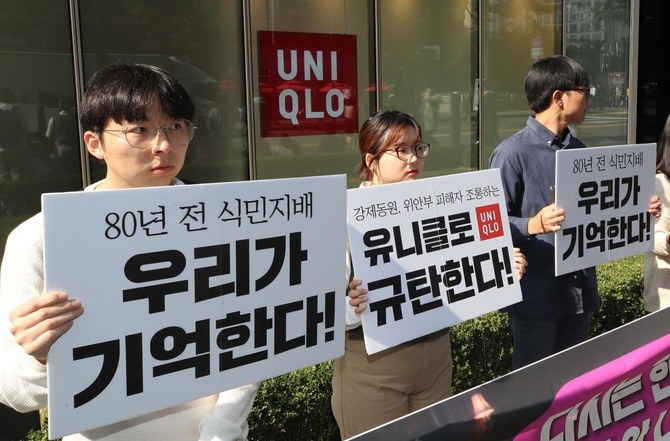
Japan’s Uniqlo pulls ad after South Korean fury

- South Korean and Japanese relationship is deeply strained by the legacy of Tokyo’s 20th-century expansionism
- Seoul and Tokyo are currently locked in a bitter trade and diplomatic row stemming from historical disputes

World must prioritize resilience over disruption, economic experts warn
- Al-Jadaan said that much of the anxiety dominating markets reflected a world that had already been shifting for years
- Pointing to Asia and the Gulf, Al-Jadaan said that some countries had already built models based on diversification and resilience
DAVOS: Saudi Arabia’s Finance Minister Mohammed Al-Jadaan urged policymakers and investors to “mute the noise” and focus on resilience, as global leaders gathered in Davos on Friday against a backdrop of trade tensions, geopolitical uncertainty and rapid technological change.
Speaking on the final day of the World Economic Forum in Davos, Al-Jadaan said that much of the anxiety dominating markets reflected a world that had already been shifting for years.
“We need to define who ‘we’ are in this so-called new world order,” he said, arguing that many emerging economies had been adapting to a more fragmented global system for decades.
Pointing to Asia and the Gulf, Al-Jadaan said that some countries had already built models based on diversification and resilience. In energy markets, he pointed out that the focus should remain on balancing supply and demand in a way that incentivized investment without harming the global economy.
“Our role in OPEC is to stabilize the market,” he said.
His remarks were echoed by Saudi Arabia’s Minister of Economy and Planning Faisal Alibrahim, who said that uncertainty had weighed heavily on growth, investment and geopolitical risk, but that reality had proven more resilient.
“The economy has adjusted and continues to move forward,” Alibrahim said.
Alibrahim warned that pragmatism had become scarce, trust increasingly transactional, and collaboration more fragile. “Stability cannot be quickly built or bought,” he said.
Alibrahim called for a shift away from preserving the status quo towards the practical ingredients that made cooperation work, stressing discipline and long-term thinking even when views diverged.
Quoting Saudi Arabia’s founding King Abdulaziz Al-Saud, he added: “Facing challenges requires strength and confidence, there is no virtue in weakness. We cannot sit idle.”
President of the European Central Bank Christine Lagarde stressed the importance of distinguishing meaningful data from headline noise, saying: “Our duty as central bankers is to separate the signal from the noise. The real numbers are growth numbers not nominal ones.”
Managing Director of the IMF Kristalina Georgieva echoed Lagarde’s sentiments, saying that the world had entered a more “shock prone” environment shaped by technology and geopolitics.
Director General of the World Trade Organization Ngozi Okonjo-Iweala said that the global trade systems currently in place were remarkably resilient, pointing out that 72 percent of global trade continued despite disruptions.
She urged governments and businesses, however, to avoid overreacting.
Okonjo Iweala said that a return to the old order was unlikely, but trade would remain essential. Georgieva agreed, saying global trade would continue, albeit in a different form.
Georgieva warned that AI would accelerate economic transformation at an unprecedented speed. The IMF expects 60 percent of jobs to be affected by AI, either enhanced or displaced, with entry-level roles and middle-class workers facing the greatest pressure.
Lagarde warned that without cooperation, capital and data flows would suffer, undermining productivity and growth.
Al-Jadaan said that power dynamics had always shaped global relations, but dialogue remained essential. “The fact that thousands of leaders came here says something,” he said. “Some things cannot be done alone.”
In another session titled Geopolitical Risks Outlook for 2026, former US Democratic representative Jane Harman said that because of AI, the world was safer in some ways but worse off in others.
“I think AI can make the world riskier if it gets in the wrong hands and is used without guardrails to kill all of us. But AI also has enormous promise. AI may be a development tool that moves the third world ahead faster than our world, which has pretty messy politics,” she said.
American economist Eswar Prasad said that currently the world was in a “doom loop.”
Prasad said that the global economy was stuck in a negative-feedback loop and economics, domestic politics and geopolitics were only bringing out the worst in each other.
“Technology could lead to shared prosperity but what we are seeing is much more concentration of economic and financial power within and between countries, potentially making it a destabilizing force,” he said.
Prasad predicted that AI and tech development would impact growing economies the most. But he said that there was uncertainty about whether these developments would create job opportunities and growth in developing countries.
Professor of international political economy at the University of New South Wales in Australia, Elizabeth Thurbon, said that China was driving a Green Energy transition in a way that should be modeled by the rest of the world.
“The Chinese government is using the Green Energy Transition to boost energy security and is manufacturing its own energy to reduce reliance on fossil fuel imports,” she explained.
Thurbon said that China was using this transition to boost economic security, social security and geostrategic security. She viewed this as a huge security-enhancing opportunity and every country had the ability to use the energy transition as a national security multiplier.
“We are seeing an enormous dynamism across emerging market economies driven by China. This boom loop is being driven by enormous investments in green energy. Two-thirds of global investment flowing into renewable energy is driven largely by China,” she said.
Thurbon said that China was taking an interesting approach to building relationships with countries by putting economic engagement on the forefront of what they had to offer.
“China is doing all it can to ensure economic partnership with emerging economies are productive. It’s important to approach alliances as not just political alliances but investment in economy, future and the flourishment of a state,” she said.
The panel criticized global economic treaties and laws, and expressed the need for immediate reforms in economic governing bodies.
“If you are a developing economy, the rules of the WTO, for example, are not helpful for you to develop. A lot of the rules make it difficult to pursue an economic development agenda. These regulations are not allowing the economies to grow,” Thurbon said.
“Serious reform must be made in international trade agreements, economic bodies and rules and guidelines,” she added.
Prasad echoed this sentiment and said there was a need for national and international reform in global economic institutions.
“These institutions are not working very well so we can reconfigure them or rebuild them from scratch. But unfortunately the task of rebuilding falls into the hands of those who are shredding them,” he said.
WEF attendees were invited to join the Global Collaboration and Growth meeting to be held in Saudi Arabia in April 2026 to continue addressing the complex global challenges and engage in dialogue.


